Trombone History: 17th Century
A history of the trombone in timeline form. For sources see Trombone History Bibliography.
A five-part pavan by Landgrave Moritz of Hesse-Kassel specifies four parts: Fiffaro, Cornetto, Trombone, and dolzano. Landgrave Moritz, incidentally, is the same man credited with the discovery and sponsorship of the young Heinrich Schütz (Boydell, Crumhorn 402).
Early 1600s—Schloss Würting, Austria
A ceiling painting in the Würting castle in Upper Austria depicts Apollo and the muses, with one of the muses playing trombone (see detail and full image below; public domain) (Feuchtmüller pl. 190).

Early 1600s—Rozmberk, Ceske Budcjovice district, Czech Republic
In Allegory of Music, an anonymous wall painting in the music alcove of the Knights’ Hall in the Lower Castle at Rozmberk, a female trombonist is depicted among several other female musicians (see below image; public domain) (Volek pl. 107).

A painting in the Oratorio dei Battuti of Santa Maria della Vita features a number of angel musicians, including what appears to be a partially-obscured trombone player (see below image; public domain). Special thanks to Bruce Dickey.
Early 1600s—Villefranche-de-Conflent, France
An altarpiece in the Church of Saint-Jacques attributed to Bortolomé González y Serrano or his circle features several angel musicians, including an angel trombonist (see close detail and wider detail below; public domain). Special thanks to Andrea Angeloni.

A painting in the Oratorio dei Battuti of Santa Maria della Vita features an angel playing what appears to be a trombone. One possibility is that part of the original bell of the instrument may have been turned into an extra bow of tubing by a restorer (see below image; public domain). Special thanks to Bruce Dickey.
Early 1600s—Fiegni, Fiastra, Italy
Incoronazione della Vergine, a fresco in the apse of the Sanctuary of the Blessed Ugolino, or Beato Ugolino sanctuary church, includes an angel playing trombone (see detail and full image below; public domain).

School of Prague, Apollo and the Muses on Mount Parnassus. See detail and full image below; public domain.


Painting from panel door of an upright harpsichord (Metropolital Museum of Art, Crosby Brown Collection of Musical Instruments, Object Number: 89.4.1224a-b). The painting bears a strong resemblance to an engraving by Kilian (see 1612). See detail and full image below; public domain.

Instruments used at La Plata Cathedral during most of the 17th century are cornett, 2 or 3 shawms, trombone, and 1 or 2 curtals (Bermúdez).
An anonymous 17th century drawing portrays five angel-musicians, including a trombonist, performing from a balcony or platform. Separate leaves of music for four of the five players are pictured draped over the edge (see below image; public domain) (Paris, Louvre; Wangermée vol. 1 287). The drawing is almost certainly either a preparatory sketch for or a copy of Guido Reni’s fresco, Gloria d’angeli (see 1609, below).
1600s—Pastrengo (Verona), Italy
A fresco in Sanctuario di Santa Maria di Pol depicts an angel trombonist (see below image; public domain) (special thanks to Michele Magnabosco).
A fresco in the parish church of San Martino features a concert of angel musicians with a trombonist (see below detail; public domain).
Spain (?): An image attributed to Santacruz featuring an angel playing trombone bears a resemblance to a painting by Lippi that is considered the earliest reliable depiction of a trombone (see below image; public domain) (source: Gallica, the digital library of the National Library of France).

A Flemish painting, Wedding at Canaa, depicts several instruments, including what is probably a trombone, playing from a loft (see detail and full image below; public domain) (special thanks to Tassos Dimitriadis).

An artist of the Flemish school paints a secular version of a very popular St. Cecilia painting (see Paper, Canvas, Silver, Wood, and Glass: St. Cecilia Trombone Image in Many Forms). Here the musicians are spread out, wings removed, with secular clothing rather than robes. Note the similarity of instruments played, sequence of instruments (though the trombone is switched with the gamba and placed on the far right), inclusion of people holding music, and placement of the organist in the middle (St. Cecilia in the original painting). The extra stay on the trombone slide is retained from the original. The ribbon flowing from the organist’s hair, present in many other versions of the painting, is also clear here. It is worthwhile to note that the original artist, Pieter de Witte, was of Flemish descent, and four other images among these copies are by Flemish artists (see below image; public domain; courtesy of Tassos Dimitriadis).
Vijf muzikanten op een bal, a print from the Dutch school, features a trombone as a member of a wind quintet (see below image; public domain) (special thanks to Tassos Dimitriadis).
1600s—Betenbrunn, Heiligenberg, Germany
A painting at the Wallfahrtskirche Mariae Geburt depicts an angel playing trombone (see below image; public domain).
1600s—Cavenago di Brianza, Italy
A fresco in the 17th-century villa of the Rasini family, part of a group of frescoes in the first floor gallery depicting musical and rural scenes, includes a trombonist (see below image; public domain).

Angeli con trombone e libro features an angel playing what is probably intended to be a trombone. The instrument has an elongated bell. See below; public domain.
c. 1600-53—Haarlem, The Netherlands
Pieter Fransz de Grebber, The Procession of the Ark of the Covenant. Oil painting on harpsichord lid. See 2 details and full image below (public domain).


A list of new instruments at the Marburg castle includes 1 trombone (Posaunn) (Baines, Two Cassel Inventories).
A musician by the name of Ottavio Basili is appointed as cathedral trombonist. He serves until 1610 (Reardon, Agostino Agazzari 53).
A small core of professional musicians is assembled at the Santissima Annunziata, the church attached to the orphanage and school Santa Maria della Scala. The group consists of maestro di cappella and trombonist Alberto Gregori, trombonist Piergiovanni Odorini, and an organist. This professional ensemble is augmented by orphan apprentices from the school. Records of an official visit by the rector in 1610 show Gregori and Piergiovanni still on staff, although the ensemble probably disbands by 1612 due to financial woes (Reardon, Insegniar 130).
A festival book for Landgrave Moritz of Hesse-Kassel documenting the 1596 celebrations in honor of the baptism of Elizabeth, daughter of Moritz, includes at least three different images (by artist Wilhelm Dilich) of trombones in musical ensembles walking in procession (see below 3 images; public domain) (Dilich 00135).


The nucleus of instrumental musicians employed at St. Mark’s is 4 trombones and cornettos (Moore 81).
Scipione Cerreto lists musicians active in Naples in his treatise, Della prattica musica. Instrumentalists include players of trombone, shawm, cornett, lute, organ, viol, and seven-course guitar (Mammarella, Musical Instruments in a 1592 Inventory).
In the palace wind band, trombonist Alberto Gregori, who has been serving in a temporary supernumerary post, becomes a permanent member of the group, replacing recently-deceased Tiverio Rivolti (D’Accone, Civic Muse 598).
Payments are made to maestri of trumpet and trombone at the Conservatorio di Loreto during the first half of the 17th century (Fabris 26).
1602—Weikersheim Castle, Germany
An organ for the castle chapel is made by Georg Schweitzer. The case just below the organ contains a relief image of a trombonist performing with a flute, viol, and organ (see detaill and full image below; public domain) (Völkl 39).

Pompeo Vizani, a Bolognese patrician, describes regular brass performances at the city’s piazza: “There on a beautiful arch or balcony of stone, trumpets are played every evening. And after the trumpets have finished, very pleasant music is played on trombones and cornettos at the same Piazza as well as the great building of the church of St. Petronio” (Smithers, Baroque Trumpet 77-78).
Pompeo Vizani describes local civic brass ensembles: “When they appear in public, these ‘Signori’ are dressed in rich robes of silk, and during the winter they are muffled up with very precious furs as well. They are accompanied by a very respectable household of eight trumpeters, with a drummer, or player of the nakers, who with these trumpets plays certain Morish drums. To both the drums and trumpets are attached banners with the arms of liberty; also eight excellent musicians with trombones and cornettos…” (Smithers, Baroque Trumpet 78).
During Monteverdi’s employment by the Duke of Mantua, Domenico Arriemi, trombone and Giovanni Srofenaur, trombone and clarino trumpet, are recognized virtuosi there (Bowers, Monteverdi at Mantua).
The nucleus of musicians at St. Mark’s, mentioned above (1601), expands for Christmas day, when 6 extra trombones are hired among the 14 extra instrumentalists (the others are 3 cornettos, 2 violins, and a violone) (Moore 81; Tim Carter, Music in Late 117).
Lodovico da Viadana’s Cento concerti ecclesiastici includes O bone Jesu, which is scored for tenor voice and 2 trombones (Roche, North Italian 54). It also includes Canzon Francese in risposta, which is scored for 2 trombones, cornett, violin, and organ (Collver 72).
Sir Thomas and Lady Kyston of Hengrave Hall, a wealthy Elizabethan family, employ madrigalist John Wilbye to manage their musical entertainment. Records show that Wilbye is supplied with 2 sackbuts, among other instruments (Boyd 124).
Trombonist Giovanfrancesco di Benedetto is elected leader of the palace wind band. He had previously played for 15 years in the Medici court in Florence, Italy (D’Accone, Civic Muse 598).
An inventory of musical instruments at the Royal Palace includes 9 trombones (sacabuches), several of which are among the most highly valued instruments in the inventory (McLeish, An Inventory of Musical Instruments).
Guido Reni’s Assumption and Coronation of the Virgin includes an angel playing trombone among the angel-musicians to the right of the Virgin Mary. If the museum’s dates of 1602-03 are correct, the original location is probably Rome (see detail and full image below; public domain) (Museo del Prado).

A permanent, salaried wind ensemble of 5 players, including trombone, is formed under Duke Vincenzo I of Gonzaga. In addition to typical court functions, it performs in plays, intermedi, tournaments, jousts, and other court entertainments (Kurtzman, Trombe).
A band of 6 Hoboies and Sagbuttes performs for the funeral of Queen Elizabeth (Whitwell, Renaissance 37).
Records for the King’s Music begin listing “Hoboies and Sagbuttes” together instead of separately, clearly indicating that they are an ensemble of their own. The group consists of 7 (Woodfill 300).
Merchant Thomas Kytson is found, upon his death, to own “One case (consort) of recorders, in number seven. Four cornutes, one being a mute cornute…. Two sackbuts….Three hoeboys, a curtall and a lysarden. Two flutes…” (Whitwell, Renaissance 153).
York House Books show that the town waits own a sackbut (Woodfill 85).
5 trombones, 4 cornetts, 1 bassoon, 2 violins, and a violone perform for Christmas at St. Mark’s (Moore 81).
Trombonist Alberto Gregori replaces trombonist Giovanfrancesco di Benedetto as leader of the civic wind band (D’Accone, Civic Muse 599).
According to a treasurer’s note detailing the instruments employed at St. Mark’s at the midnight Mass and Christmas morning Mass, more trombones are employed than any other instrument. The instruments include 1 violin, 3 cornetti, 1 trumpet, 4 trombones, 1 bass violin, 1 bassoon, and 1 portatif (on the balcony), in addition to the 2 main organs.
Payment accounts for La Plata Cathedral record repairs to the sackbut (Bermúdez).
The title page of Christian Erbach’s Modorum sacrorum sive cantionum, liber II features a woodcut with many musicians, including a trombonist (see below image; public domain) (Naylor 218).
Adam Elsheimer’s, The Exaltation of the Cross, part of an altar piece of several copper panels, portrays an angel playing trombone among a group of other angel musicians. Elsheimer, known for his variety of light effects, places the trombonist near the burst of light at the top of the painting (see detail below; public domain: wikimedia commons; Städel Museum) (Klessmann).

Vasco Pereira Lusitano paints Coroacão da Virgem, in which he depicts numerous instruments, including 2 trombones played by angels (see detail and full image below; public domain) (Museu Carlos Machado, Ponta Delgada, Azores, Portugal) (source: wikimedia commons).


A Te Deum is performed in celebration of a coronation. Alternating verses are played by the civic wind band of cornetts and trombones and a trumpet and timpani ensemble (Whitwell, Baroque 206).
Sansovino mentions Venetian musicians, “who on certain solemn days over the year play most excellently on trombones, cornettos and other, various and diverse instruments at Mass as well as at Vespers.”
Duke Charles of Lorraine, wishing to procure trombonists for his court orchestra, sends to England for the best players (Daubeny 94).
The court of Johann Schweickard von Kronberg maintains a band of trombones and cornetts (Whitwell, Baroque 45).
A painting by Alessandro Albini and Francesco Lucio in the cupola of Basilica di San Domenico features an angel-trombonist (see below image; public domain) (special thanks to Kellyn Haley).
At Queen Anne’s, churching anthems are sung “with organ, cornetts, sackbut, and other excellent instruments of music” (Woodfill 190).
An attempt is made to teach 4 clerics at San Petronio to play trombone. The effort is apparently unsuccessful, as payments for their instruction only continue 4 months, after which 3 trombonists are recruited from Germany “per uso della Cappella” (Schnoebelen, Performance Practices at San Petronio, 44).
During a diocesan inquiry about monks’ use of outside musicians at St. Amrogio, witnesses, including a paid trombonist himself, testify to the presence of singers, violins, trombones, and cornetto, along with an occasional lute (Kendrick, Sounds of Milan 79).
A fresco by Ludovico Carracci and Camillo Procaccini (also attributed to Lorenzo Garbieri) on the ceiling of the Cathedral of Piacenza includes an angel playing trombone (see below image; public domain) (Brogi pl. 203; Neilson, Camillo Procaccini, Paintings and Drawings, pl. 147).
Trombone is among the musical instruments named in Swiatowa rozkosz, a book of poetry by Hieronim Morsztyn (Przybyszewska-Jarminska, The History of Music in Poland: The Baroque, Part 1, p. 153).
Paolo Piazza’s Adorazione dei Magi, an altarpiece painting in Innsbruck’s Kapuzinerkirche, depicts many angel musicians, including an angel trombonist (see below detail; public domain) (Panchieri 43).
Leone Leoni’s Sacri fiori includes two works that feature trombone: In te Domine speravi for 2 alto voices and two trombones, and Deus exaudi for 2 soprano voices, a trombone, and a violetta (Kurtzman, Monteverdi Vespers, 121).
5 “supernumeraries” (musicians not considered full-time), consisting of 4 trombones and one violin, are retained at the Basilica del Santo for music of “solemn occasions” (Roche, North Italian 22).
Hendrick de Clerck’s painting, The Nuptials of Thetis and Peleus, features a group of musicians (upper-middle); among the musicians are several musical instruments resting on the ground, including what appears to be a trombone (see detail and full image below; public domain).

Monteverdi’s L’Orfeo, considered by many the first true opera, calls for 5 trombones. Trombones are particularly prominent in the underworld scenes (Daubeny 95). An ensemble of trombones and cornettos plays in acts III and IV.
Jean-Baptiste Duval, French ambassador to Venice, attends the first Vespers of St. Theodore, at the Church of the Redeemer in Venice, and remarks, “There was a concert of the best musicians they had, singers as well as instrumentalists; mainly six small organs besides that of the church, which is very good, trombones or sackbuts, oboes, viols, violins, lutes, cornettos, recorders and flageolets (small flutes). Their harmony and music is very full, and they sing well according to their style which one does not relish at first, and does not find a pleasure, since it is different from our usage.”
Jean-Baptiste Duval, French ambassador to Venice, visits St. Mark’s on Christmas day, hearing music in which “the double organs and different instruments, such as trombones, cornettos and treble violins were united with voices of the singers, and all this indeed filled the church and produced a grand harmony” (Kenton 35).
A depiction of a portion of a procession features a trombone player and 3 shawm players on horseback (see below image; public domain) (Dresden, Sachsische Landesbibliothek).
King James and his son, Prince Henry, feast at the hall of the Merchant Taylors Company. Among the entertainers, according to account books, are “Mr. Laneere, and four others of his Majesty’s musicians, players of wind instruments, being placed over the screen.” The “Laneere” referred to could be any of 5 different wind-playing Laniers, at least 3 of whom play trombone, who are all in court employ at this period (Duffin, To Entertain a King).
Lord Hay commissions a masque at Whitehall by Thomas Campion to celebrate Lord Hay’s marriage. Present at the performance is King James I. The masque features several consorts, including a 10-member group with a double sackbut (double Sack-bott) (Long Study 47; Spitzer 46).
An inventory of the instrument collection of Philip II made after his death includes “four silver sackbuts, with keys; a sliver sackbut of great dimension; a soprano sackbut; a brass sackbut” (Whitwell, Renaissance 101).
Musical personnel are hired for the church of San Pedro. The initial 4 musicians are instrumentalist: 2 trombones, an alto shawm, and a bajón (Kirk, Instrumental Music in Lerma).
Giulio Radino publishes a Magnificat which, though texted in all 16 parts, specifies Choro de Tromboni in 4 of the parts (Kurtzman, Monteverdi Vespers, 124).
A posthumous print of Giulio Radino Padavano’s Concerti per sonare et cantare includes works by several composers. Amadio Freddi’s O Domine Iesu, which is included in the collection, is texted in all voices, but has a rubric calling for trombone in every part except the cantus. The Padavano collection also contains Media nocte, a 12-part motet by Orindio Bartolini that calls for trombone in the texted part-book (Kurtzman, Monteverdi Vespers, 121).
Agostino Agazzari writes his first and most influential treatise, Del sonare sopra il basso. He includes trombone in the category of “ornamenting” instruments, responsible for embellishing the bass line with interpolated notes (passagi) and devising counterpoint. Agazzari also writes, “Sometimes in small consorts, when there are organetti in the octave above, the trombone replaces the double bass, but it must be well and softly played” (Agazzari 65).
The title page to Michael Praetorius’s collection, Musicae Sionae, features an ornate woodcut that includes a depiction of trombone (see middle-right of below image) (public domain; source: wikimedia commons).
At the dedication of St. Gertrude’s Chapel, trombones participate in polychoral works by Praetorius and Jacob Handl (Gable, St Gertrude’s Chapel).
According to Anthony Baines, during this time span there exists a Nuremberg-made trombone “for about every three of four years, including at least seventeen in the tenor range, five basses (mostly pre-1650) and five altos (post 1660)” (Baines, Brass 111).
Giovanni Gabrieli, Dulcis Jesu Patris Imago, Sonata Con Voce a 20 utilizes trombones extensively.
English traveler Thomas Coryat attends a performance at the Scuola San Rocco that includes a 20-voice vocal choir and 24 instrumentalists: 10 trombones, 4 cornetts, 2 violas da gamba, 1 violin, and 7 organs. Clearly overwhelmed, Coryat remarks, “This feast consisted principally of Musicke, which was both vocall and instrumentall, so good, so delectable, so rare, so admirable, so super excellent, that it did even ravish and stupifie all those strangers that never heard the like” (Glixon, Honoring God 157).
Jean-Baptiste Duval, French ambassador to Venice, visits the Church of the Frari for the celebration of Mass, where music is provided by “trombones, spinets, bass viols, violins, lutes and oboes” (Fenlon, Music in Monteverdi’s Venice).
Raverii’s 1608 collection, Canzoni per Sonare con ogni sorte di stromenti, includes Claudio Merulo’s Canzon vigesimaterza a 5 and Canzon decimaottava a 5.
Il tempio della Pace, an intermedio by Michelangelo Buonarroti that makes use of polychoral techniques, written for the wedding of Cosimo de’ Medici to Archduchess Maria Magdalena, includes multiple trombones (Carter, A Florentine Wedding).
Glory of God the Father and the Angels, a fresco by Giovanni Mauro della Rovere (also known as Fiammenghino), located in the Church of Santi Gusmeo e Matteo, includes a depiction of what could be a trombone. The instrument has characteristics of both slide trumpet and trombone; it could simply be an awkwardly-rendered depiction of either instrument. Other nearby angel-musicians play viol, organ, flute, and lute (see detail and full image below; public domain) (Angelis 43).


During the visit of Isabella of Savoy, Paolo Bravusi conducts a performance of 5 trombones and 3 cornetts (Whitwell, Baroque 187).
The earliest extant work by Heinrich Schütz, Ach wie sol lich doch in Freuden leben (Ah how shall I still live in joy), calls for 3 “choruses”: soprano voice with 3 lutes, soprano voice with 3 violas, and soprano voice with 3 trombones (Smallman 12).
A decree at Exeter states that Peter Chambers “shalbe considered for his instruments, viz one doble Sackbutte and one single Sackbutte as shalbe in reason thoughte fitte” (Payne 146).
Shakespeare includes the following reference to sackbut in Coriolanus: “The trumpets, sackbuts, psalteries, and fifes, Tabors and cymbals and the shouting Romans, Make the sun dance. Hark you!” (Long Histories 226).
An engraving by Friedrich Brentel depicting the funeral of Charles III, Duke of Lorraine, includes 2 trombonists performing with other musicians in a loft of St. François Church (see detail and full image below; public domain) (“Obsequies of Charles III, Duke of Lorraine,” Bibliotheque Nationale, Paris; see also Lesure 60 and Whitwell, Baroque 25). Funeral records of the event indicate, “The last high Mass was performed by singers from the ducal chapel [along with] cornetts, dulcians [gros haultbois] and sackbuts” (Bowles, Music in Court Festivals of State). Click to expand detail. You can also find the image online at the Metropolitan Museum of Art.

Tiburtio Massaino, maestro di cappella at Lodi from 1600 to 1608, writes for a pure consort of 8 trombones and continuo in Canzon 33 per 8 Tromboni from Canzoni per sonare con ogni sorte di stromenti (Massaino).
Il primo libro de’ concerti ecclesiastici…, a collection of vocal music by Arcangelo Crotti, includes numerous works that specify trombone. Among them are Sonata sopra Sancta Maria (soprano, 2 violins or cornetts, trombone, organ), O sacrum convivium (soprano, cornett, trombone, organ), Congratulamini (soprano, cornett, trombone, bass instrument, organ), and Pater peccavi (soprano, cornett, 3 trombones, organ) (Collver 101).


A single trombonist is included in the orchestra maintained by the Salzburg court (Chafe 37).
At the wedding celebrations of Archduke Johann Friedrich of Württemberg-Teck and Markgräfin Barbara Sophia of Brandenburg, a trio of trombone, cornetto, and bombard is featured in the Entourage of Young Court Noblemen (see below image; public domain) (Bowles, Musical Ensembles 177). In a separate performance, “As soon as the noble party had arrived at the [court] chapel, there could be heard the trombones, trumpets and kettledrums [along] with two choruses placed opposite each other” (Bowles, Timpani 370). Also in connection with the celebrations, according to records of the time, “There was a completely glorious musical performance, with 20 voices and five ensembles with all kinds of instruments, such as lutes, fiddles, bassoons, dulzians, cornetts, trombones and others” (Bowles, Musical Ensembles 167).
At the Pauline monastery at Jasna Góra an admonition following a visit by Bishop Piotr Tylicki advises “that those skilled in playing the trombone conduct themselves in the gallery in such a way that from this may arise no cause for indignation” (Przybyszewska-Jarminska, The History of Music in Poland: The Baroque, Part 1, p. 104).
Guido Reni’s Gloria d’angeli, a fresco located in S. Gregorio Magno, Cappella di S. Silvia, includes 2 trombones (see preparatory sketch, detail and full image, below; click on picture to expand; images public domain) (Cavalli, pl. 28 and 32; Pepper, pl. 30). The sketch is located in Milano, Civiche Raccolte Grafiche e Fotografiche del Castello Sforzesco. Gabinetto dei Disegni. A drawing pictured above (see 1600s—Southern Netherlands) is clearly either another preparatory sketch or a copy of Reni’s painting.


Jean-Baptiste Duval, French ambassador to Venice, again visits the Church of the Frari in Venice (see 1608, above), this time hearing music performed by “two portative organs, trombones, lutes, theorboes, cornettos and bass violins.” He then remarks, “Those who are accustomed to their music find it very good and full” (Kurtzman, Monteverdi Vespers 114).
Prince Francesco, setting up his court as governor of the Mantuan province of Monferrato, seeks assistance of Ercole Gonzaga in hiring group of pifferi from Cremona (Kurtzman, Trombe). Claudio Monteverdi is also engaged in assisting Prince Francesco, and refers to the players he is recruiting in a letter to the court secretary: “You will be doing me a kindness by letting the said Prince know that I have spoken to those cornett and trombone players [“sonatori di cornetto et trombone”], as he commissioned me to do, and that they told me they will come and serve His Highness, but on these two conditions: one, that they would like to be helped by His Highness with letters of request to the Count of Fuentes (or to whom it my concern) so that they can draw some wages which fall due after the Count of Fuentes leaves for the state of Milan; and so that Your Lordship may understand, these wages are due because they play in the castle at Cremona. And the other point is that the father and two sons who play all the wind instruments would each like 12 scudi a month. I objected to this at once, and told them that His Highness would go up to eight, with which (it seems to me) they should be contented. They have not said either yes or no about it. The two others, because they are not as competent as these three, could I believe be had for less salary. They play together well and readily both dance and chamber music, since they practise every day” (Stevens Letters 64).
Adriano Banchieri describes a mass he composed for 4 choirs that included, in addition to several continuo instruments, violins, viole da gamba, and 3 trombones (Schnoebelen Bologna 1580, 113).
A number of Girolamo Giacobbi’s psalms are scored for coro ordinario (SATB) and coro grave (alto voice with 3 trombones) (Roche, North Italian 120).
Lodovico da Viadana’s Cento concerti III includes Repleatur, a concertato work for alto voice, tenor voice, and 2 trombones. It also includes Benedicam Dominum in omni tempore for 2 tenor voices and 2 trombones (Roche, North Italian 82; Kurtzman, Monteverdi Vespers 123).
A motet titled Cantate Domino contains the following rubric at the beginning of the piece: “To be concerted with two violins and two trombones” (Kurtzman, Monteverdi Vespers, 123).
Ercole Porta calls for violin and trombone in his 2-part Sinfonia (Winkler 298).
St. Omer, France: A document about musical practices at a Jesuit school describes the trombone as Tuba ductilis (Herbert, Sackbut 70).
St. Omer, France: A document describes the elements of a good music education for boys, listing sackbuts and cornetts among suitable instruments (Herbert, Sackbut 78).
Artist Daniel Bretschneider depicts a procession of elaborately-costumed musicians featuring 3 string players and a trombone player. The musicians are part of a larger carnival procession (see detail below; public domain) (Bildindex der Kunst und Architektur).
Artist Daniel Bretschneider depicts an elaborately-costumed ensemble of 2 trombones and 2 cornetts, part of a larger carnival procession (see detail below; public domain) (Bildindex der Kunst und Architektur). 
Artist Daniel Bretschneider depicts a wind band consisting of 3 trombones and 3 cornetts in Roman garb. The ensemble is part of a larger carnival procession (see detail below; public domain) (Bildindex der Kunst und Architektur).
Artist Daniel Bretschneider depicts an apparently all-female wind band comprised of 4 trombones and 4 cornetts. The ensemble forms part of a larger carnival procession (see detail below; public domain) (Bildindex der Kunst und Architektur).
Artist Daniel Bretschneider depicts an ensemble of Moorish musicians in procession (see detail below; public domain) (Bildindex der Kunst und Architektur).
Artist Daniel Bretschneider depicts a group of 3 Moors playing wind instruments as part of a procession. The two instruments on the outside appear to be shawms, the one on the inside a trombone (see detail below; public domain) (Bildindex der Kunst und Architektur).
Artist Daniel Bretschneider portrays a group of 7 musicians in procession. The individual instruments are difficult to distinguish; however, the 5th musician appears to be playing a trombone (see detail below; public domain) (Bildindex der Kunst und Architektur).
Johann Schein says, in his song Frisch auf, de edle Musikkunst from Venus Kräntzlein, “Summon with the noise of cornetts, the sound of trombones (Posaunen), curtals and Sordanen, with pommers too, the gentle sound of recorders, with crumhorns” (Boydell, Crumhorn 71).
Hendrick de Clerck’s painting, Minerva and the Muses, includes a trombone resting on some foliage in the foreground of the painting (see bottom-left of below image; click for larger image; public domain).
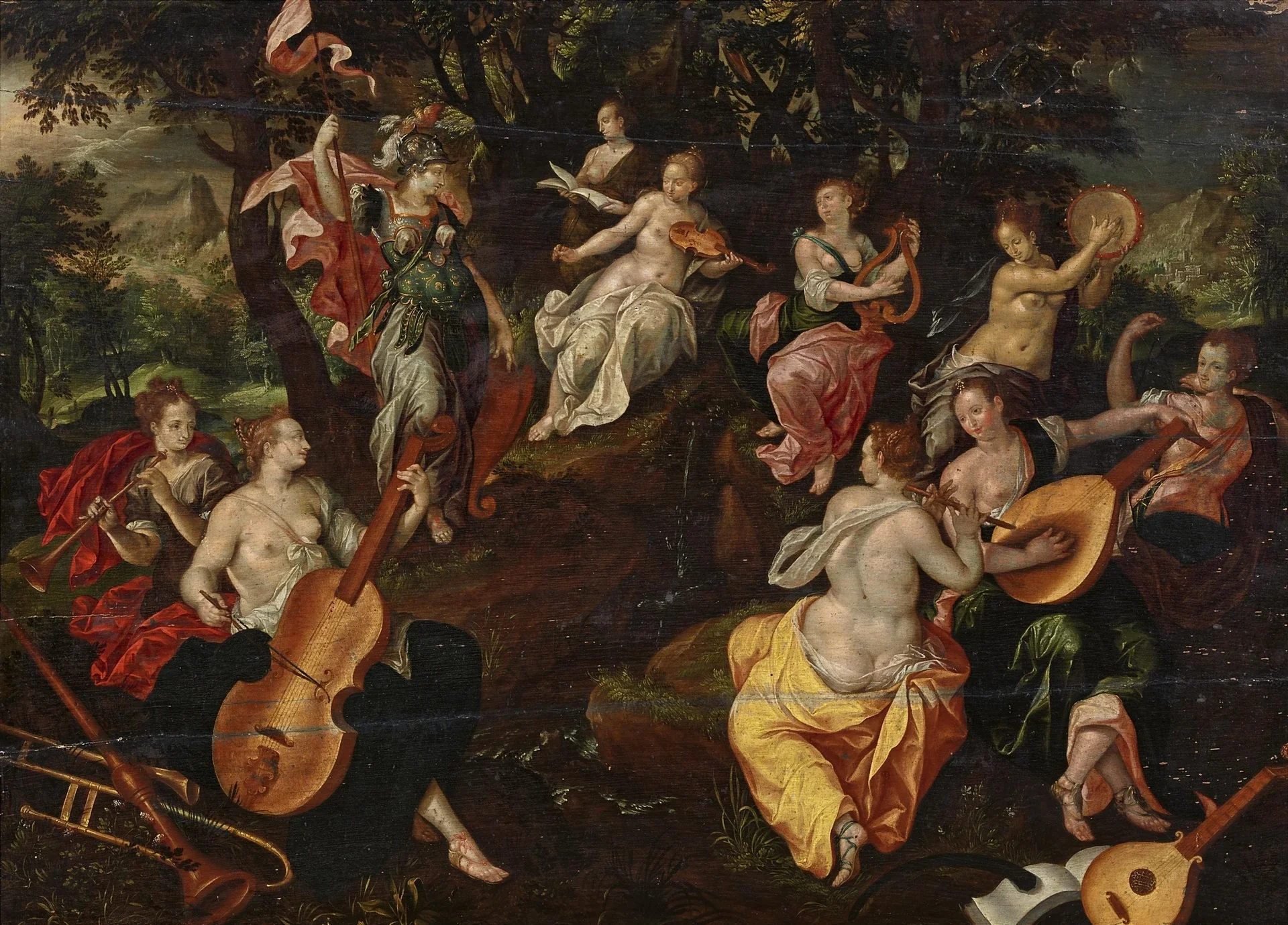
Hendrick van Balen’s painting, The Banquet of the Gods, includes a trombone resting on the ground among several other instruments (see bottom right of below detail; public domain image). For other paintings by the same artist that include trombone, see c. 1615 and c. 1625.
The Judgment of Midas, a painting by Flemish artist Adriaen van Stalbemt, includes a trombone. As in numerous Flemish paintings, the trombone rests on the ground rather than being played (see below image; public domain). 
Apollon défié par Marsyas or Der musikalische Wettstreit Zwischen Pan und Apollo, a painting attributed to Frans Francken (1581-1642) or Adriaen van Nieulandt the Elder (1587-1658), includes a trombone resting on the ground (see below image; public domain) (National Library of France).

Flemish artist Adriaen van Stalbemt (1580-1662) includes a somewhat awkwardly-rendered trombone in his painting, Landschaft mit Minerva (see detail below; public domain) (National Library of France). For numerous other images by Flemish artists depicting trombones resting on the ground, see here.
Wedding at Cana, a painting by Flemish artist Frans Francken II (1581-1642) depicts musicians playing trombone, bass viol, viola da braccio, lute, and cornetto (see below image; public domain) (French National Library).
Lionello Spada’s painting, Concert, which shows a group of musicians presumably preparing for a performance, includes a clear depiction of a musician removing the outer slide of a trombone (see below image; public domain) (Egan; Monducci 81).

Artist Cristoforo Roncalli, known as “Pomarancio,” makes a set of preparatory red chalk drawings for a fresco to be painted on the cupola of the Basilica di Loreto (fresco now largely lost). Among the drawings are several angel-trombonists. Notice the particular attention the artist seems to pay to the grip of both the left hand and the slide hand in the bottom 2 sketches (see below 3 images; public domain) (Chiappini Di Sorio 194; Polichetti).


Antonio Maria Viani’s Parnassus as Allegory of Mantuan Literary Glory, located in the Hall of Mirrors of the Ducal Palace, features what appears to be a woman holding a trombone (see detail and full image below; public domain) (special thanks to John Rojak).
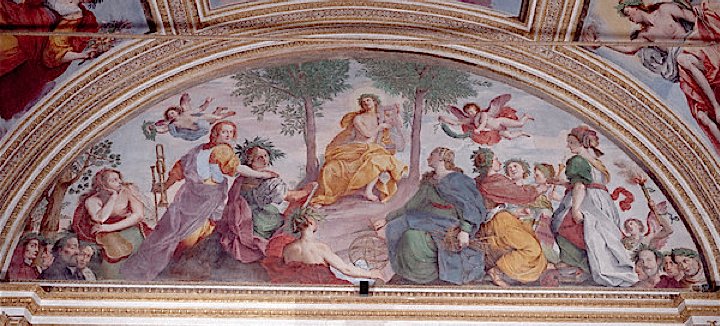
A quartet of instrumentalists consisting of 2 trombones and 2 cornetts is retained at the Canterbury Cathedral. The group’s functions is “to make music in the quire” of the Cathedral, on feast days, and on vigils (Bowers 440).
The instrumental ensemble of Santa Petronio includes 7 trombones, 2 cornetts, and 1 violin. Strings are gradually added later (Schnoebelen Bologna 1580, 106).
Adriano Banchieri writes a collection of 21 motets. Following the last page of music, the composer gives a table of several ways the motets may be performed; among the ways are “Trombone & Violino Stromenti” and “Basso Trombone & Soprano voce” (Collver 42).
A musician by the name of Pietragnolo Maestri resumes employment as cathedral trombonist, where he contiues to serve until 1613. He had previously served from 1597 to 1601 (Reardon, Agostino Agazzari 53).
Monteverdi’s 1610 Sextus part-book reveals what may be a doubling practice for trombonists of the time. As musicologist Andrew Parrott puts it, “At ‘Quia respexit’ the cornett III part shares a stave with trombone I, making it entirely feasible in this verse for one and the same player first to play cornett (of one size or another), then tenor sackbut, and finally cornett again, using the intervening woodwind duets to switch instruments” (Parrott, Monteverdi: Onwards and Downwards).
Louis XIII maintains a court wind band that includes 2 trombones (Whitwell, Baroque 24).
“Nativitas tua” from Grandi’s first published music collection, the Primo libro de motetti a due, tre, quattro, cinque, & otto voci, con una Messa à quattro.
Lodovico Viadana, Sinfonia “La Bergamasca” for 8 instruments, from Sinfonie musicali.
Claudo Monteverdi composes Vespers, which uses trombones prominently. Only 3 pieces in the collection specify particular instruments; in all 3 of these, trombone is named (Domine ad Adjuvandum, Sonata Sopra Sancta Maria Ora Pro Nobis, and Magnificat a Sette Voci) (Holman, Col nobilissimo; Kurtzman, Monteverdi Vespers, 412). In Sonata sopra Sancta Maria, not only does Monteverdi call for trombone, but he suggests the instrument as a substitute for the vivola da brazzo part (Bonta Violone 69). In Domine ad Adjuvandum, the instrumental bass part is marked, “Trombone, Contrabasso da gamba, & Viuola da brazzo” (Holman, Col nobilissimo).
Giovanni Paolo Cima specifies trombone in numerous works from his collection Concerti ecclesiastici, including Sonata (trombone or violone) and Cappriccio a 4 (1 trombone) (Collver 47).
Carlo Bononi’s painting, Convito di Assuero, includes a trombone among a group of musicians in a loft (see upper left of below image; public domain).

La Plata Cathedral employs a trombonist by the name of Antón de Toledo. Accounts also contain records of repairs for shawms, trombones, and curtals (Bermúdez).
Trombones participate as part of the “Winde Musick” in an elaborate pageant-procession on the eve of the coronation of Charles II (Halfpenny, The Entertainment of Charles II).
Pieter de Witte (also known as Peter Candid and Pietro Candido) includes an angel playing trombone in his drawing, Euterpe (see bottom-left of below image; public domain) (Volk-Knüttel 102).
Randle Cotgrave’s A Dictionarie of the French and English Tongues includes the following entry for the word Sarbacane: “Sarbacane, or (which is better) Sarbataine: A long trunke to shoot in; also, the musicall Instrument called a Sagbut” (Dart, Music and Musical Instruments in Cotgrave’s Dictionarie).
Arcangelo Borsaro’s Novo giardino de concerti specifies optional substitution of trombones for the lower 2 voices in each of its 20 motets (Kurtzman, Monteverdi Vespers 123).
In a letter from Claudio Monteverdi to Prince Francesco Gonzaga (governor of Mantuan province of Monferrato), Monteverdi reveals that he is still trying to help the prince establish a wind band (see 1609 entry, above). He says, “Your Highness left instruction with Messer Giulio Cesare [Bianchi] the Cremonese (who plays the cornetto) that if someone could be found who would play the recorder, cornetto, trombone, flute and bassoon—for want of a fifth part in Your Highness’s wind band—you would be pleased to take him on. I therefore approach this letter of mine to let Your Highness know that there is a young man here of about twenty-six or twenty-eight (I do not know whether he is passing through or has come on purpose) who can play on the afore-mentioned instruments very readily at least, and with assurance, because I have heard him play both recorder and cornetto; moreover he says that he can also play the gamba and the viola….As is my custom, I sounded him out and told him: ‘If His Highness the Prince were pleased to take you on, this gentleman very much likes not only to hear a variety of wind instruments, he also likes to have the said musicians play in private, in church, in procession, and atop city walls; now madrigals, now French songs, now airs, and now dance-songs.’ And he told me in reply that he would do everything, as he will always consider it great good fortune, this becoming fit to be allowed to serve the likes of Their Highnesses in some way” (Stevens Letters 81).
The chapel hires a trombone player (Mendoza de Arce 140).
The cathedral trombonist receives a raise (Stevenson, Mexico City Cathedral Music).
Amante Franzoni writes Canzon francese for 2 trombones, cornetto, and organ. The piece is part of a large collection called Concerti ecclesiastici (Collver 50).
2 trombones are included in the orchestra maintained by the Salzburg court (Chafe 37).
A shagbutt is repaired at Trinity (Payne 146).
A fresco painted by Giovanni Battista de Advocatis in chiesa parrocchiale dell’Invenzione di Santo Stefano features a large group of angels playing musical instruments, including trombone (see below image; public domain).
Manufacture date of the bass trombone that historian Anthony Baines calls “the most beautiful trombone in existence” (Young 22). It is also, according, to Robin Gregory, “the oldest known Quintbass trombone in existence” (Gregory 33). In addition to the flat stays, conical bell, and hinged slide extension typical of this period, it has two extra turns of tubing at the top, with a supplementary slide extension for this upper section of tubing. The manufacture location is Nuremberg, a city famous for brass instrument manufacturing (Germanisches Nationalmuseum, Nuremberg) (Montagu 105).

According to Philip Bate, a trombone with a double slide, made by Jobst Schnitzer, survives from this date (Bate 136).
Lodovico da Viadana’s Salmi a Quattro chori contains instructions for performing his polychoral works for 4 choirs. In the third choir, he instructs, “the tenor is sung by several voices, with trombones.” In the fourth choir, “the [second] part is in a comfortable tenor register, sung by a number of voices with trombones; the third part is a baritone—again, this should have good voices or trombones, with violins. The bass is always low, so it should be sung by deep voices with trombones…” (Roche, North Italian 118; Collver 181).
Adriono Banchieri composes his Moderna armonia di canzoni alla francese. In the foreword, he suggests trombone as one of many options for performing the work (Collver 42). Numbers 11 through 25 are 2-part works (trombone and cornett), and numbers 26 and 27 are 4-part works (2 trombones and 2 cornetts) (Winkler 298).
Records for the King’s Music list Sackbuts and Hautboys together rather than separately. The group consists of 7 (Woodfill 301).
A musician by the name of Juan García Sotos Albos is appointed as a trombonist at Cuenca Cathedral (De Pascual).
Trombonist Bartolomé de Selma leaves employment as trombonist at Cuenca Cathedral to become instrument maker to the royal chapel in Madrid.
Musical instruments enumerated in a list of possessions left on the death of Albert Zielinski, owner of Strzalkow, over which a court case is disputed, include 3 trombones (Przybyszewska-Jarminska, The History of Music in Poland: The Baroque, Part 1, p. 72).
A single trombonist is included in the orchestra maintained by the Salzburg court (Chafe 37).
Various engravings from Wolfgang Kilian’s Musae IX feature trombones, including Chorus Musarum, Thaleia, Cleio, and the title page (see below 4 images; public domain). The caption for the 2nd image (Thaleia, Muse of Comic Poetry), which depicts a trombonist reading from music held up by a cherub or putto, says, “If our story is great, or if it is a comedy of life, Our story, even after it has been told does not satisfy God, It does not create the eternal well-being which pleases us; And expressed it does not include the praises of God” (see below image; public domain) (Naylor 96).


The welcoming festivities for Elector Friedrich V of the Rhine Palatinate and his Bride, Princess Elizabeth of England, include a series of triumphal arches constructed along the streets by the faculties of the University of Heidelberg. At the first arch, staged by the Faculty of Philosophy, “pleasing music was [performed] by trombones and cornetts.” The festival record continues, “His Highness the Elector, as well as his spouse, were received with a cordial and very lovely musical [performance with] all kinds of string-playing and [other] instruments. Up high [on the stage] stood an angel who blew on two [sic] sackbuts….When His Highness the Elector, as well as the princes, were escorted in the procession by the four faculties of the world-famous University of Heidelberg, [they] passed through four triumphal arches [surrounded by] many well-wishers. Upon the first archway, which was hung with tapestries, sweet music by sackbuts and cornetts was presented” (Bowles, Musical Ensembles 188). A graphic representation of the welcoming ceremonies depicts a group of musicians, including 3 trombones, performing on a triumphal arch (see below detail; public domain) (Bowles, Musical Ensembles 190; Guion, A History 103).
The Hofkapelle includes 2 trombonists on staff (Baines, Two Cassel Inventories).
An inventory of the Hofkapelle includes several sizes of trombones, along with various parts of these instruments: “1 great posaune with its E…[?] or joints [gliedern] mounted with silver, partly gilded; with slides [zugen] and crooks [bogen]; also 2 silver mouthpieces and a silver image [biltlein],” “1 bad posaune with its slide and crooks,” “4 Tenor and Alt posaunen, with 7 crooks and shanks [aufgesticktes],” “2 small Alt or Discant posaune with 3 crooks and shanks,” “1 Quart posaune with crooks and slide,” and “1 bell [glocke] of a posaune without appurtenances and front section” (Baines, Two Cassel Inventories).
At the wedding of Duke Wolfgang Wilhelm of Bavaria to Countess Magdalena of the Pfalz, the wedding party goes to the Frauenkirche, where, according to one report, “Throughout the church, high up, trombones, trumpets and kettledrums were heard” (Bowles, Music in Court Festivals of State).
Alberto Gregori, whom Montebuoni Buondelmonti praises as “a most singular trombone player, perhaps the best in Italy,” is hired at the cathedral. He serves there until 1618, then again from 1627 to 1641. He is also employed at various times throughout his career at Siena’s Palazzo Pubblico and Santa Maria della Scala (Reardon, Insegniar 127).
Pietro Cerone writes his Spanish-language treatise, Melopeo y Maestro. He classifies trombones [sacabuches] among instruments de viento, also noting that ensembles [conciertos] are found comprised of trombones, curtals, Doppioni, recorders, dolzaine, cornetts, Cornamusas, and crumhorns (Cerone 1038).
Amante Franzoni, maestro at Santa Barbara, includes “Concerto a cinque” for 4 trombones and tenor voice, as well as Sancta Maria ora pro nobis for 4 trombones and soprano voice, in Apparato Musicale di Messa, his collection of liturgical music (Kurtzman, Monteverdi Vespers 32; Sanders, Gonzaga 154).
Drayton’s Polyolbion relates a musical contest between the Welsh and the English: “So were there some again, in this their leaned strife, Loud Instruments that loved, the cornet and the fife, The Hoboy, sagbut deep, recorder and the flute: Even from the shrillest shawm unto the cornamute” (Whitwell, Renaissance 38).
Records from the convent Santa Margherita show that a woman named Suor (sister) Olimpia Ghisilieri and another nun both own trombones (Monson, Disembodied 47).
Civic musician Wolf Hueber is found to own, upon his death, 3 trombones, 4 trumpets, 5 cornetts, a shawm, 9 “Querpfeifen,” 8 violins, and a zither.” Historian David Whitwell has speculated that “some civic musicians, perhaps unwilling to trust the town to have the necessary instruments available and in good repair, owned large personal collections of all the instruments they might need” (Whitwell, Renaissance 152).
Christoph Strauss utilizes 2 trombones in O Rex gloriae à 10 (Collver 176).
Christoph Strauss utilizes 3 trombones in Deus laudem meam à 8 (Collver 176).
Giulio Belli writes Concerti ecclesiastici a due et a tre voci, which calls for trombone. Specifically, Canzona No. 16 is a 2-part work that specifies trombone, cornett (or violin), and continuo, and Canzona No. 29 is a 3-part work calling for 2 cornetts (or violins), trombone, and continuo (Collver 43).
Ercole Porta’s Canzona 33, a 2-part work, calls for cornett and trombone. Canzona 34, a 3-part work, calls for 2 cornetts or violins and one trombone (Winkler 299). His La Luchina, canzon in risposta, from Vaga Ghirlanda di soavi, calls for violin, cornett, 2 trombones, and basso continuo (Collver 65).
Heinrich Schütz calls for 3 trombones in Veni Sancte Spiritus, SWV 475 (Collver 169).
An image documenting a procession in honor of the baptism of Duke August depicts two trombones and a cornetto, followed by a person dressed as Mercury (see below image; public domain) (Dresden Staatsarchiv).
Usper’s Intonuit is scored for 2 voices and 4 trombones (Whitwell, Baroque 213).
Giovanni Bassano presents the Doge with a request to make his piffari e tromboni a “union of instrumentalists” with the privilege of playing “both in the churches and the scuole grande within and outside of Venice.” The request is approved and detailed bylaws are drawn up two years later (Moore 82).
Pietro Lappi calls for trombone in his vocal work, Sacrae melodiae (Collver 129).
An official roster for the orchestra at St. Mark’s cathedral indicates that there are at least 3 trombones on payroll (Selfridge-Field, Bassano and the Orchestra of St Mark’s).
The Colledge Sagbutt is repaired at Trinity (Payne 146).
The Church of Santa Maria della Neve contains an anonymous fresco lunette featuring several angel musicians, including a trombonist. The trombone is particularly noteworthy because it is a rear-facing (sometimes called “over-the-shoulder”) instrument, an unusual configuration for this early date (see below image; public domain) (Morandi; Farioli). For another early rear-facing instrument, see 1578 in the 16th century timeline, where a cherub-trombonist is featured. In later centuries, particularly the 19th century, rear-facing trombones become much more common; the 19th century timeline includes at least 9 such images.
Allegory of Music by Jan Bruegel the Elder includes a trombone among numerous instruments resting on the floor (see below image; public domain).

Hendrick van Balen’s painting, Minerva among the Muses, on the cover of a virginal belonging to Queen Maria Kazimiera Sobieski, features a trombone among several instruments resting on the ground. The trombone is somewhat unusual because of the double loop of tubing on the back of the instrument, similar to the one portrayed by Brueghel and Rubens in Allegory of Hearing (1617-18). Queen Maria, originally from Poland, marries King James Stuart and spends most of her life in Rome. Hendrick van Balen, the artist, is a mannerist from the Antwerp School (see detail and full image, below; click full image for larger version; public domain) (source: wikimedia commons).

Hendrick van Balen’s painting, Minerva and the Muses, includes a trombone among several musical instruments resting on the ground (see below image; public domain). See also the copy within Bruegel and Rubens, Allegory of Hearing (1617-1618, below).
St. Omer, France: Pas de Calais, headmaster of the College of St. Omers, describes the musical activities of the school. Sackbut is included among the category of “Other wind instruments [that] require more lung-power” (Long Study 28).
Giovanni Valentini (c. 1582-1649) writes Canzon a 2 for trombone, cornett, and continuo; Sonata a 4 for trombone, cornettino, bassoon, and organ; and Sonata a 5 for trombone, 2 cornetts, 2 violins, and continuo (Collver 71).
Sienese artist Francesco Rustici (sometimes known as “il Rustichino”) includes what appears to be a trombone in his painting, Concerto. The trombonist, standing in the middle-rear, appears to be female (see detail and full image below; public domain) (Museo di Arti Figurative; Markova). For a commercial reproduction of a detail of the trombone player (labeled “trumpet” on the site), see here.

Hans Rottenhammer’s painting, Madonna col Bambino in Gloria con angeli musicanti, bears several similarities to Raphael Sadeler’s engraving, Allegory of the Immaculate Conception (which, in turn, is after a painting by Pietro Candido). An angel playing trombone is featured on the bottom-left of the image (see below image; public domain).

Munich, Germany (?): Allegory of the Immaculate Conception, an engraving by Raphael Sadeler (1584-1632) after Peter Candid (also known as Peter de Witte and Pietro Candido), includes an angel-trombonist among a group of musical angels (see detail and full image below image; public domain) Click on detail to expand.

Regarding music in Mexico, Juan de Torquemada says, “After a while there was no single instrument used in churches which Indians in the larger towns had not learned to make and play. It became unnecessary to import any of these from Spain. One thing can be asserted without fear of contradiction; in all Christendom there is nowhere a greater abundance of flutes, sackbuts, trumpets, and drums, than here in New Spain” (Stevenson Music in Mexico 68).
Bartolomeo Roverio’s painting at Santa Maria church, Chiaravalle Abbey, features an angel-trombonist among a number of other angel-musicians (see below image; public domain) (Die bemalten Orgelflügel 360).
Archduchess Isabella visits Brussels and subsequently commissions several paintings to portray the related celebrations. In a series of several paintings, Denis van Alsloot, court painter for Archduke Albert and Isabella, depicts the ommegang, or procession, that had taken place outside the Brussels church of Notre Dame du Salon. One of the paintings depicts the 6-member civic wind band of Brussels that had been part of the procession (see 1st detail and full image, below; public domain). The group includes trombone, cornetto, dulcian, and several sizes of shawms, and occupies a place of honor between the relics and the statue (Denis van Alsloot, Procession en l’honneur de Notre-Dame du Sablon a Bruxelles le 31 mai, Museo Prado, Madrid) (Lesure 94-95; Forney, Antwerp 363; Whitwell, Baroque 181; Wangermée, vol. 1 241). Another artist, Antoine Sallaert, also depicts the procession, portraying the wind band in nearly the same posture and configuration as Alsloot, then in a slightly different configuration (see final 2 details, below; public domain) (Galleria Sabauda, Turin).


Modena Cathedral possesses a musical establishment of approximately 15 singers, a cornettist, a trombonist, and an organist (Kurtzman, Monteverdi Vespers 381).
Authorities grant trombonist Alberto Gregori permission to augment his salary by playing at the church of Santa Maria di Provenzano (Reardon, Insegniar 136). The same year, Lorenzo Scala, a full-time member of the chapel and former student of Gregori, petitions for permission to supplement his income by playing trombone at the Santa Maria di Provenzano; his request is approved on condition that he play no more than 2 times a month at the church (Reardon, Music and Musicians).
Lionello Spada’s fresco in the cupola of the Chiesa della Ghiara includes depictions of numerous angel-musicians, including an angel playing trombone. The other instruments include harp, recorder, triangle, tambourine, cornetto, lute, and violin (see detail and full image below—click on full image to expand; public domain) (Quintavelle, plate 81; Monducci 130; Artioli, plates 8 and 12).

Symphoniae sacrae II, a collection of Giovanni Gabrieli’s works, is published 3 years after his death. Trombone is featured prominently. For example, Jubilate Deo is scored for alto voice, tenor voice, 5 trombones, 2 cornetts, and bassoon. Surrexit Christus is scored for alto voice, tenor voice, bass voice, 4 trombones, 2 cornetts, and 2 violins, and features extended instrumental sections (Roche, North Italian 115; Collver 116). Suscipe a 12 calls for 6 voices and 6 trombones (Bartlett, Giovanni Gabrieli: A Guide). Quem vidistis pastores a 14 utilizes 3 trombones (Collver 116).
Giovanni Gabrieli’s collection of 16 canzoni and 5 sonatas, Canzoni et sonate, published posthumously, calls for trombone extensively.
Arcangelo Borsaro writes for 2 cornetts (or violins), trombone, and organ in his La Matusaleme a tre from Odarati fiori (Collver 45).
An artist from the studio of Sallaert includes a trombone in the below drawing that appears to be either a preparatory sketch or a copy of the more famous 1616 Procession by Sallaert (see below image; public domain) (Van Sprang, Pictura Nova, 2014, vol. 2, no. F6, ill. 95).
A painting by Thomas Maurer, The Diocesan Synod of 1610 in the Cathedral of Augsburg, includes what may be two trombones situated on opposite sides of the group of musicians, with only the rather long rear bow of the instruments visible (see detail and full image below; public domain) (Chevalley 142).

Bernardino Borlasca, newly-appointed Hofkapellmeister of the Bavarian court, publishes Scala Iacob, a collection of motets. The preface to the collection says the following about instrumentation of polychoral works: “The first choir is to consist of four principal parts with a soprano and a castrato or a pleasant falsetto, accompanied by a body of diverse stringed instruments such as viole da braccia or da gamba, a large harp, a lirone, or other similar instruments as are common today, especially at the Bavarian court; indeed His Serene Highness has examples of every kind of instrument of this sort, as well as men of exquisite excellence. Moreover, where the letter V. is found, the voice should sing; at the word Sinfonia the instruments should play, and at the letter T. the voices and instruments should play together. The second choir should, like the first, also consist of the same voices, but of different instruments. For, if in the first are found plucked instruments or strings, in the second should be placed wind instruments, such as cornetts and trombones, and pleasingly tempered by a violin playing the contralto part an octave above. In this same way in the first choir a cornett playing the same part, if it is a choir of viols, is such a different instrument that by following these instructions one will be assured of obtaining lovely and delightful harmony.” Borlasca’s collection contains at least a dozen works that utilize 2 or 3 trombones in such a manner (Collver 93).

A highly symbolic series of engravings by Esaias van Husen depicts trombones with various combinations of instruments. The players are said to represent town musicians (stadtpfeifer) who entertain at peasant weddings, baptisms, fairs, and dances. In the facing image, bass trombone performs with 2 cornetts (see facing image; public domain) (Naylor 28, 194).
Beaumont and Fletcher’s tragicomedy, The Mad Lover, uses trombones for a solemn scene, indicated by the following stage direction: “A dead march within of drums and sackbuts” (Long Study 37).
Festivities celebrating the baptism of Prince Friedrich von Württemberg feature trombone extensively. First, at the service itself, the “Assum Version” festival book records, “The charming piece by Gregor Aichinger, Laudate Dominum &c. for eight voices, with two cornetts, four trombones and two bassoons was executed by the most select vocalists, ending most appropriately.” Following the baptism, a Te Deum by Salomon is sung, utilizing 3 ensembles: “The first, with a positive organ, four fiddles, two lutes, a small pipe and large contrabass viols, besides four singers. The other, with regal, one cornett, two trombones, a bassoon and four vocal soloists. The third also with a regal, three trombones, a serpent, in addition to four musicians. Whenever the three ensembles played together [there was added] the great organ, a cornett and a contra bassoon [Pommerten Vagoten].” Later, trombone is again involved, this time during a banquet: “For this, the Kapellmeister of the prince directed a warm, intense chamber and banquet music for the assembled company with select members of the ensemble, in the Italian, English and French manner, with instruments [such as] portative organ, cornetts, trombones, bassoons, lutes, fiddles, viole bastarde, small pipes and live voices, the best soloists, [all] in various combinations.” Two days later there is a procession incorporating instrumentalists dressed as the Nine Muses that includes a trio of trombone and 2 cornetts (See below image; public domain) (Bowles 199-200, 207).
In a separate account of festivities celebrating the baptism of Prince Friedrich von Württemberg (as distinct from the “Assum Version” cited above), the author of the “Weckherlin Version” renders the account into English himself, taking note of the banquet: “None may doubte of the plentie of costlie meate and any kind of daintinesse, and rich shew’s of fountaines, images, beasts and other prettinesse set upon the boord, dressed most artificially, no lesse as of sweet musicke. For there were heard three severall companes th’ one after the’ other, so that when the first (that did sound, after the Italian fashion, instruments and voices together) did finish, the second (playing according to the English manner with cornets and sack-botts) did beginne…” The author then describes a “Ballet of Nations” that follows, in which characters representing various nations crawl out of 4 large heads. Of the trombone’s role he says, “The third that came forthe of the second head was a Laponian, covered with the skinne of a beare, and trampling about at the sound, such an other fellow of Lappie did tune with a sackbotte” (see below image; public domain) (Bowles 209-11).
As part of festivities celebrating the baptism of Sophie Elisabeth, first daughter of Markgraf Christian Wilhelm of Brandenburg, there is an enormous introductory procession that includes a group of 3 gypsies on horseback, escorted by a musical trio of 2 viol players and a trombonist (see below image; public domain) (Bowles 203, 220).
Ludovico Carracci’s Paradise, an altarpiece painting located in the Church of San Paolo Maggiore, features an angel-trombonist situated prominently among a group of angel-musicians (see below image; public domain) (Komma 109; Emiliana 167).
Hendrick van Balen and Jan Brueghel collaborate on a painting called An Allegory of the Five Senses, which includes a trombone among several instruments in the foreground (see below detail; public domain) (Haeften, pl. 8). For other depictions of the trombone by the same painter, see c. 1610 (Banquet of the Gods), c. 1615 (Minerva among the Muses), and c. 1625 (Allegory of Music).
An account of the consecration ceremony at the convent Santi Abbondio e Abbondanzio shows that a chapel master and six musicians, including a trombone player, participate in the ceremony. It also records a supplementary payment to the trombone [el maestro del tronbone], who attended two rehearsals before the ceremony (Reardon, Holy Concord 60).
Jacques Callot, Cavaliers and Ladies at a Dance, probably produced while Callot was serving as a court artist for the Medici court under Cosimo II de’ Medici. Notice the trombone (upper-right). See below; public domain.

Bartolomeo Roverio includes 3 trombones among many angel musicians in a ceiling fresco at San Marco (see 3 details and full image below; public domain) (Perer 172).


A festival book with engravings by Esaias von Hulsen, published in 1618, portrays the Stuttgart festivals of 1617 surrounding the christening of Ulrich of Württemberg and the marriage of Ludwig Friedrich of Württemberg to Elisabeth Magdalena of Hesse-Darmstadt. It features two different plates in the procession that include 4 different trombonists, all of them apparently female players (see below 2 images; click on image for larger version; public domain) (sources: Komma 128, Festkultur online).

In a letter from Heinrich Schütz to Heinrich Posthumus of Reuss-Gera (Germany), Schütz recommends that 2 boys of the court ensemble be trained on trombone (Spagnoli 69-70).
A 3-day celebration is held to mark the centenary of the start of the Reformation. For the occasion, Heinrich Schütz writes several richly scored Psalm settings that include cornetts, trumpets, trombones, and timpani (Smallman 29).
Biagio Marini’s Affetti musicali, a collection of instrumental music, includes several works that specify trombone: La Giustiniana (2 cornetts or violins, trombone, continuo), La Foscarina (2 cornetts or violins, trombone or bassoon, continuo), La Hiacinta (violin or cornett, trombone, continuo), La Marina (cornett or violin, 2 trombones, continuo) (Winkler 299, Collver 45).
Incoronazione della Vergine, a painting by Carlo Bononi in the basilica di Santa Maria in Vado, includes a lute and trombone (see below image; public domain).
Jan Brueghel the Elder and Peter Paul Rubens collaborate on a series of paintings on the subject of the 5 senses. The Sense of Hearing or Allegory of Hearing depicts a trombone among the many instruments in the room (see Detail 1, below). In the upper-left of the painting is a painting within a painting: a copy of Hendrick van Balen’s Minerva and the Muses, which also includes a trombone (see Detail 2, below and c. 1615, above). The full painting by Brueghel and Rubens is the third image below (images public domain) (Woollett, 91-92; Museo del Prado, Madrid).

Detail 1 from lower-left of Breugel and Rubens, The Sense of Hearing or Allegory of Hearing.

Detail 2 from upper-left of Breugel and Rubens, The Sense of Hearing or Allegory of Hearing, showing a painting-within-a-painting of Hendrick van Balen’s Minerva and the Muses (c. 1615).

Jan Brueghel the Elder and Peter Paul Rubens, The Sense of Hearing or Allegory of Hearing (full painting).
Jan Brueghel includes a trombonist resting on the ground in his allegorical painting, Taste, Hearing, and Touch (see lower-left corner of detail and full image below; public domain).

Trombonist Alvise Grani becomes a member of the ducal pifferi. At some point, he also becomes a teacher at the Pieta in Venice—the earliest known hiring of an external maestro at that institution (Baldauf-Berdes 188).
Town musicians are forbidden to play cornetts or trombones at “common” weddings; rather, fiddles and other stringed instruments are encouraged for such occasions (Marcuse 811).
Biagio Marini’s Madrigali et symfonie a una, 2, 3, 4, 5 utilizes trombone in “La Rizza,” which calls for violin, cornett, trombone, bassoon, and basso continuo (Collver 60).
Bastiano Miseroca writes Canzon a 3 for 2 cornetts, trombone, and continuo. The work is part of a larger collection called I pietosi affetti (Collver 62).
Suor (sister) Angela Maria Rugieri brings a trombone and bass viol with her to the convent Santa Caterina (Monson, Disembodied 263).
Pieter Lastmann’s altar scene, David in the Temple, portrays a trombone performing with voices, tamborine, pommer, and 2 string instruments (see detail and full image below; public domain) (Kinsky 177; Buchner 254; Herzog Anton Ulrich-Museum, Braunschweig).

Heinrich Schütz (1585-1672) utilizes trombones in Concert mit 11 Stimmen, Haus und Güter erbet man von Eltern, which he composes for the wedding of Michael Thomes and Anna Schules (Collver 167).
Johann Hermann Schein (1586-1630) writes Das Te Deum Laudamus, a polychoral work that calls for 2 trombones in one choir and 1 trombone in another (Collver 163).
An anonymous oil painting depicts a wedding procession led by 4 town musicians—alto, tenor, and bass trombones with cornett (instrument identification according to Walter Salmen). The wedding party is apparently wealthy and the musicians are elegantly dressed. The painting is set against the backdrop of the Hanseatic town of Bremen (Salmen, Status).
Records for the King’s Music list Hautboys and Sackbuts together instead of separately. The group consists of 6 (Woodfill 302).
A fresco by Jan Vasoens in the vaulted ceiling of Dominicanenkerk portrays several musicians, including trombonists. The church has now been converted into a bookstore. See 2 details and full image below; public domain.


The title page from Polyhymnia panegyrica by Michael Praetorius depicts 3 angels playing trombone among a compact jumble of other musicians (see below image; public domain) (Naylor 216).
Giovanni Priuli, Canzon terza a 6 (due cornetti e viola, due tromboni e fagotto).
Giovanni Priuli, Canzon quarta a 6 (3 violini, 3 tromboni).
Christof Angermair’s ivory carving from the coin cabinet of Elizabeth of Lorraine depicts a number of musicians, including a trombonist in the foreground, performing with Pan, the shepherd’s god (see detail and full image below; public domain) (Munich: Bayerische Staatsgemäldesammlung; Salmen, Gartenmusik 75; Hindley 164).


Venetian composer Giovanni Priuli calls for 3 trombones in Laudate pueri a 12 (Collver 153).
In his Syntagma Musicum II, Michael Praetorius calls the trombone (posaun) the “wind instrument par excellence in concerted music of any kind.” He continues, “A skilled player can play at will in all sorts of keys through tones and semitones, and can go beyond the compass in either direction; not only by inserting and extracting the crook (called cromette) and the other extension-piece (polette), but also by practiced control of embouchure and wind-pressure, without using the slide at all.” Praetorius uses the term posaun, but lists the following additional terms for the instrument: trombone, tuba ductilis, tuba oblonga, trombetta (Praetorius-Crookes II 44; Praetorius II 35).
Michael Praetorius, discussing tuning in his Syntagma Musicum II, reveals qualities valued in contemporary trombone performance, asserting that the lower the trombones are tuned, “the more solemn and stately they will sound” (Praetorius-Crookes II 31).
Michael Praetorius claims that there is no better guide to a correct pitch standard than a tenor trombone of Nuremberg make, with the slide extended by a width of two fingers. (Trombones from the period do seem reasonably standardized in dimensions, according to historians, and provide a pitch of roughly a’=460).
Praetorius, discussing tuning, reveals some qualities that are valued in trombone playing at the time, asserting that the lower tuned the trombones are, “the more solemnly and majestically they present themselves” (Praetorius-Crookes II 31).
In his Syntagma Musicum II, Praetorius details an acceptable way of performing Quo properas, a double-choir, 10-voice motet by Orlando di Lasso. He recommends trombone in 8 of the 14 sections, thus using the trombone more than any other instrument.
In his Syntagma Musicum II, Praetorius includes the following paragraph about some noteworthy trombone players: “Some players, however—among them Phileno, the famous Munich virtuoso—have taken this instrument to even greater lengths by assiduous practice. They can play without discomfort from bottom D to top c, d, or e in the soprano register. In fact, I myself have heard in Dresden the player Erhardus Borussus, who is supposed to be living in Poland now: he could take this instrument almost as high as a cornett (reaching the top g sol re ut) and as low as a quart-posaun, down to A. He was capable of the fast coloratura divisions that are played on a viola bastarda or a cornett” (Praetorius-Crookes II 43).
In his discussion of cornetto torto, a cornetto pitched in the tenor range, Praetorius states, “However, since its sound is unpleasantly horn-like [hornhafftig], I think it better to use a trombone in its place” (Praetorius-Crookes II 47).
Michael Praetorius, in his Syntagma Musicum III, writes enthusiastically about a mixed consort he says is in use in England: “The English quite appropriately refer to a consortio as ‘consort,’ when several people with assorted instruments, such as harpsichord [Clavicymbeln] or double harpsichord [Großspinet], large lyra viol, double harp, lutes, theorbos, pandoras, penorcon, cittern, violas da gamba, small discant violin [Geig], transverse flute or recorder, sometimes also a soft trombone or recorder, play harmoniously together, softly and sweetly in a charming ensemble (Praetorius-Kite-Powell III 19).
Praetorius, in his Syntagma Musicum III, discusses use of various instrumental configurations: “In the instrumental choir it is only instruments such as trombones, cornetts, curtals, flutes, or violins [Geigen] that perform; it is added to the vocal choir; that is, to the concertato voices, for the sake of greater weight and a fuller, more pleasing sound” (Praetorius-Kite-Powell III 126). Discussing the Italian style of vocal soloists with accompaniment, he says, “They do not like this style as they believe it is too sparse, and that it has no particular attraction or harm for those who have no understanding of music. Therefore I had to come up with the solution of adding a four-part choir or consort of either trombones or violins [Geigen] that could play along at all times. And because such a sound is somewhat more pleasing to the ear when arranged in this fashion in the church, I have earned the public’s approbation” (Praetorius-Kite-Powell III 126).
Praetorius, explaining the expectations of table musicians in his Syntagma Musicum III, recommends alternating voices with various instruments, including trombone.
Praetorius, discussing canzoni in his Syntagma Musicum III, mentions various groups of wind instruments, detailing specific transpositions. He says, “And both of these (nos. 3 & 4), as well as the first two in the Hypoionian mode, can be played on 6 crumhorns if they are transposed up a tone. The following, however, is played at pitch on crumhorns, but a fifth lower on curtals, pommers and trombones [posaunen].” Elsewhere he suggests an ensemble of one chor of 4 crumhorns and another chor of 4 trombones (posaunen). Given the music and clefs he shows, Praetorius recommends that the entire ensemble transpose down a fourth.
Date of trombone made in Nuremberg for George Ehe. The Ehe family is a major brass dynasty in Nuremberg. The instrument has the bore of a tenor trombone, but the tube length is longer than normal, making it a major 2nd or minor 3rd below standard pitch (Young 43). One expert has remarked specifically on the craftsmanship of the instrument: “Perhaps the finest example of the solderer’s art on a musical instrument can be seen on the flawless toothed bell seam…” (Barclay 34).
Polyhymnia caduceatrix et panegyrica, a collection by Michael Praetorius of compositions based on Lutheran hymns, includes vater unser im Himmelreich, a hymn accompanied by contrasting groups of 4-part strings and 4-part trombones (Leaver 281). Many others call for trombone, including Das alte Jahr ist nun vergahn, Nun komm der Heiden Heiland, Wachet auf, Christ unser Herr zum Jordan kam (3 trombones), Jubiliret frölich, In dich hab ich gehoffet Her (4 trombones), Als der gütige Gotte, Lob sei dem allmächtigen Gott, Erhalt uns Herr bei deinen Wort (4 trombones), In dulci jubilo, Wenn wir in höchsten Nöten sein (3 trombones), and Herr Christ der einzig Gottes Sohn (Collver 151).
Heinrich Schütz publishes Psalmen Davids, his first major collection of German church works. Many of the works include prominent trombone parts and obbligato roles (Smallman 35, 37, 42). Herr unser Herrscher and Zion spricht, der Herr hat mich Verlassen both call for 4 trombones, for example, while Ist nicht Ephraim mein theurer Sohn and Wol dem, der den Herren fürchtet call for 3 trombones (Collver 168).
Robert Parker successfully competes against Henry Field for an open position with the town waits. Parker is reportedly especially good on wind instruments; among his many instruments are double sackbut, violen, and low tenor violin. He holds his position until 1649 (Woodfill 249).
City leaders, who feel that the Bristol town waits, consisting of 4 players, need strengthening, resolve to grant a salary “to a fifth man to play with the other musitions of the City on the saggebutt to make up a fifth part.” (Bridge, Town Waits and Their Tunes).
An anonymous ceiling painting in the Heaven Room of Bolsover Castle shows Christ’s ascension, surrounded by angels. The outer circle of angels features angels with several different musical instruments, including trombone (see detail and full image below; public domain) (Drury 25).

The Stadtpfeifer play “spiritual songs” on trombones at 3:00 am, 9:00 am, and 7:00 pm. (At 9:00 am and 4:00 pm they play on trumpets) (Whitwell, Baroque 156).
An Assumption Day celebration at the cathedral includes 21 singers accompanied by cornetts and trombones (Kurtzman, Monteverdi Vespers 381).
Francesco Usper writes Compositioni armoniche. It includes Sonata a 8, which calls for 4 trombones, 2 cornetts, 2 violins, and continuo; Beatus qui intelligit, which utilizes 3 trombones (including “Trombone Grosso”); and Ego dormio a 8, which utilizes 4 trombones (Collver 71, 179).
Motetti spirituali by Sulpitia Cesis calls for 2 trombones (Collver 99).
Lorenzo Mini, who has been singing with the choir since 1617, replaces his former teacher, Alberto Gregori, as cathedral trombonist. He holds the trombone post until his death in 1626, whereupon Alberto Gregori resumes the role (Reardon, Agostino Agazzari 53).
Giovanni Priuli’s Canzon prima a 12 is published as part of a collection that includes a number of canzoni featuring trombone.
Giovanni Valentini calls for 2 cornetti and 2 trombones in Canzon a 4.
Visione di S. Cecilia e angeli, a painting by Giovanni Battista Bertusio (1577-1644) located in chiesa di S. Agata, includes a depiction of an angel playing trombone (see detail and full image below; public domain) (Negro and Roio 37).

A painting by Giovanni Mauro della Rovere (also known as Fiammenghino) in the Chiesa Parrocchiale de Bienno includes a depiction of an angel playing trombone among a large group of angel musicians (see detail and full image below; public domain).

Italian Baroque painter Bernardo Strozzi includes a putto holding a trombone in the painting, Santa Cecilia con le teste di Valeriano e Tiburtio (see below image; public domain) (source: The Digital Library of the National Library of France).
A painting by Vincenzo Maganza in the church of San Stefano features 4 musical angels, including an angel-trombonist (see below image; public domain) (Die bemalten Orgelflügel 564; Palladio e la Maniera 126).
Genio delle arti (Genius of the Arts), a painting by Carlo Bononi, includes a trombone (see first image below; public domain) (Benati 19; Collezione Roberto Lauro, Bologna). An anonymous print duplicates the painting closely (see second image below; public domain) (Moir pl. 44). Located at the foot of the angel, the trombone is noteworthy for its bell flare, which would appear to be slightly more pronounced than that of other trombones of the period. The image belongs to an interesting group of allegorical art works from the 17th century that feature trombones, including Brueghel’s Allegory of Hearing, Van Kessel’s Allegory of Music, and a Czech wall painting from Rozmberk Castle entitled Allegory of Music.

In a painting called Minerva Visits the Nine Muses, attributed to Hendrick van Balen and Jan Brueghel the Elder, a trombone rests upon the ground among several other musical instruments (see below image; public domain).
Composer Juan Bautista writes a vernacular song, “Quién será aquel caballero,” with a texted voice labeled Tiple and 3 untexted voices labeled Bajoncillo, Sacabuche, and Bajón grande (Kreitner, Minstrels in Spanish Churches).
Giovanni Baglione’s painting, Euterpe, Muse of Music, includes a trombone (see below image; public domain). 
The altarpiece of the Virgin of the Rosary of the Parish of Santa Ana, probably painted by Diego López Bueno and Miguel Cano, includes a depiction of an angel playing trombone (see bottom-right of below image; public domain) (Alonso Cano 613). Other sources have the artist as Juan del Castillo, with a date of 1625.\

Heinrich Schütz utilizes 3 trombones in Freue dich des Weibes deiner Jugend (Collver 170).
Woodcuts of the various members of the trombone family appear in Michael Praetorius’s Sciagraphia, a collection of illustrations appended to Syntagma musicum (Treatise of Music). The trombones pictured include alt or discant posaun (comparable to modern alto), gemeine posaun (comparable to modern tenor), quart- or quint-posaun (bass trombones, fourth and fifth below tenor), and octav posaun (contrabass, an octave below tenor) (see below image; Praetorius II, plate 8; public domain).
Also included, on a separate plate of Praetorius’s Sciagraphia, is a highly-decorated bass trombone similar to an extant trombone by Johann Isaac Ehe (Nuremberg, 1612—see entry for 1612, above) (Praetorius II, plate 6; Naylor 196; public domain image).

A chronicler records that when King James travels in state to St. Paul’s Cathedral, “by them conducted into the Quire; where having heard the Divine service for that day most solemnly performed with Organs, Cornets, and Sagbots, they went to a prepared place…” (Heylyn 20).
At Santa Maria Maggiore, musical records list 4 instruments: 2 violins, cornett, and trombone (Roche, Maggiore).
Ercole Porta’s Mass is scored for five-part choir, 3 trombones, and 2 violins (Roche, North Italian 140).
Ercole Porta’s L’Animosa and La Spensierata, both 2-part works, are scored for trombone and violin (Winkler 300).
Francesco Rognoni’s improvisational treatise, Selva di varii passaggi, includes a setting of Lassus’s song, Susanne un jour. Marked “Modo di passegiar il violone over trombone alla bastarda,” it features rapid technical passages to be played on either violone or trombone (Baines, Brass 114; Guion, Short History; Herbert, Trombone 87).
Giovanni Battista Riccio calls for trombone in a collection of canzoni (Selfridge-Field, Instrumentation). Specific examples include Canzon La Fineta, a 2-part work for trombone and violin; Canzon La Savoldi, a 2-part work for trombone and violin; Canzon La Picchi, a 2-part work for trombone and violin; Canzon La Rubina, a 3-part work for 2 violins or cornetts and trombone, and Canzon La Moceniga, a 3-part work for 2 violins and 2 trombones (Winkler 300).
Two frescoes by Belisario Corenzio at the church of Gesu Nuovo include angels playing trombone (see below images; public domain) (Romano 10, 19).

King James visits St. Paul’s cathedral, where musicians “with solemn singing brought the king into the quire [and] they began to celebrate Divine Service, which was solemnly performed with organs, cornetts, and sackbuts” (Woodfill 149).
Ercole Porta’s Corda Deo dabimus, contained in the collection Sacro convito, is scored for soprano voice, alto voice, and 3 trombones. Historian Jerome Roche later coins the phrase “trombone motet” for this type of piece, a genre that culminates in Schütz’s Absalom fili mi (1629) (Roche, North Italian 82). Also from the same collection is Porta’s Messe secunda toni, which calls for 2 violins and 3 trombones to accompany a 5-part choir; when doublings occur, trombones double the 3 lowest voices (Schnoebelen, The Role of the Violin).
Among the leading ministriles mentioned in records of the Seville cathedral are trombone players Alonso Ortega and his son Diego, and Juan de Viedma (Stevenson, Christmas Music from Baroque Mexico 68).
Johann Hermann Schein writes Lyrica Davidica, which calls for trombone (Collver 163).
Michael Altenburg (1584-1640) publishes the collection Der dritte Theil, which includes at least 2 intradas that call for trombone (Collver 76).
Francesco Rognoni, Divisions on Palestrina’s Pulchra es. This piece does not specify trombone; however, see Susanne un jour, by the same composer, above.
Banchieri’s collection of sonatas specifies trombone and violone (Selfridge-Field, Instrumentation). Specifically, Sonata sopra l’Aria del Gran Duca calls for trombone and 2 violins (Winkler 299).

The title page of Praetorius’s Sciagraphia (a collection of illustrations appended to Syntagma musicum) depicts a performance of several church musicians, including 2 trombones (see facing image; public domain) (Praetorius II).
c. 1620-24—Wolfenbüttel, Germany
The organ is installed at the Wolfenbüttel Hauptkirche. Paintings located under the organ balcony, which probably date from the same period, include an angel playing trombone (see below image; public domain).
Francesco Gregori is employed as trombonist and cornettist at music chapels in Malta and Caltagirone (Reardon, Insegniar 127).
An ordinance at the Württemberg court of Duke Johann Friedrich requires the trombone and cornett players to appear without fail for the choir rehearsals during the week (Whitwell, Baroque 206).
John Adson, a London wait, composes Courtly Masquing Ayres composed to 5 and 6 Parts for Violins, Consorts, and Cornets. Three of the 5-part works (airs 19, 20, and 21) are specifically scored for “Cornets and Sagbuts” (Collver 40; Boyd 163; Whitwell, Catalog Baroque 12). See altus part from air 19 below (public domain).
Dario Castello, a member of the piffaro (wind band), composes numerous chamber compositions with parts for 1 or 2 trombones, particularly in his Quinta Sonata from Book I (Selfridge-Field, Instrumentation; Wigness 9). Referring to the virtuosic technical demands of the trombone parts in these sonatas, the second edition of Book 1 includes the following note: “He says, in short, that they are the consequence of the new style everyone is observing and hopes that the players will not give up on the first try” (Wigness 10). Specific pieces include Quarta Sonata (No. 47), Quinta Sonata (No. 48), and Sesta Sonata (No. 49), all of which are 2-part works scored for soprano and trombone or violetta, as well as Duodecima Sonata (No. 50), which is a 3-part work scored for 2 violins and trombone or violetta (Winkler 300).
Stefano Bernardi’s (1585-1636) 7 Canzonas a 3 from Madrigaletti a due et a tre voci specify the following for the bottom musical line: theorbo or bassoon or trombone. The other 2 voices are to be played by either 2 cornetts or 2 violins (Collver 43).
Heinrich Schütz calls for 3 trombones in En novus Elysiis from Syncharma Musicum tribus choris adornatum (Collver 168).
Johann Schein’s, Musica Boscareccia, which contains music of 3 melody lines, specifies the following for the third line: “bass voice or trombone or bassoon or violone” (Dart, Interpretation 128).
At the Bavarian court, cornettist and trombonist Giulio Martino Cesare writes a collection of 28 instrumental and vocal works titled Musicali Melodie. It includes “La Hieronyma,” the earliest known solo work to specify trombone. Also included are “La Augustana,” for cornett (or violin) and trombone, “La Costanza,” for 2 cornetts (or violins) and trombone, “La Famosa,” for 2 cornetts (or violins) and trombone, “La Gioia,” for 2 cornetts (or violins) and trombone, “La Bavara,” for 4 trombones, “La Monachina,” for 3 cornetts and trombone, “La Fenice,” for 2 cornetts and 2 trombones, and “La Vittoria,” for 3 cornetts and 3 trombones (Whitwell, Catalog Baroque 122; Collver 47; Winkler 300). Also included is a motet for one voice and 3 trombones (Dickey, Cornett and Sackbut 107).
Samuel Scheidt writes for 3 trombones and 2 trumpets in Courant a 5 voc. ad imitationem Courant 17 from his collection Ludi Musici (Smithers, Baroque 343).
Richard Brathwaite’s Some Rules and Orders for the Government of the House of an Earle describes use of trombones at banquets: “At great feasts, when the earl’s service is going to the table, they are to play upon shagbut, cornetts, shawms, and such other instruments going with wind” (Bowles, Musical Ensembles 125).
At Santa Maria Maggiore, music for the feast of the Assumption includes 2 trombones (Roche, Maggiore).
Alessandro Grandi, “Salve Regina” from Motetti a una e due voci con sinfonie utilizes trombone.
Procession of Our Lady of San Lorenzo, a painting by Matias Velasco in the Church of San Lorenzo, includes a trombone among a group of musicians (see detail and full image below; public domain).

At the church Santa Maria di Provenzano, the 4-singer chapel is augmented with a trombone for the Christmas season (Reardon, Music and Musicians).
Adriano Banchieri writes several works scored for violin, trombone, and organ: Prima Sonata, Seconda Sonata, Terza Sonata, and Quarta Sonata (Winkler 300).
By this date, P.A. Mariani writes Canzon Per il Deo Gratias, a 2-part work for violin and trombone (Winkler 300).
A document dealing with the town waits indicates that the group owns at least 3 trombones (Whitwell, Baroque 170).
Samuel Scheidt calls for trombone in his vocal work, Pars prima concertuum sacrorum. For example, both Concertus III and Concertus XII utilize multiple trombones (Collver 163).
Vincenz Jelic [Jelich] writes Parnassia militia, which contains 4 ricercari for cornett, trombone, and continuo (Whitwell, Catalog Baroque 131; Collver 54).
Giacinto Bondioli (1596-1636) includes 7 canzoni in his collection, Soavi fiori colti, that call for cornetto (or violin), trombone (or bassoon), and organ (Collver 44).
A silversmith is paid for repairs to the trombone owned by La Plata Cathedral (Bermúdez).
Giovanni Francesco Barbieri (also called Guercino) includes angels playing cornetto and trombone in The Glory of St. Chrysogonus (formerly held in the Church of San Crisogono in Trastevere, Rome). Special thanks to Tassos Dimitriadis. See below image; public domain.

The permanent instrumental ensemble at the chapel includes a trombone (Mendoza de Arce 140).
Cappella XI, cappella della Resurrezione, of Sacro Monte, is completed. The semicircular apse features a fresco by Isidoro Bianchi that includes what is probably a trombone among one group of angel-musicians (see detail and bottom-left of full image, below; click image to expand; public domain) (Angelis 147).

The York House Books show that the town waits own a sackbut (Woodfill 85).
Ignazio Donati’s psalm collection, Salmi boscarecci, features instrumental accompaniment of 3 trombones (or bassoons) and 3 violins (or cornetts). The composer instructs, “If one wishes to use the last six books for both voices and instruments, it should be noted that where it says solo, only the singer should sing, and where it says trombone or violin, only the instrument should play; in passages marked tutti, they both sing and play in unison” (Roche, North Italian 132).
At the church Santa Maria di Provenzano, the 4-singer chapel is augmented with a trombone for the Christmas season (Reardon, Music and Musicians).

The title page of Johann Hermann Schein’s Fontana d’Israel features a pure consort of 3 trombonists in one of the panels performing under the direction of a conductor (see facing image; public domain) (Naylor 215).
Giovanni Andrea Ansaldo’s trompe l’oeil balcony painting in the castle Villa Spinola di San Pietro includes a trombone among numerous other instruments playing from the balcony (see detail and full image below; click to expand; public domain) (Heck, Guitarists in the Balconies).

A priest by the name of Giovanni Francesco Castello is engaged as a trombonist at San Marco (Selfridge-Field, Dario Castello).
A Mass by Giovanni Priuli includes ornate parts for trombone, cornett, and violin (Roche, North Italian 140).
Stefano Bernardi scores for 4 trombones, 4 cornetts, and 4 violins in Sonata ottava a 12 from Il terzo libro de madrigali (Collver 43).
Pietro Lappi calls for trombone in the ripieno of his Messa secondo libro (Collver 129).
A red-chalk study by Camillo Procaccini for one of the ceiling compartments in the church of SS Paolo e Barnaba includes an angel-trombonist (see below image; public domain) (British Museum; see also Neilson, Camillo Procaccini, Paintings and Drawings, pl. 289).
Records for the King’s Music show livery payments for the following Sagbutts: John Snowesman, Richard Blagrave, Clement Lanier (Ashbee, Records III 133).
Walerian Trepka writes Liber chamorum, wherein he names more than 100 musicians, including trombones (Przybyszewska-Jarminska, The History of Music in Poland: The Baroque, Part 1, p. 153).
A painting attributed to Jan van Kessel, Hendrik van Balen, and Jan Brueghel titled Allegory of Music features depictions of numerous instruments, including trombone (see below detail; public domain) (Wangermée vol. I, 292; Saint-Germain-en-Laye, Musée municipal).
As part of the city’s extensive ordinances for musicians, weddings are allowed to include processions to and from the church, accompanied by trombones decorated with banners (Buelow, Protestant 203).
Italy: Alessandro Grandi’s Dixit Dominus calls for trombone (Arnold, Alessandro Grandi).
Hans Tilens’s painting, Concert des Muses, includes a trombone resting on the ground (see detail and middle-center of full image below; public domain) (The Digital Library of the National Library of France).

Giovanni Serodine paints Coronation of the Virgin with Saints in Ascona’s parish church. The imagefeatures a consort of angel-musicians playing 2 viols, cornetto, and trombone (see below detail of top portion of painting; public domain).
Leandro Gallerano, maestro at the Basilica del Santo, uses 2 violins and a trombone as obbligato instruments in a hymn setting in honor of St. Anthony (Roche, North Italian 22).
A painting by Giovanni Battista della Rovere (also known as Fiammenghino), originally located the church San Vito al Pasquirolo (subsequentally transferred onto canvas), features an angel playing trombone (see below image; public domain) (Museo d’Arte Antica, Pinacoteca). For a similar rendering of a trombone by his brother, Giovanni Mauro, see 1608 (above).
A painting by Giovan Battista della Rovere or Giovan Mauro della Rovere (brothers both known as “il Fiamminghino”) depicts an angel playing what may be a trombone (see below image; public domain).

c. 1625—Porto Valtravaglia, Italy
An angel-trombonist is included among a group of angel musicians in a fresco in the Cappella Porta of the church of Santa Maria Assunta (see detail and full image below; public domain).

A fresco by Giovanni Mauro Della Rovere (also called Fiammenghino) includes an angel playing what may be a trombone (see below image; public domain).
A painting by Italian Pietro Paolini (or his school), entitled Gruppo di giovani suonatori con vaso di fiori, offers a clear representation of a female trombonist among a group of musicians (see below image; public domain) (Giusti 158).
Francesca Caccini’s ballet-opera La liberazione di Ruggiero is performed to honor a visiting Polish prince (Guion, Short History). Caccini uses 4 trombones, 4 viols, a positive organ, and keyboard instruments to depict an infernal scene (Weaver, Sixteenth-Century Instrumentation).
Giovanni Picchi calls for trombone frequently in his collection of sonatas and canzoni titled Canzoni da sonar don ogni sorte d’Instrumenti. Specifically, Canzon Terza is scored for violin and trombone, Sonata Sesta is scored for violin and trombone, Canzon Settima is scored for 2 violins and trombone, Canzon Ottava is scored for 2 violins and trombone, Canzon Decima is scored for 2 flutes and 2 trombones, Canzon Undecima is scored for 2 cornetts and 2 trombones, Canzon Duodecima is scored for 2 violins and 2 trombones, Canzon Decima Terza is scored for 2 cornetts and 2 trombones, Canzon Decima Quarta is scored for 2 violins or cornetts and 4 trombones, Canzon Decima Quinta is scored for 2 violins and 4 trombones, and Sonata Decima Sesta is scored for 2 violins, 2 flutes, trombone, and bassoon (Winkler 301; Selfridge-Field, Instrumentation; Picchi, Canzoni da sonar).
Records for the King’s Music list Hautboys and Sackbuts together instead of separately. The group consists of 11 players (Woodfill 303). Elsewhere, the Sagbutts are listed as John Snowesman, Richard Blagrave, Clement Lanier (Ashbee, Records III 136).
A fresco by Matthäus Ostendorfer located in the Nonnenchor of Kloster Nonnberg (or Nonnberg Convent) features three angel-trombonists (see below image; public domain).
the Salisbury cathedral employs cornetts and sackbuts (Woodbury 149).
2 trombones are used at the funeral of James I in Westminster Abby (Daubeny 95).
At the Canterbury Cathedral, repairs are made to the “Sackbut book,” indicating the players are reading from written notation (Bowers 445).
A painting by Anton Boten in the dome of the mausoleum at St. Martinikirche includes an angel playing a large trombone (see below image; public domain).

The Royal Palace at Brussels, a painting attributed to Sebastian Vranckx and Jan Brueghel the Younger, includes a depiction of a trombone. The trombone rests on the ground, along with a dulcian, near an ensemble of 2 voices and 3 strings that is informally performing outdoors (see above image; public domain) (Kenyon de Pascual, Two Contributions).
Heinrich Schütz calls for 4 trombones in Herr, unser Herrscher (Psalmus 8), SWV 449 (Collver 169).
Francis Bacon says in his Sylva Sylvarum, “All instruments that have either return as trumpets or flexions as cornets, or are drawn up and put from as sackbuts, have a purling [murmuring] sound; but the recorder or flute, that have none of these inequalities, give a clear sound” (Bacon 50).
Johann Hermann Schein, director of music at the Thomaskirche, publishes the collection Opella nova, ander Theil, geistlicher Concerten, which features numerous chamber motets in 4 or 5 parts that include trombone: “O Maria, gebenedeiet bist du” (“trombone o fagotto”), “Siehe, das ist mein Knecht” (“fagot o trombone”), “Also heilig ist der Tag” (1 trombone), “Uns ist ein Kind geboren” (1 trombone), “Selig sind, die da geistlich arm sind” (3 trombones), “Vater unser, der du bist im Himmel” (2 trombones), “Mach dich auf, werde Licht,” (3 trombones), and Nun ist das Heil und die Kraft (3 trombones) (Hadden 128; Collver 163).
Johann Hermann Schein, Ich will schweigen, a funeral lament.
Camillo Cortellini’s collection of concerted masses, Messe concertante a otto voce, includes specific instructions on how instruments are to be used: “The Mass In Domino confido has the concerted Gloria, and where the text is in capital letters, the singer will sing the solo, and where the text is replaced by lines, the trombones or other similar instruments will play soli for the accompaniment of the parts. This can be done without organ if instruments are present…” (Guion, Missing Link).
Giovanni Rovetta specifies trombone in a collection of canzoni. Specifically, Canzon Seconda, a 3-voice work, calls for 2 violins or cornetts and trombone (Winkler 301; Selfridge-Field, Instrumentation).
Payment records for Assumption Day celebrations at Santa Maria Maggiore show 2 trombones among the 13 instrumentalists (Roche, North Italian 142).
William Bedell serves as provost of Trinity College of Dublin. A contemporary biographer describes him as being “much dissatisfied with the pompous service at Christ’s church in Dublin, which was attended and celebrated with all manner of instrumental musicke, as organs, sackbuts, cornets, viols, &c, as if it had been at the dedication of Nebuchadnezar’s golden image in the plain of Dura…” (Boydell, Cathedral 140; Parrott, Grett and Solompne Singing).
1628—Hermetschwil, Switzerland
Hans Kügeli, Angel with trombone. Choir stalls, monastery and parish church St. Martin (see below; public domain).

Records from the court of Charles I list 9 hoboies and sackbuts (De Lafontaine 66; Ashbee, Records III 32). Elsewhere the following are listed separately as Sagbuttes: John Snowesman, Richard Blagrave, Clement Lanier (Ashbee, Records III 139).
Peter Smart, Prebendary of Durham Cathedral, expresses his puritan disgust with the use of instruments in church: “This makes me call to remembrance, a strange speech little better then blasphemy, uttered lately by a young man, in the presence of his Lord, and many learned men: ‘I had rather goe forty miles to a good service, then two miles to a Sermon.’ And what meant he by a good service? His meaning was manifest; where goodly Babylinish robes were worne, imbroydered with images. Where he might heare a delicate noise of singers, with Shakebuts, and Cornets, and Organs, and if it were possible, all kinde of Musicke, used at the dedication of Nabuchodonosors golden Image” (Smart Sermon 22). Smart brings a lawsuit against John Cosin, fellow-Prebendary and Bishop of Durham, complaining about Consin’s “Popish” activities. Among Smart’s specific complaints are the following: “Article 7: He has divided the morning service into two parts; the six o’clock service which used to be read only and not sung, he chants with organs, sackbuts and cornetts, which yield a hideous noise….Article 8: He enjoins all the people to stand up at the Nicene Creed…which he commands to be sung with organs, sackbuts and cornetts…” (Buttrey). The following year, Smart publishes “A Short Treatise of Altars, Altar-furniture, Altar-cringing, and Musick of all the Quire, Singing-men and Choristers,” wherein he asks, “Can such paltry toyes bring to our memory Christ and his blood-shedding? Crosses, Crucifixes, Tapers, Candlesticks…sumptuous Organs, with Sackbuts & Cornets piping so loud at the Communion table, that they may be heard halfe a mile from the Church?” (Smart Altar 19).
Ottavio Maria Grandi calls for trombone in Sonata Decima Nona, a 5-voice work for violin and 4 trombones, and Sonata Vigesima, a 6-voice work for 3 violins and 3 trombones (Winkler 301).
A payment record from the court of Charles I is made: “To Anthony Bassano, one of his Majesty’s Musitions for the wynd Instruments…for two setts of new hautboyes & Sackbutts & for new Cases to putt them in” (Ashbee, Records III 141).
Veronese artist Fra Semplice da Verona includes a depiction of a cherub playing trombone in Infant Jesus and Musical Angels, an image framing a pre-existing Madonna in the Convento del Redentore. Other instruments being played include cornetto, viol, violin, and lute (see detail and full image below; public domain) (Portogruaro, plate 37).

Jan van Bijlert’s Music Making Company includes a trombone resting on the floor (see bottom-left of below image; public domain).
Bartolomeo Mont’Albano specifies trombone in a collection of his works. Specifically both Sinfonia Settima Castelletti and Sinfonia Octava Fiumicello are 3-part works scored for 2 violins and trombone (Winkler 302; Selfridge-Field, Instrumentation).
Gasparo Pietragrua calls for trombone in a collection of sonatas and canzoni. Specifially, Canzone La Nozente is a 2-part work scored for violin and violone or cornett and trombone (Winkler 302; Selfridge-Field, Instrumentation).
Pietro Lappi specifies trombone or cornett or violin in his 8-voice Canzon L’Anconitana (Collver 57; Winkler 301).
Dario Castello, a member of the piffaro, calls extensively for trombone in a collection of sonatas. Specifically, Sonata Quinta is scored for soprano voice and trombone or violetta; Sonata Sesta is scored for soprano voice and trombone or violetta; Sonata Undecima is scored for 2 soprano voices and trombone or violetta; Sonata Duodecima is scored for 2 soprano voices and trombone or violetta; Sonata Decima Terza is scored for 2 soprano voices and 2 trombones or violette; and Sonata Decima Quarta is scored for 2 soprano voices and 2 trombones or violette (Winkler 301; Selfridge-Field, Instrumentation).
Heinrich Schütz’s collection of works, Symphoniae Sacrae, utilizes trombone extensively, drawing on both the German church tower tradition and Italian polychoral methods. Noteworthy examples include “Fili mi, Absalon” (bass voice accompanied by 4 trombones and organ), “Attendite, popule meus” (bass voice accompanied by 4 trombones and organ), and “Veni, dilecte mi” (3 solo voices accompanied by 3 trombones) (Beulow 274; Whitwell, Catalog Baroque 144).
Numerous works from Biagio Marini’s instrumental collection, Sonate, sinfonie, canzoni, passemezzi…, specify trombone: Sonata octava (2 bassoons or bass trombones, bass continuo), Sonata nona (2 bassoons or bass trombones, continuo), Sinfonia terza (2 cornetts, trombone, basso continuo), Sinfonia quarta (2 cornetts, trombone, basso continuo), Canzon terza a 4 (4 trombones or violas), Canzone quarta a 4 (2 violins or cornetts, 2 trombones ad lib, basso continuo), Canzone sesta a 4 (2 cornetts, 2 trombones ad lib, basso continuo), Canzon septima (2 cornetts, basso ad lib, 3 trombones), Canzon octava (2 violins, 4 trombones), Canzon nona (2 violins, viola, 3 trombones), Canzone decima a 6 (2 violins or cornetts, 4 violas or trombones, basso continuo), and Sonata per l’Organo (violin or cornett, trombone ad lib, organ) (Collver 60; Selfridge-Field, Instrumentation; Winkler 301).
Alessandro Grandi’s O beate Benedicte from the Motetti con sinfonie III is scored for soprano voice, tenor voice, trombone, and violin (Roche, North Italian 86).
Carlo Milanuzzi’s Missa primi tone from his Messe a tre voce contrasts a group of 3 vocal soloists with a 4-part vocal choir and another choir of 2 violins and 2 trombones. The trombone lines are independent of the vocal lines (Schnoebelen, The Role of the Violin).
c. 1630—Prague, Czech Republic
A decorative border in “Antiphonarii Praemonstratensis Sionei pars aestivalis” includes what appears to be a trombone (see below image; public domain). Special thanks to Bruce Dickey.
A trompe l’oeil balcony by Giovanni Bernardo Carlone and Giovanni Battista Carlone in the palace Villa Spinola alla Prioria di S. Agnese features a well-dressed trombone player among a small group of musicians (see detail and full image below; click to expand; public domain images) (Heck, Guitarists in the Balconies).

Minerva Visiting the Muses on Mount Helicon, a painting by Hans III Jordaens, includes a trombone and a viol resting on the ground in front of Minerva (see below image; public domain).
A painting on the lid of a harpsichord by Franz Francke (1581-1643) depicts Belshazzar’s feast. A trombone is pictured performing with string instruments and a keyboard (see below image; public domain) (Munich, Bayerisches Nationalmuseum. Cat. No. 174; Hirt, Stringed Keyboard Instruments 263).

An etching from the series Figure con instrumenti musicali e boscarecci by Giovanni Battista Bracelli features a trombone and a serpent (see below image; public domain) (Falletti 107).
Giovanni Valentini’s Dixit Dominus calls for trombones.
The plague kills nearly a quarter of the city’s population, including Camillo Cortellini, trombonist and leader of the musici, the trombone and cornett subset of the town wind band (Guion, Missing Link).
Members of the violin family replace cornett and trombone as the favored instruments in Italian sacred music (Bonta Ensemble 38).
A preacher expresses his disgust with the current use of music in worship services: “Our Durhamers have been so eager upon piping and singing, that instead of the Morning Prayer at 6 of the clock, which was wont to be read distinctly and plainly…they brought in a solemne Service, with singing and Organs, Sackbuts and Cornets, little whereof could be understood of the people, neither would they suffer the Sacrament to be administered without a continuall noise of Musick, both instrumentall and vocal, to the great disturbance of these holy actions” (Whitwell, Baroque 195).
The Ospedale (or Hospital) di San Lazaro e dei Mendicanti, an orphanage and school, replaces an old trombone that has been in their possession, indicating the nuns there have probably played and taught the instrument for some time. Indeed, other sources indicate that trombone is one of the instruments taught at ospedali, and inventories from the Mendicanti from slightly later include multiple trombones (Baldauf-Berdes 130, 141, 171).
Alessandro Grandi’s collection of large-scale church works, Raccolta terza, is published posthumously. It contains numerous works that use trombones prominently. For example, Nisi Dominus is scored for SATT soloist, SATB ripieno, and 3 trombones. The trombones play in both tuttis and solos (Roche, North Italian 127). In Messa concertata, trombones are featured among several different solo groupings (Roche, North Italian 143). Sinfonia avanti il Gloria is written for cornetto, trombone, and continuo (Collver 118).
Giovanni Croce’s Laudate pueri, which would have been written before his death in 1609, is published posthumously. The work features three 4-part choirs, at least one of which includes trombones (Kurtzman Monteverdi Vespers, 124).
A Mass in connection with the coronation of Eleonora as queen of the Romans is performed by the imperial singers and instrumentalists, including trombones (Saunders, Cross, Sword, and Lyre 199).
Christoph Strauss calls for 3 trombones in his Missa Maria (Collver 177).
Christoph Strauss calls for 3 trombones in his Missa Gratiosa a 12 (Collver 177).
1631—Braunschweig (Brunswick), Germany
The organ case at Martinikirche (St. Martin’s Church) features a pair of trombone-playing angels (see detail and wider detail below; special thanks to Raymond Faure).

Monteverdi’s “Mass of Thanksgiving,” a solemn mass for the feast of S. Maria della Salute in thanksgiving for the delivery of Venice from the plague, includes trombones (Mansfield, Some Anomalies).
After this date, Astolfo Petrazzi paints Il ritorno del figliol prodigo (The Return of the Prodigal Son). See detail and full image below; public domain. Special thanks to Alessio Bacci.


In the convent Santa Cristina, nuns accompany themselves, according to contemporary Mauro Ruggeri, “with various instruments, violins, trombones, harps, and such like” (Monson, Disembodied 52).
Edward Kellie, Master of the Chapel Royal in Scotland, visits London and “…carryed home an organist and two men for playing on cornetts and sackbuts…most exquisite in their severall faculties” (Parrott, Grett and Solompne Singing; Whitwell, Baroque 194).
Cathedral records show employment of 2 sackbut players, 2 cornett players, and 2 organists (Buttrey).
Although the printed version of Giovanni Priuli’s 12-voice motet, Pascha nostrum (1619), contains no indication of instrumental participation, the manuscript copy (c. 1633) assigns six of the parts to instruments: three to trombones, one to violin, one to cornetto, and one to either violin or cornetto” (Saunders, Cross, Sword, and Lyre 28).
A carving in a lectern in the Collegiate Church of Corpus Christi depicts a group of town musicians, including a trombonist (Kilbey, Curtal 137; Lesure 14; Whitwell, Baroque 3; Buchner 106). See below image; public domain.
Sienese priest Montebuoni-Buondelmonti is greatly impressed with the playing of Alberto Gregori, a trombonist employed at the Siena cathedral. He remarks that Gregori “needs only the mouthpiece to play anything for which other players need the entire instrument” (Onde con il bocchetto solamente ha fatto esperienza di tutto cio che fanno gl’altri con il trombone intero). Gregori also served as maestro di cappella at the Palazzo Pubblico and director of musical activities at the hospital church of the Santissima Annunziata (Reardon Agostino Agazzari 53).
A print, possibly by French artist Jacques Callot, shows a solitary trombonist casually playing while sitting cross-legged on a chair (see below image; public domain). Notice the similarity to the Bracelli etching, above (c. 1630).
records show that the Canterbury Cathedral has substituted two corniters and two sackbutters for the deacon and subdeacon called for by authorities (Woodfill 149).
James Shirley’s masque, The Triumph of Peace, includes several sackbuts; 6 musicians are listed under the heading “Hautboy and Sackbutts,” while another player, listed under “King’s Musicians for the Violins,” is described as “low tenor violin, hautboy and sackbut, also musician for the wind instruments, also a wait of the city of London” (Lefkowitz, The Longleat Papers).
Payment is made at the Canterbury Cathedral “for prickinge one service in both Sackbut bookes” (Bowers 445).
A ceiling painting in the Rosenborg Castle depicts musicians of the court of Christian IV of Denmark (1577-1648), including 3 trombonsits (see 2 details and full image below; public domain) (Hindley plate 17).


According to an inventory probably taken in the 1630s, the Conservatorio dei Poveri di Gesu Cristo owns 2 trombones, 3 cornetts, and violins of various sizes (Arnold, Instruments and Instrumental Teaching; Guion, Missing Link).
The verse anthem “When the mountains were brought forth” by William Lawes is described in the Chapel Royal Anthem Book as “An Anthem with verses for Cornetts and Sagbutts” (Morehen 141; Woodfill 191).
An inventory of instruments located in the shop of John Gerard, who is probably a musical instrument dealer, includes a sackbut (Fleming, Some Points Arising from a Survey).
An engraving of Johann Andreas Herbst, Kapellmeister in Darmstadt, Frankfurt, and Nuremberg, by Sebastian Fürck, features a depiction of a trombone in the outside border (middle right) (see below image; public domain) (Kinsky 167).
Records for the King’s Music list Hautboys and Sackbuts together instead of separately. The group consists of 12 players (Woodfill 305).
Petrus Goltbeck makes a bass trombone in F (labeled by the modern holder, “Quart-Bassposaune in F”). The modern holder of the instrument is Musikinstrumenten-Museum der Universität Leipzig. See below.

The court ensemble at the chapel of Duke Wladyslaw Dominik Ostrogski-Zaslawski (d. 1656), which is comprised of some 12 to 17 vocalists and instrumentalists, includes multiple trombones (Przybyszewska-Jarminska, The History of Music in Poland: The Baroque, Part 1, p. 88).
From at least this year, a chapel is maintained by Tomasz Zamoyski, the son of Grand Chancellor. Among the 11 musicians known to have worked at his residence, and probably at the collegiate church in Zamosc, are 2 trombonists, 2 organists, 2 violinists, a curtalist, a cornettist, and 3 singers (Przybyszewska-Jarminska, The History of Music in Poland: The Baroque, Part 1, p. 88).

Mersenne writes, “If another method is not used to play the trombone [sacquebute] than to play the trumpet, it imitates the tone of the aforesaid trumpet, which is considered vicious and unsuited for concerts” (Mersenne 272; Mersenne-Chapman 343). Speaking of the trombone’s technical abilities, he remarks, “Those who use it [the trombone] well perform diminutions of sixteen notes to the measure” (Mersenne 272; Mersenne-Chapman 343). Mersenne also observes, “Musicians have invented many instruments to mingle with voices, and to make up for the defect of those who perform the bass and treble, since singers who have low bass voices are very rare. That is why the bassoon is used, and the sackbut and the serpent, just as the cornet is used to supplement those of the treble which are not usually good.” Mersenne includes an engraving of a trombone (see facing image; public domain) (Mersenne-Chapman, 348).
Mersenne, describing the shawm band, explains that it is used for large assemblies, such as ballets (though violins have replaced shawms there), weddings, village festivals, and other public celebrations. His musical example includes 2 treble shawms, 2 tenor shawms (or alt pommern), sackbut, and bass.
Mersenne explains that in France, it is customary to create a bass trombone by simply adding a crook or tortil to the tenor trombone, lowering the pitch by a fourth (Bate 136).
Charles Butler voices his opinion against using strings in church services in his Principles of Musick: “Becaus Entata [string instruments] ar often out of tun; (which soomtime happeneth in the mids of the Musik, when it is neither good to continue, nor to correct the fault) therefore, to avoid all offence (where the least shoolde not bee givn) in our Chyrch-solemnities onely the Winde-instruments (whose Notes ar constant) bee in use” (Parrott, Grett and Solompne Singing).
Giovanni Battista Buonamente uses trombones prominently in his collection, Sonate et canzoni a due, tre, quattro, cinque et a sei voci. Specific works include Canzon a 5 for 2 cornetts or violins, 3 trombones, and continuo; Sonata a 5 for violin, cornett, 3 trombones (“trombone contralto, trombone tenor, trombone basso”), and continuo; Sonata a 6 for violin, cornett, 3 trombones (“trombone contralto, trombone tenor, trombone basso”), theorbo, and continuo; Sonata a 6 for 2 cornetts or violins, 4 trombones, and continuo; and Canzon a 6 for 2 violins and 4 trombones (Collver 46; Winkler 302; Allsop 148).
*
The court chapel inventory includes 2 trombones (Whitwell, Baroque 203).*
*
Juan Criollo, a Creole slave and professional musician from Santafé, becomes a trombonist at the Santo Domingo Convent. He calls himself sacabuche de chirimía (“sackbut player of a group of shawms”) (Bermúdez).*
*
Juan Sacabuche, a slave and professional musician from Cartagena, becomes a trombonist at San Francisco Convent (Bermúdez).*
Organist, composer, and theorist Francisco Correa de Arauxo makes the following comment in his treatise, Facultad orgánica, in regard to a trombone-playing colleague: “There was in that holy church in Seville a trombone [sacabuche] player named Gregorio de Lozoya, a man remarkable in knowledge and especially in skill of embellishing on this instrument. One critic said of him that he had ruined [echado a perder] many trombone players of his time, because in imitating his embellishments they revealed faults that they hid [when] playing quietly; that is, plainly [unembellished]” (Lash 218-219; Jacobs, Francisco Correa 4).
*
Francesco Fiamengo scores for 2 violins, viola, and trombone (or tiorba) in his Pastorali concenti al presepe (Winkler 302).*
*
A government document defines the city’s piffari (wind band) as an ensemble consisting of 4 cornetts and 4 trombones (Dickey, Cornett and Sackbut 113).*
*
Music for Assumptiontide at Santa Maria Maggiore includes trombone (Roche, Maggiore).*
*
J. Ganassi calls for trombone in a collection of canzoni (Selfridge-Field, Instrumentation). Specifically, he scores for violin and trombone in Canzon Prima, Canzon Seconda, and Canzon Terza (Winkler 302).*
*
Tobias Michael, director of music at the Thomaskirche, publishes Musicalischer Seelen-Lust ander Theil. A collection of works for voice and a variety of instruments, it features numerous works that include trombone: “Wo der Herr nicht das Haus bauet” (2 trombones), “Wie lieblich sind auff den Bergen” (“trombone grosso”), “Gott schweige doch nicht also” (single trombone) (Hadden 130).*
*
Exeter requires “two new Shagbutts and two new Cornetts to be provided for the service of the Quire with all convenient speed” (Payne 146).*
A drawing by Cornelis Saftleven depicts a seated trombonist holding the instrument in what would appear to be a somewhat unorthodox manner (see below image; public domain) (Naylor 97).
Ferdinand III reigns as emperor of Austria. An avid supporter of music, he is also an amateur composer himself who uses trombones in many of his compositions (Guion, Trombone 4).
Antonio Bertali (1605-1669) is employed at the Imperial Court, where he writes several sonatas that employ trombone (Wigness 3).
The chapel ensemble at St. Mary’s Church, founded by Cracovian burghers with a charter from King Wladyslaw IV, initially comprises 7 musicians: 3 trombonists, 3 violinists, and an organist (Przybyszewska-Jarminska, The History of Music in Poland: The Baroque, Part 1, p. 103).
Records show that Two Sagbutts and two Cornetts are paid for their regular services at Christ Church Cathedral (Boydell, Cathedral 140; Boydell, Music at Christ Church, 70). Elsewhere in the same record, the same year, the terms Sakebutt and Sacke-but are used (Boydell, Music at Christ Church, 72, 83).
A painting by Paul Keil on the left organ shutter in the Bergkirche includes an angel trombonist among several angel musicians (see below image; public domain) (Die bemalten 108-09).
A petition is made by the dean for the payment of salaries due to the choir and the sackboots at the Christ Church Cathedral (Boydell, Cathedral 142).
Records for household of King Charles I include “Warrant to swear Robert Strong a musician to his Majesty for the wind instruments, who is to wayte and serve upon the double sackbut and among the violins, in the room and absence of Robert Parker who through infirmities incident to old age is almost past service” (De Lafontaine 100).
Molli calls for violino, liuto, and trombone in a collection of his works (Selfridge-Field, Instrumentation). In addition, he scores for 2 violins and trombone in Sinfonia La Liera and Sinfonia La Viviana, and he scores for 3 violins and trombone in Sinfonia L’Anguillona and Sinfonia La Ludovisia (Winkler 302).
Juan Ricci’s painting, The Virgin of Montserrat, depicts a choir accompanied by cornett, 2 shawms, trombone, and curtall (see below image; click image to expand; public domain) (Museum of Montserrat, Barcelona, Spain) (Remnant West 203).
c. 1639—Palma de Mallorca, Spain
Virgin of Montserrat, oil on canvas in the Chapel of Piety of the Cathedral of Palma de Mallorca (see below; public domain).
Repairs done on a trombone owned by San Francesco cathedral indicate the likely use of the instrument. The years later, in 1641, an inventory of the contents of the chambers of the maestro di cappella includes trombone (Allsop 88).
Marco Uccellini calls for trombone in a collection of his works (Selfridge-Field, Instrumentation). Specifically, his Sonata Prima is scored for violin and trombone, and his Sonata Duodecima is scored for 3 violins and trombone or bassoon (Winkler 303).
An instrument that is possibly the oldest surviving contrabass trombone is manufactured by Georg Nikolaus Oller. The instrument is very long and does not utilize a double slide (Gregory 34). It is held in Musikmuseet, Stockholm (Herbert, Trombone 312).
Flemish artist Adriaen van Stalbemt paints Midas Listening to Apollo, which includes a trombone among several other instruments resting on the ground (see below image; public domain). For several similar trombone images, see Pick That Thing Up and Play! 9 Trombone Paintings from 17th-Century Flanders.

Alonso Cano’s The Virgin of Montserrat, a painting very similar to Ricci’s 1639 painting of the same name (see above) includes a depiction of what appears to be a child perfoming on trombone (see detail and full image below; public domain) (Usandizaga 61; Museum of Real Academia de Bellas Artes de San Fernando). Yet another 17th century painting of the same name, Francisco Chiwant’ito’s 1693 painting from Cuzco (Peru), also includes a child-trombonist in the foreground of the image (see 1693, below).

Juan de Castillo’s Inmaculada Concepción in Convento de la Trinidad includes a putto playing trombone (see middle-right of below image; public domain).
Marcin Mielczewski’s Missa Cerviensiana calls for alto trombone, 2 tenor trombones, and bass trombone (Przybyszewska-Jarminska, Baroque part I, 543).
Marcin Mielczewski’s Missa Sancta Anna calls for alto trombone and 2 tenor trombones (Przybyszewska-Jarminska, Baroque part I, 543).
Marcin Mielczewski’s Missa triumphalis calls for alto trombone, 2 tenor trombones, and bass trombone (Przybyszewska-Jarminska, Baroque part I, 543).
Marcin Mielczewski’s Vesperae Dominicales II calls for alto trombone as a substitute for alto voice, tenor trombone as a substitute for tenor voice, and bass trombone as a substitute for bass voice in 2 of 4 choirs (Przybyszewska-Jarminska, Baroque part I, 544).
Four different paintings in Basilica della Santissima Annunziata del Vastato feature angels playing trombone (see below 4 images; public domain) (photo credit: Catalina Vicens; see also Heck, Guitarists in the Balconies).


Henry Loosemore (d. 1670) writes A Verse for y Organ A Sagbot Cornute & Violin (Collver 59).
Jan van Kessel’s Allegory of Hearing depicts a room with numerous instruments, including a trombone leaning against a stool (see detail below; public domain). The image is similar to a painting on which the artist collaborated with Hendrik van Balen and Jan Brueghel (see c. 1625, above).
c. 1640—Caltagirone (Sicily), Italy
By this approximate date, the standard makeup of the capella, a group of musicians maintained by the city to perform in various churches as appropriate, is the following: maestro, SATB, violin, lute, cornett, trombone, and organ (Dixon, Review of Musica Sacra).
Flemish artist Thomas Willeboirts Bosschaert (1614-54) paints Amor Triumphant among Emblems of Art, Science, and War, which includes a trombone in the foreground (see below image, click to expand; public domain) (Wikimedia commons; Heinrich 507; National Museum, Stockholm).
Sinfonia La Barbisona by Gregorius Urbanus is scored for 2 cornetts and trombone (Winkler 303).
King’s Music (England) includes as many as 11 sackbut players. Many of them play other instruments as well.
Gregorio Urbano writes Sacri armonici, which includes a work for trombone, 2 cornetts, and organ (Collver 70).
In a literary work by Aleksander Obodzinski entitled An Ancient Trove of Polish Monarchs, the author praises the musicians of Cracow, including trombonists: “Many players will you find—prominent and famous…regals and instruments, prestigious trombones [puzany] In Cracow perform many fair pavans of their own” (Przybyszewska-Jarminska, The History of Music in Poland: The Baroque, Part 1, p. 154).

A ceiling painting in the Pauline monastery in Prague depicts what appears to be a pure consort of 3 trombonists being led by a Kapellmeister (see facing image; public domain) (Volek plate 147).
Inventories of Cambridge University Musicians list a Sackbutt, held by university musitian William Tawyer (d. 1640).
As part of festivities connected to the entry into London of Charles I on his return from Scotland, “After dinner, the Lord Major, with his brethren the Aldermen and the 500 horse conducted his Majesty from the Guild Hall with 14 trumpets with Banners, in Scarlet Cloaks, Sac-buts, Cornets, and all instruments of musick usuall, with Bells ringing at 121 parish Churches, where there was no failings in expressions of love and loyalty by the people, as appear’d by their shouts and acclamations…” (Englands Comfort 005).
c. 1641—Prosto di Piuro, Valchiavenna, Italy
A fresco in the vault of the presbytery of chiesa dell’Assunta painted by either Giovan Battista Recchi or his brother, Giovan Paolo Recchi, includes a trombonist among several angel musicians (see below image; public domain) (Pescarmona 77).
Monteverdi’s “Gloria” that appears in his Selva morale specifies an instrumental ensemble of 4 viole da brazzo or 4 trombones, and 2 violins (Schnoebelen, The Role of the Violin). His setting of “Beatus vir” (Psalm 111) requires 3 viole da brazzo or trombones (Tim Carter, Music in Late 232).
Johann Vierdanck (c.1605-1646) calls for trombone in several works contained in the collection Erster Theil newer Pavanen, Gagliarden, Balletten und Correnten. Highlights include 2 sonatas scored for cornett, 3 trombones, and continuo, as well as a sonata for 2 cornetts and 3 trombones (Collver 72).
Giacomo Predieri begins a long career as trombonist in Concerto Palatino, the city wind band, where he continues until 1694. According to Crowther, this ensemble performs at wide variety of ceremonial activities: “By the mid-seventeenth century the band’s duties were largely ceremonial. It played daily on the balcony of the Palazzo Comunale, and had a writ to play on the streets and in the city churches. Its home ground, however, was the Piazza Maggiore, ‘a space where the sacred and the profane could meet on equal terms for all civic religious ceremonies.’” Giacomo also serves as a singer at San Petronio (1636-1657) and vice maestro di cappella (1650-1657) (Guion, Missing Link; Crowther, Oratorio in Bologna 37).
Kantor Thomas Selle, in his guidelines for instrumentalists, recommends that each of the 5 performers (minimum) be proficient on a number of instruments: 2 cornettists should also bring violins and recorders, an alto trombonist should also play violin and recorder, another trombonist should be capable of playing tenor trombone, bass trombone, tenor violin, and recorder, and a string bass player should also play bassoon, dulcian, and bass trombone (Buelow, Protestant 192).
Johann Stadlmayr utilizes 3 trombones or violas in his Missa concertatae a X et XII (Collver 175).
Marco Uccellini scores for trombone and violin in his 2-part Sonata Seconda La Bucefalsca (Winkler 303; Selfridge-Field, Instrumentation).
Nicolas a Kempis writes Symphonia 2. XXI for 3 strings and trombone, Symphonia XXII for 4 strings and trombone, and Symphonia XXIII for 4 strings and 2 trombones (Winkler 303).
A painting on an the case of an organ by Christian Smith depicts a trombonist (see below image; public domain) (Parrott, Grett and Solompne Singing).
A male chorus and 4 trombones perform a “funeral composition” at a pageant-concert given by Nuremberg civic musicians. According to Whitwell, among German civic musicians, “The most frequently used instruments, and the highest ranking in [their] hierarchy, were the cornetts and trombones” (Whitwell, Baroque 150).
Johann Erasmus Kindermann publishes a collection of works that includes Symphonia in D-flat, Sonata, Sonata in D, Symphonia in D, Symphonia in F, and Rittornello in G, all for trombone, 2 cornetts, and basso continuo. Also included are Symphonia in E for 3 trombones, Intrada in C for 2 trombones and 3 cornetts, and Symphonia for 3 trombones and 2 cornetts (Whitwell, Catalog Baroque 132).
Kantor Thomas Selle composes a St. John Passion that features prominent use of trombone (Buelow, Protestant 191).
1643—Berne, Niedersachsen, Germany
Renovations of the organ at St. Aegidius Church are completed by Harmen Kröger. It is probably at this time (or possibly at the 1714 renovation by Christian Vater) that a sculpture of a trombonist is added to the organ case (see below image; public domain) (Seggermann 29, 53).
Trombones are among musicians in the Piazza Navona who perform to celebrate the accession of Innocent X to the papacy. 30 vocalists are accompanied by an ensemble of 6 trombones, 2 cornetti, four violins, a violone, and an organ (Spitzer 63).
Il Volterrano (also known variously as Baldassare Franceschini and Franceschini Baldassare detto Volterrano) is commissioned to paint a lunette fresco in Florence’s Santissima Annunziata. He makes a red-chalk preparatory sketch for the painting (see below) that is quite similar to the final painting (see lower image, below). (For 2 even earlier preparatory sketches, see www.kimballtrombone.com/2010/the-evolution-of-a-trombone-painting.) The images feature angels playing violin, trombone, and lute (public domain images) (Strozzi 332; Falletti 76).

Expressing a Puritan element within the Anglican church, Sir Edward Dering says, “One single groan in the Spirit, is worth the Diapson of all the Church-Musick in the world. Organs, Sackbuts, Recorders, Cornets, &c. and voices are mingled together, as if we would catch God Almighty with the fine ayre of an Anthem, whilst few present do or can understand” (Parrott, Grett and Solompne Singing).
Paul Schäffer calls for 2 trombones in his Jauchzet dem Herrn alle Welt (Collver 162).
c. 1645—Campione d’Italia, Italy
Isidoro Bianchi paints Gloria d’angeli, a fresco in the sanctuary of S. Maria dei Ghirli. The painting includes an angel playing what may be an awkwardly-rendered trombone, with a slide clearly visible but without the rear bow of the instrument extending behind the head (see detail and full image below; public domain) (Angelis 43). For a similar rendering by the same artist, see 1623, above.

Allegory of the Sense of Hearing, a painting attributed to Karel van Mander III, includes a depiction of a trombone (see below image; public domain) (Rijksmuseum).
Jan Brueghel the Younger’s Allegory of Hearing includes a trombone among many musical instruments. See bottom-right of below image; click image to expand; public domain.
The title page of Michel Christian’s Auf das Clavier-Instrument includes a depiction of a female trombonist performing with a diverse ensemble of other instrumentalists (see below image; public domain) (Kinsky 179).
Andreas Hammerschmidt (c. 1611-1675) publishes the collection Vierdter Theil, which calls for trombone extensively. For example, Wer waltzet uns den Stein, Herr höre und sey mir gnädig, Laudate servi Domini, Verleih uns Friede genädiglich, and Alleluia lobet den Herren in seinem Heiligthumb all call for 3 trombones (Collver 119).
Artists Angelo Michele Colonna (sometimes known as Michelangelo Colonna) and Agostino Mitelli collaborate on a mural in the Palazzo Ducale di Sassuolo that depicts a trombone and 3 other instruments playing in a balcony (see first 2 images below; public domain) (Southorn, front jacket; Sala della Guardia, Palazzo Ducale, Sassuolo). Another image by Colonna, a muse holding a trombone, decorates the ceiling of the same room, the salone (see third image below; public domain image) (Pirondini 251). Special thanks to Tassos Dimitriadis.


Heinrich Schütz calls for 2 trombones or violas in Meine Seele erhbt den Herren from Symphoniae Sacrae secunda pars, SWV 344 (Collver 169).
Trombonist-composer Paul Hainlein, who is visiting from Germany, complains about the quality of trombonists in Venice: “I have no desire to study with what passes as a trombonist here, for I have heard much better players before. I don’t think that much attention is given to this instrument in all of Italy—even in Rome. I wouldn’t know at this time where a really good artist on this instrument could be found. I also have no desire to spend much money on this, because all I need is practice” (Samuel 15).
In his motet, Cantate gentes, Giovanni Valentini calls for 7-part choir, along with an instrumental ensemble of 3 cornetti, violetta, viola, 2 trombones, and organ. The ensemble plays an introductory sonata and interludes between the 4 verses of the motet. Valentini indicates optional substitutions for 3 of the parts: “Piffaro o Cornetto tertio,” “Alto Trombone o Violetta primo,” and “Viola o Trombone secondo” (Saunders, The Hapsburg Court of Ferdinand II).
The Church of Soraya (Aymaraes) lists in its inventory a trombone, a cornett, an organ, a set of shawms, two bajones, a consort of 7 recorders, and a bajonçillo (Baker, Imposing Harmony 200).
Friedrich Behaim, patron of composer-trombonist Paul Hainlein’s studies in Italy, summarizes his answer to Hainlein’s letter (above): “It is most important now that he try by whatever means to learn the language and also look—even outside Venice—for a good trombone teacher. So that he will be more acceptable to the teacher, he should present him with a good trombone. He shall practice this instrument industriously and perfect himself on it, as well as on the violin and clavier, so that he will be able to bring back a good style, to instruct others, and to organize a good musical life here.” To this end, a trombone is actually purchased by his father and sent to the son, but no record exists that it is ever presented to a teacher (Samuel 16).
Trombonist-composer Paul Hainlein records in his diary that, while visiting in Venice, he hears in the Church of Saints Giovanni and Paolo an alto vocalist accompanied by 4 trombones, with another vocalist echoing from afar (Marcuse 811).
Hainlein’s description of a Vespers service in San Francesco della Vigna says the orchestra includes 4 trombones.
Nicolaus a Kempis scores specifically for trombone in 3 works: Symphonia 1 for cornett, violin, and trombone, Symphonie 1 for trombone and 3 strings, and Symphonie 2 for trombone and 3 strings (Winkler 303).
Popular playwright John Fletcher writes The Little French Lawyer. In the play, a group of women imprisoned in a dark cave are terrified by “A Horrid noise of Musique within….A strange Musick. Sackbut & Troop Music” (Ingram 90).
An engraving by Michael Frommer on title page from Currus Triumphalis by Andreas Rauch depicts 4 angels playing trombone among other angel musicians (see below image; public domain) (Naylor 217).
City payrolls show 3 trombones on salary. One of the 3 players is also an instrument maker (Samuel 9).
Stephan Otto publishes his vocal collection, Kronen Krönlein. Several pieces in the collection specify trombones, including Sihe meine Freundin and O ihr lieben Hirten, both of which call for “trombone picciolo” and 2 trombones (Collver 142). Less than 30 years earlier, Praetorius had stated the following about trombone terminology used by Italians: “The word trombone is usually used for the tenor sackbut; bass sackbut, however, is called trombone majore and alto sackbut is trombone picciolo…” (Praetorius III Kite-Powell 132). And in the illustrations of his Sciagraphia of 1620, Praetorius clearly shows the alto trombone as a shorter instrument than the tenor trombone (Praetorius II, plate 8).
Cazzati calls for trombone in a collection of sonatas and canzoni (Selfridge-Field, Instrumentation).
Johann Rosenmüller scores for soprano voice, 2 violas or trombones, violone or trombone, and basso continuo in Lieber Herre Gott (Leonard, The Role of the Trombone…Mid- and Late Seventeenth Century).
Johann Rosenmüller scores for alto voices, 3 violas or trombones, violone or trombone, and basso continuo in O admirabile commercium (Leonard, The Role of the Trombone…Mid- and Late Seventeenth Century).
Giovanni Battista Gisleni’s drawing, Orchestra of Wladyslaw IV Vasa, includes at least one trombone (see center-left of below drawing; public domain). The drawing is a sketch of decorations in the presbytery of Cracow Cathedral for the funeral ceremony of Wladyslaw IV (Poland Baroque, 72).
An engraving by Georg Daniel Heumann depicting the visit of the Field Marshall, who later became King Karl Gustav, to the Nuremberg Courthouse, includes several trombonists in the antiphonal ensembles.
Johann Andreas Herbst writes the cantata Danket dem Herrn, den er ist freundlich, which calls for 3 choirs: a choir of solo voices, a choir of violins, and a choir of trombones (Samuel 77). The same year, Herbst also writes Danck- und Lobgesang, which uses 4 trombones (Collver 122).
Biagio Marini calls for trombone in a collection of his works (Selfridge-Field, Instrumentation).
Emperor Ferdinand III composes Hymnus de Nativitate, a work for chorus and instruments that includes 2 trombones (Whitwell, Catalog Baroque 3).
Johann Hentzschel writes Canzon for 8 trombones or violdigamben and basso continuo (Whitwell, Catalog Baroque 130).
Nicolaus a Kempis writes several symphonias in which he scores specifically for trombone: Symphonia 1. XVIII for 2 violins and trombone; Symphonia 2. XIX for horn, violin, and trombone; Symphonia XXII for 2 violins, tenore viola or trombone, and basso viola; Symphonia 2. XXIII for 2 violins, tenore viola or trombone, and bass viola (Winkler 304).
Marco Antonio Ferro, lutenist at the court of Emperor Ferdinand III in Vienna, publishes his Sonata a due, tre, e quatro in Venice. The work, comprising 12 ensemble sonatas for strings, specifies alternative scorings, 3 of which include trombone: Sonata 5 for violin, tenore da gamba, viola da gamba or cornetto, trombone, and tiorba; Sonata 8 for 2 violins, violetta da braccio, viola da gamba or 2 cornetti, trombone, and fagotto; Sonata 11 for 2 violins, violetta da braccio, viola da gamba or 2 cornetti, trombone, and bassoon (Winkler 303; Apel, Italian Violin Music 147; Collver 49).
Wolff Birckholtz manufactures what is possibly the earliest extant alto trombone. The instrument is held in Marienkirche, Gdansk (Herbert, Trombone 313).
Lists of payments made to musicians at the royal chapel show 3 trombonists in the chapel’s ensemble of 36 adult musicians (Przybyszewska-Jarminska, The History of Music in Poland: The Baroque, Part 1, p. 72).
c. 1650—Goslar, Niedersachsen, Germany
Two different panel paintings on the front of the organ loft in Jakobikirche include angels playing trombone (see wide view, detail, and full panels, below; public domain).


Padre Giambattista d’Este, gia duca Alfonso III, a painting by Matteo Loves, includes what is probably a trombone (bottom-right of full image) among a number of other musical instruments. Judging by the size of the objects around it (lute, violin, music book, text book), the instrument appears to be of alto trombone size. There is some extra tubing on the back bow of the instrument (see detail and full image below; public domain) (Galleria Estense, Modena).

Swiss-born artist Pier Francesco Mola includes a trombone at the foot of his painting, Young Musician Playing a Viola da Gamba. Although it is impossible determine with certainty, the instrument may be an alto trombone, given its size relative to the nearby instruments and music pages, in addition to its proportion relative to the musician (see detail and full image below; public domain) (Mola 161).

The Martyrdom of St. Lawrence, an oil painting by José Juárez, depicts a trombone-playing angel with several other angel-musicians (see detail and full image below; public domain) (Toussaint 227; Juárez 156).

Bartlomiej Pekiel’s Missa Concertata La Lombardesca calls for an instrumental accompaniment of 2 violins and 3 trombones (labeled alto, tenore, and grosso) (Przybyszewska-Jarminska, Baroque part I, 261).
A performance at the Basilica di SS. Giovanni e Paolo before and during High Mass and at Vespers for the Dominican Order’s Feast of the Holy Rosary consists of music composed and conducted by Giovanni Rovetta. Four antiphonal choirs include about 40 singers, 6 violinists, 4 trombonists, and an organist (Baldauf-Berdes 39).
Peter Troschel’s engraving of Duke Frederick (Friederich) of Württemberg (posthumous portrait) includes a trombone (see bottom-left of below image; public domain).

Artist Wenzel Hollar (known as Wenceslas Hollar in England) includes a trombone-playing putto in his print, Concert of Putti in the Clouds (see below image; public domain) (source: Wenceslas Hollar Digital Collection, University of Toronto, Pl. P500).
Anonymous, 4 Sonatas for 5 trombones or bombardi (shawms) and basso continuo ad.lib. (Gorxheim: Parow’sche Musikalien, 1994).
Herod’s Banquet by an unknown artist features a trombone. See detail and full image below; public domain.

A painting in the Camaldoli Monastery by an unknown Tuscan artist depicts 2 putti playing trombones (source: Catalogo generale dei Beni Culturali). See below; public domain.
Heinrich Schütz, Gelobet seist du, Herr (Gesang der drei Manner im feurigen Ofen), SWV 448, calls for 3 trombones (Collver 170).
Antonio Bertali writes 6 Sonate a 6, which call for “2 violini o cornetti e 3 viole o tromboni col basso per l’organo” (Bertali, 13 sonate manoscritte).
c. 1650—Venice, Italy (probably)
Belshazzar’s Feast, attributed to Joseph Heintz the Younger (Augsburg, 1600-Venice, 1678). See detail and full image below: 

Instrumentälischer Bettlermantl (“An Instrumental Patchwork”), an anonymous musical compendium written in German and Latin, offers illustrations of 4 sizes of trombones with their respective slide positions (Campbell, Instrumentälischer).
A fresco of angel musicians from a side chapel of Pavia cathedral includes a trombone on the far right (see detail and below image below; public domain).


Cesar van Everdingen includes what appears to be a trombone among several instruments at the bottom of the image in his painting, Four Muses and Pegasus on Parnassus (see below detail; public domain) (Huis ten Bosch, The Hague).
German artist Joachim von Sandrart draws an “angel concert” in red chalk that includes a trombone (see below image; public domain) (source: Deutsche Fotothek).
1650—Amsterdam, The Netherlands
Adriaen van Nieulandt’s painting, Allegory of the Peace under Stadholder William II, includes a trombone among a group of musicians that follow the chariot (see detail and full image below; public domain) (Rijksmuseum, Amsterdam).

A service of thanksgiving for the peace includes a civic wind band of trombones, cornetts, and dulcians (Whitwell, Baroque 204).
Johann Andreas Herbst writes the cantata, Wenn wir in Höchsten Nöten sein, which calls for 4 trombones in one of 3 choirs (Samuel 93).
A musician by the name of Dionizy Bilinski is active as a trombonist in the music ensemble at the Dominican monastery (Przybyszewska-Jarminska, The History of Music in Poland: The Baroque, Part 1, p. 107).
Monteverdi’s Laetatus sum (SV 198), published posthumously in his 1650 collection Messa a quattro voci et Salmi, is scored for six voices, two violins, two trombones, a bassoon (fagotto), and basso continuo. Trombones do not merely double the vocal lines but act as true obbligato instruments.
Athanasius Kircher depicts and briefly describes the trombone in his Musurgia universalis. He labels the trombone Tuba ductilis, as opposed to the trumpet, labeled Tuba ordinaria (see below detail; public domain, source: wikimedia commons) (Guion, Missing Link).
Severo Bonini’s Discorsi e Regole mentions trombones: “Many other wind instruments came from the pipe such as flutes (which were introduced into Italy by the Gauls) and transverse flutes (which were introduced by the Swiss). Later, the more artful and difficult cornetts and trombones [tromboni] were invented. The Saxons invented trombones, and in Nuremberg they fashion them perfectly” (Bonini 34). Speaking of funeral music, Bonini says, “Even today this practice is maintained, particularly in the Romagna, where they accompany [the dead] with mournful songs and the playing of trombones [tromboni]” (Bonini 79).
Reference is made to an instrumentalist named Giovanni Battista degli Antonii, who is admitted as a member of Concerto Palatino: “It was ordered that the Palatine Musicians should be called to play with the said G.B., flautist and trombonist” (Allsop, Secular Influences).
Marriage festivities for Princess Adelaide of Savoy and Prince Ferdinand Maria of Bavaria include trombones. First, on the way to the Cathedral of San Giovanni for the service itself, “Swiss Guards and arquebusiers of Their Majesties…lent their presence to the retinue setting out for the cathedral from the great hall of the palace [along] with trumpets, trombones, oboes and drums.” After the wedding service there are “signals by trumpets and trombones to those present who, because of the huge crowd, couldn’t observe the nuptials.” Later, during a series of races in the palace courtyard, races alternate with musical performances by musicians in a gallery (see below image, an engraving by Tomasso Borgonio titled Gli Hercoli domatori; public domain): “From the other palace, above the gallery, among the various events alternating with the races was the reverberation of the sound of an ensemble of instruments; that is, trumpets which, animated by the virtue of such glorious love [of the newlyweds] became the voices of Fame; trombones, which, with harmonious notes echoed the praises of everyone, rousing more ardently by the hour the affections…” (Bowles 275-279; Tim Carter, North Italian 42).
In the Church of Sant’Andrea della Valle, a large fresco by Mattia Preti depicting the crucifixion of St. Andrew, includes a trombone-playing angel (see detail and full image below; public domain).

Follower of Francesco Monti, Angel Musicians (Chicago Institute of Art). See below; public domain.

Musicians for Johann Georg I (ruler of the electorate of Saxony), where Heinrich Schütz is Kapellmeister, include a trombone player named Daniel Philomethes (Spagnoli 3-4).
Johann Andreas Herbst writes Domine Dominus noster, which calls for 3 trombones (Collver 123).
Italian composer and organist Massimiliano Neri issues a collection of sonatas, Sonate da sonarsi con varii stromenti, scored for diverse combinations of instruments, including trombones. Regarding instrumentation, the collection’s preface mentions that performers may adapt instrumentation “to their taste.” Many of the sonatas may have been intended for the wedding of the Habsburg emperor Ferdinand III (Selfridge-Field, Instrumentation). Sonata 8 is scored for 2 cornetts, bassoon, and 3 trombones; Sonata 11 is scored for 2 violins, viola, 2 cornetts, bassoon, and 3 trombones; Sonata 12 is scored for 5 violins and 5 trombones; and Sonata 14 is scored for 2 cornetts, bassoon, 3 trombones, 2 violins, viola, and tiorba or viola (Collver 63; Winkler 304).
Mattia Preti’s fresco, Gloria di Angeli Musicanti, located in the apse of San Biagio, includes a depiction of an angel playing trombone among many other angel musicians (see detail and full image below; public domain) (Adani; Quintavalle plate 95).

An inventory at a Tópaga church lists 4 trumpets, one of which is used to make a trombone (Bermúdez).
Sebastian Hainlein II manufactures one of the earliest extant alto trombones. The instrument is held in Marienkirche, Gdansk (Herbert, Trombone 313).
Andreas Hammerschmidt calls for 3 trombones in Lob- und Danck Lied aus dem 84 Psalm (Leonard, The Role of the Trombone…Mid- and Late Seventeenth Century).
Johann Rosenmüller scores for alto voice, 2 violas or trombones, violone or trombone, and basso continuo in O dives omnium bonarum dapum (Leonard, The Role of the Trombone…Mid- and Late Seventeenth Century).
Johann Rosenmüller scores for soprano and alto voices, 2 violas or trombones, violone or trombone, and basso continuo in O dulcis Christe, bone Jesu Charitas (Leonard, The Role of the Trombone…Mid- and Late Seventeenth Century).
Johann Rosenmüller scores for alto voices, 3 violas or trombone, violone or trombone, and basso continuo in Amo te Deus meus amore magno (Leonard, The Role of the Trombone…Mid- and Late Seventeenth Century).
The head of court minstrels, Francesco de Baldes, is ordered to begin a music school for minstrels. He is directed to form a wind band with the following instrumentation: 4 soprano shawms, 2 tenor shawms, 2 “contra altos de shawm,” and 4 trombones” (Whitwell, Baroque 69).
A fresco in the ceiling of Chiesa Santi Simone e Giuda features a number of angel-musicians, including a trombonist (see below detail; public domain image; click on image to expand).
In a letter to his father, Johann George II proposes a court ensemble at Dresden (Germany) of 20 instrumentalists, including 6 trombone players (Spagnoli 146).
Musicians at University of Cambridge inspire a poem by Nicholas Hookes: “We have good Musick and Musicians here, If not the best, as good as anywhere; A brave old Irish Harper; and you know English or French way few or none outgo Our Lutenists; the Lusemores too, I think For Organists; the Sackbuts breath may stink…” (Knight Cambridge 32; Payne 150).
Records of the activities of British Ambassador Bulstrode Whitelocke state, “In the evening, Whitelocke being reasonably well recovered, the music of the church here, about twenty persons, came to Whitelocke’s house, and brought with them their instruments of music, sackbuts, cornets, and violins, and did sing and play in his presence reasonably well, although not exactly; and for their pains Whitelocke bestowed on them forty six-dollars, whereof they were nothing shy in the acceptance. Whitelock was informed that these musicians were sent to him from the Archbishop of Upsal, who was newly come to town…” (Whitelocke 363).
A trombone is added to the music ensemble at Plock Cathedral (Przybyszewska-Jarminska, The History of Music in Poland: The Baroque, Part 1, p. 98).
Records of the coronation of Louis XIV at the cathedral of Reims describe a procession that includes wind and percussion instruments: “The king was escorted to the cathedral…preceded by a dozen trumpeters, drummers, fife-players, oboists, flutists, bagpipers and trombonists, all dressed in white taffeta” (Bowles, Musical Ensembles 281). Jean Le Pautre’s engraving depicting the coronation, titled La Pompeuse et Magnifique Cérémonie du sacre de Louis XIV, shows a wind band of 12 players, at least one of whom is playing trombone (see below detail; public domain image) (Hindley 221).
An anonymous painter renders the image in careful detail (Portrait of the Coronation of Louis XIV, Morritt Collection, Rokeby Park, County Durham, United Kingdom). See detail and full image below; public domain.


1654—Jindrichuv Hradec, Moravia (modern Czech Republic)
Organist and composer Adam Václav Michna writes Missa pro defunctis, a Requiem Mass in which 3 trombones double vocal lines (Chase 127).
A masque called Der Natur Ballet, by Sophie Elisabeth, is performed. It portrays the character of each of the 7 planets, using trombones and cornetts on the Jupiter portion (Spagnoli 46).
Hans Hake writes for 3 trombones, 2 cornetts, and continuo, in Arias 37, 38, 39, and 40 of his Ander theil neuer Pavanen, Sonaten, Arien, Balletten, Brandlen, Couranten, und Sarabanden (Collver 52).
Author and composer Wolfgang Caspar Printz learns how to play trombone and cornetto as a youth from a town musician and “assist[s] him by playing hundreds of times from the tower” (Rose, Musician-Novels).
Biagio Marini’s Sonata Quarta a 4 from the collection Per ogni sorte di strumento musicale calls for 2 violins, viola or trombone, and basso (Winkler 304).
Samuel Friedrich Capricornus, Kyrie (Mass) from Opus musicum, calls for 3 trombones (Collver 98).
Extant alto trombone. Maker: Michael Nagel; Location: Nuremberg; Key: E-flat; Holder: Bayerisches Nationalmuseum, Munich.

Francesco Cavalli Musiche Sacre, a collection of 28 pieces, includes three optional trombone parts printed into the alto, tenor, and bass parts of the second choir (Glover 125).
Francesco Cavalli scores for trombone and strings in 2 sonatas and 2 canzonas (Winkler 304).
1656—Breslau, Germany/Wroclaw, Poland
Tobias Zeutschner calls for 4 trombones in Der Herr gebe euch vom Taw des Himmels (Collver 183).
Visione di Giovanni Evangelista, an image by Joseph Heintz il Giovanni, includes an angel playing trombone among other angel musicians (see detail and full image below; public domain) (Stoccarda, Staatsgalerie, Graphische Sammlung).

Johann Rudolph Ahle scores for alto voice, 2 violas or trombones, violone or trombone, and basso continuo in Gehe aus auf die Landstrassen (Leonard, The Role of the Trombone…Mid- and Late Seventeenth Century).
Johann Rudolph Ahle scores for alto voice, 3 violas or trombones, a violone or trombone, and basso continuo in Jesu dulcis memoria (Leonard, The Role of the Trombone…Mid- and Late Seventeenth Century).
Johann Rudolph Ahle scores for SATB, cornetto or violin, 2 violas or trombones, a violone or trombone, and basso continuo in his Magnificat (Leonard, The Role of the Trombone…Mid- and Late Seventeenth Century).
Johann Rudolph Ahle scores for SATB, 2 violins, 3 trombones or violas, trombone or violone, and basso continuo in his Missa a 10 (Leonard, The Role of the Trombone…Mid- and Late Seventeenth Century).
A triumphal arch with concert of the muses, designed on occasion of the visit of Johann Georg II to Leipzig, includes a muse playing trombone (see below image; public domain) (special thanks to Bruce Dickey).

Copper engraving from Constantin Christian Dedekind of Parnassus and the Muses and Poets includes a pair of trombones (see detail and full image below; public domain).

During the period that Don Maurizio Cazzati is maestro di cappella at San Petronio, the number of trombones employed in the regular chapel is always 1-2 (Schnoebelen, Performance Practices at San Petronio 42; Enrico, The Orchestra 31).
The vestry board decrees that “a fixed number of musicians” should be established at San Petronio, including an instrumental body of 2 violins, 2 alto and 2 tenor violas, 2 trombones, 1 violone, 1 contrabasso violone grosso, 1 theorbo, and 2 organs. The decree stipulates that “the number shall never be increased, but should there be even one part lacking, his place should be filled with a similar one” (Allsop, Secular Influences; Schnoebelin, Cazzati vs. Bologna).
On the occasion of the patronal feast, 2 “outside” trombonists are brought in to supplement San Petronio’s 2 regular trombonists (Schnoebelin, Cazzati vs. Bologna).
Johann Rosenmüller, an unfrocked priest and predecessor of J.S. Bach’s at the St. Thomas School in Leipzig, becomes a trombonist in the cappela musicale of St. Mark’s cathedral. Rosenmüller had fled from Leipzig a few years earlier (1655) after escaping imprisonment for offenses of pederasty. Later, also in 1658, he becomes the first foreigner to be hired as a teacher (maestro) at Venice’s Ospedale della Pieta, where he eventually assumes the role of music director. Near the end of his life, he returns to Germany to work as Kapellmeister at the Wolfenbüttel court (Baldauf-Berdes 188; Rose, The Musician in Literature 54).
Christian Sartorius calls for 2 trombones in the “Alleluja” of his Unterschiedlicher Teutscher (Collver 162).
Georg Ball und seine Stadtpfeifer, a painting by Johann Geisius, includes a trombone player sitting around a table with a group of musicians. The trombone is relatively small and could be an alto trombone (see detail and full image below; public domain). Special thanks to Tassos Dimitriadis.

Jonas Weigel completes the organ for St. Vincenzkirche, which includes a sculpture of an angel-trombonist on the organ case. The angel-musician on the opposite side plays the cornetto (see detail and full image, below; public domain).

An inventory of musical instruments at St. Wenzel’s Church includes “mouthpieces for trumpets and trombones” (”Mundtstücke für Trompeten und Posaunen”) (Boydell, Crumhorn 96).
An official government document called The Confirmation of Imperial Privileges states that trumpets may only be used for royalty (“the Emperor, Kings, Electoral and Imperial princes, counts and lords of knightly rank, and similar persons of quality”), not by the town musicians or others, further stipulating, “…nor shall they [the non-certified] use them—and certainly not trombones as if they were trumpets—for processional fanfares [Aufzüge], dances [or] blowing alarms…” (Collins).
Johann Rudolph Ahle scores for bass voice, viola or trombone, violone or trombone, and basso continuo in Herr, nun läst du deinen Diener (Leonard, The Role of the Trombone…Mid- and Late Seventeenth Century).
Johann Rudolph Ahle scores for soprano, alto, and tenor voice; 3 flutes or violins; flute or trombone or violone; and basso continuo in Seht euch für den falschen Propheten (Leonard, The Role of the Trombone…Mid- and Late Seventeenth Century).
Johann Rudolph Ahle scores for voices, trombone or bassoon or viola, trombone or bassoon, 2 bassoons, and basso continuo in Fürchtet euch nicht (Leonard, The Role of the Trombone…Mid- and Late Seventeenth Century).
Johann Rudolph Ahle scores for voices, 2 violins, 2 violas or trombones, 2 flutes, 2 trombones, and basso continuo in Meine Seele erhebet den Herren (Leonard, The Role of the Trombone…Mid- and Late Seventeenth Century).
Johann Rudolph Ahle scores for SATB, 2 violins, 3 trombones, and basso continuo in Erschienen ist der herrliche Tag (Leonard, The Role of the Trombone…Mid- and Late Seventeenth Century).
Johann Rudolph Ahle scores for voices, 3 trombones or violas, “trombone majore,” and basso continuo in his Magnificat (Leonard, The Role of the Trombone…Mid- and Late Seventeenth Century).
Briegel scores for voices, 2 cornetti, 4 trombones, and basso continuo in his Nun lob mein Seel (Leonard, The Role of the Trombone…Mid- and Late Seventeenth Century).
The title page of Heinrich Müller’s collection, Geistliche Seelen-Music, features an engraving of numerous angel musicians, including one playing trombone (see below image; public domain).
Andreas Hammerschmidt writes Jauchzet ihr Himmel, which contains a Sinfonia for 3 trombones and 2 cornetts (Whitwell, Catalog Baroque 129).
Jürgen Ovens (1623-1678), Apollo und die Musen, includes a trombone-playing muse. Painting now in the Jever Schloss. Special thanks to George Butler. See detail and full image below; public domain.

Elisabetta Sirani or circle, Saint Cecilia (see below; public domain).

Pierre Paul Sevin’s watercolor drawing of a performance of a mass for 4 choirs includes what appears to be a group of 3 trombones, including one rear-facing instrument (see detail and full image below; click image to expand; public domain images) (Nationalmuseum, Stockholm) (Bjurström, Feast and Theatre 60).

Antonio Bertali calls for 4 trombones in Missa Sancti Spiritus (Collver 90).
Andreas Hammerschmidt writes numerous sacred vocal works, at least 24 of which call for 4 trombones (Whitwell, Catalog Baroque 128).
Matthias Weckmann composes a set of Sonatas for Violin, Cornettino, Trombone (or Viola da Gamba/da Braccio), Bassoon (or Bombard) and Basso Continuo for the Collegium Musicum that he founded in the Hanseatic League in 1660.
Johann Sebastian Müller, a Saxon diplomat, sightseer, and diarist, visits Vienna, where he attends the “clothing and introduction ceremony” of an imperial Kammer-Fräulein (lady-in-waiting) at the Königinkloster. As part of the ceremony at the church, “instrumental music was performed with four choirs of instruments: one with violins, theorbos, and violas da gamba; a second with trombones and cornetti; a third with trumpets and timpani; and the fourth with high trumpets” (Page, Convent Music 19).
By this date, Rome’s civic wind band is enlarged from its earlier size of 4 trombones and 2 cornetts (see, for example, 1600) to 5 trombones and 4 cornetts (Kurtzman, Trombe).
Jacob Melani utilizes 3 cornetts and a trombone in his opera, Ercole in Tebe (Weaver, Sixteenth-Century Instrumentation).
Records for the household of King Charles II include sackbut players among “musicians in ordinary to his Majesty.” They also note a “Warrant to pay John Strong, his Majesty’s musitian upon the wind instruments, the sum of 30 pounds, for two double sackbuts for service in his Majesty’s Chappell” (De Lafontaine 128).
Marco Uccellini scores for trombone and violin in Sonata Decima Terza (Winkler 304; Selfridge-Field, Instrumentation).
1661—Breslau, Germany/Wroclaw, Poland
Tobias Zeutschner calls for 4 trombones in Te Deum laudamus (Collver 184).
An instrument called a double sackbut is bought for his Majesty’s Chapel Royal (Ashbee, Records I 21).
Matthew Locke (c. 1621-1677) composes Music for his Majesty’s Sagbutts and Cornetts, possibly for the coronation of Charles II. The music is a suite of pieces for 2 cornetts and 3 trombones (Herbert, Sackbut 79; Collver 58).
At the festival of St. George at Windsor, “…the hymn was composed and set with verse and chorus by Capt. [Henry] Cook—by whose direction some instrumental loud musick was at that time introduced, namely, two double sackbuts and two double courtalls—one sackbut and courtal before the four petty canons who began the hymn, and the other two immediately before the prebends of the College” (Whitwell, Baroque 198).
Instrumental inventories at the Mendicanti conservatoire (orphanage) for the years 1661, 1670, 1673, 1682, 1700, and 1707 list several trombones (Baldauf-Berdes 171).
Artist Mattia Preti includes an angel-trombonist in his fresco on the apse of San Giovanni (see below image; public domain) (photo by Alfred Gouder).
Reverend Christen Staffensön Bang writes “In our Lutheran churches a goodly number of musical instruments are used, especially on major holidays and whenever people of the upper class hold their wedding service. On these occasions instrumental music is played using organ, trumpets, trombones, zithers, violins, etc. And in this way singers and instrumentalists alike join together in praising and serving God as best they can” (Grinde 44).
Antonio Bertali’s (1605-1669) Sonata S. Leopoldi a 14 calls for 4 trombones (Collver 44).
Leopold I writes Domine Jesu Christe, which calls for 2 trombones (Collver 132).
Antonion Bertali’s Sonata à 3 per due violini, trombone ò fagotto e continuo utilitzes trombone extensively (Partiturbuch Ludwig, No. 93).
Johann Heinrich Schmelzer, Sonata II a otto from Sacro-profanus concentus musicuscalls for 2 cornettini, 2 trumpets, 3 trombones, and organ (Collver 67).
Johann Heinrich Schmelzer, Sonata XII a sette from Sacro-profanus concentus musicus calls for 2 cornettini, 2 trumpets, 3 trombones, and organ (Collver 67).
Andreas Hammerschmidt scores for soprano voice, 2 trombette, 4 trombones, violone, and basso continuo in Nun lob mein Seel (Leonard, The Role of the Trombone…Mid- and Late Seventeenth Century).
Andreas Hammerschmidt scores for alto voice, 2 clarinos, 4 trombones, violone, and basso continuo in Herr hadre and Gelobet systu Jesu Christi (Leonard, The Role of the Trombone…Mid- and Late Seventeenth Century).
Andreas Hammerschmidt scores for voices, 2 violins, 3 trombones, and basso continuo in his Missa XIII (Leonard, The Role of the Trombone…Mid- and Late Seventeenth Century).
Crato Bütner’s Te Deum laudamus calls for 4 trombones (Collver 96).
Johann Michael Nicolai’s Sonata a 2 in G is included in the Partiturbuch Ludwig.
Artist Franz Friedrich Franck (1627-1687) displays a trombone prominently in his painting, Musikstilleben (Music Still Life) (see below image; public domain).
Andreas Hammerschmidt scores for voices, 2 violins, 4 trombones, and basso continuo in his Missa XVI (Leonard, The Role of the Trombone…Mid- and Late Seventeenth Century).
According to a written proposal, the Hofkapelle consists of 13 musicians, including a player of either trombone or bassoon (Schulze, Johann Sebastian Bach’s Orchestra).
Estimates for the performers at the feast of San Petronio include 3 trombones: 2 “regulars” and another “extra” (Schnoebelen, Performance Practices at San Petronio, 43).
Manufacture date of an alto trombone by Michael Nagel of Nuremberg, one of the earliest extant models. Pitched in E-flat, it is labeled “Macht Michael Nagel, Nurnb., 1663” and features a detachable stay on the bell, with tubular stays on the slide (possibly added at a later date). Less ornate than many older trombones, the instrument may mark the beginning of a trend of Nuremberg manufacturers toward more utilitarian appearance of instruments. The instrument is held at Horniman Museum in London (Carse, Collection 68; Gregory 35, 52). According to the museum website, it is a composite instrument: “It embodies parts of an old trombone: the eyeleted bows are from another source, probably a trumpet; the bell garland and the detachable stay are likely to be contemporary with the reconstruction; the sleeves are of several different designs and of different dates; the associated mouthpiece is of a later date and inappropriate” (horniman.ac.uk). According to both the museum website and Herbert, the instrument’s pitch is D, not E-flat (horniman.ac.uk; Hebert, Trombone 313).
Payment records for musicians of King Charles II include sackbuts (De Lafontaine 163).
Musicians working for King Charles II, including sackbuts, are exempted from paying 4 different taxes levied by the Parliament (Ashbee, Records I 50). In 1667, a similar document exempts the musicians from paying “the poll money granted in the Parliament” (Ashbee, Records I 77).
Johann Rudolph Ahle scores for voices, 2 violins, 2 trombette, 2 cornetti, 2 trombones, 2 flauti, and basso continuo in Sie ist fest gegründet (Leonard, The Role of the Trombone…Mid- and Late Seventeenth Century).
An endowment from Archdeacon Sebastian Kokwinski results in a vocal-instrumental chapel in the collegiate church in Sandomierz that includes a trombonist (Przybyszewska-Jarminska, The History of Music in Poland: The Baroque, Part 1, p. 99).
A warrant encompassing trombone playing is drawn up “for the apprehension of all persons professing the art and science of music, playing at any playhouses, gamehouses, taverns, victualling houses, or any place in the city of London and Westminster, without the approbation and licence of the Marshall and Corporation of Musick” (Ashbee, Records I 55).
Following the breaking of their voices, Alexander Shaw and Matthew Ridley transfer to sackbut and cornetto at the Durham Cathedral (Crosby, Durham Inventory).
Heinrich Schütz writes his Christmas History, which includes a pair of trombones acting as obbligato instruments and specifically representing high priests (Smallman 151).
Bernhard’s multichoral Benedic anima mea calls for 4 trombones (Leonard, The Role of the Trombone…Mid- and Late Seventeenth Century).
Johann Rudolf Ahle’s Salamonisches Liebes Gespräch Komm meine Braut von Libanon calls for 5 trombones (Leonard, The Role of the Trombone…Mid- and Late Seventeenth Century).
Karl Liechtenstein, Prince-Bishop of Olmutz, states in a letter that he has 6 or 7 trumpets, 10 to 12 strings, and 8 or more trombones at his disposal at his residence (Kromeriz). A large amount of music with significant trombone parts is composed for this court by Biber, Vejvanovsky, Bertali, and others (Otto).
An inventory of the Durham Cathedral mentions “Two Sackbutts and Two Cornetts” (Crosby, Durham Inventory).
Sebastian Knüpfer, Domine ne in furore tuo.
Johann Rudolph Ahle’s sacred work, Höre, Gott mein Geschrey, calls for 5 tenor trombones and 2 bass trombones (Leonard, The Role of the Trombone…Mid- and Late Seventeenth Century).
Johann Rudolph Ahle scores for voices, 2 violins, 4 trombones, and basso continuo in Zwingt die Saiten in Cithara (Leonard, The Role of the Trombone…Mid- and Late Seventeenth Century).
Johann Rudolph Ahle scores for voices, 2 violins, 4 trombones, and basso continuo in Wie bin ich doch so herzlich froh (Leonard, The Role of the Trombone…Mid- and Late Seventeenth Century).
Johann Rudolph Ahle scores for voices, 2 trombette, 3 trombones, and basso continuo in his Benedicamus (Leonard, The Role of the Trombone…Mid- and Late Seventeenth Century).
Johann Rudolph Ahle calls for 4 trombones in his Gloria in excelsis Deo (Leonard, The Role of the Trombone…Mid- and Late Seventeenth Century).
Antonio Bertali’s Sonata Sublationis is copied. The work is written for 2 trumpets, 2 trumpets ad lib, 2 violins, 3 viols or trombones (notated respectively in alto, tenor, and bass clefs), and continuo (Bertali, Sonata Sublationis).
A print on the title page of Hector Mithobius’s Psalmodia Christiana portrays trombone, lute, harp, cornet, bassoon, viol, and organ performing in a sacred setting. The trombone is on the far right (see below image; public domain).
Cesti employs 3 trombones, 2 cornetts, a bassoon, and a regal in the opera Il Pomo d’oro (Weaver, Sixteenth-Century Instrumentation).
5 trombones from Concerto Palatino, the city wind band, are admitted to the prestigious Accademia Filarmonica (Guion, Missing Link).
Mort d’Amnon, fils de David, a print by Jean Le Pautre, shows a trombone playing with a group of musicians from a raised platform or balcony (see detail and full image below; public domain) (French National Library).

A record of events surrounding the yearly celebration of the Battle of Fossalta mentions trombones: “And if the harmonious music was continually followed by the sweetest symphonies, the end of the action was similarly followed by a boisterous but pleasing noise of trumpets, timpani, corni da caccia, trombones, cornetti, and I must say an infinity of wind instruments” (Allsop, Secular Influences).
Payment records for musicians of King Charles II include hoboyes and sackbuts (De Lafontaine 195).
Martin Schneider writes Erster Theil. The collection contains several works for the following instrumentation: soprano voice, alto trombone, tenor trombone, 2 trumpets (or cornettinos or violins), violone or trombone, and continuo (Collver 166).
Antonio Cesti’s Il Pomo d’oro calls for calls for trombone, particularly in Act I, Scene I, set in the underworld. The instrumentation in the scene is 2 trombones, 2 cornetts, and a continuo of trombone, bassoon, and regal organ (Rose, Agazzari and the Improvising Orchestra).
c. 1668—Kroměříž, Czech Republic (then Moravia)
Correspondence from Karl II von Liechtenstein-Kastelkorn, Prince-Bishop of Olomouc (Olmütz), says that he can provide the Viennese court “six or seven clarini, ten to twelve strings [geigen] and seven, eight or more trombones” (Chafe, Church Music 8).
Johann Melchior Gletle, Expeditionis musicae classis II calls for trombones (2 viole or 2 trombones) (Collver 117).
An organ is installed in the evangelische Kirche. At around the same time, the painted panels on the front of the balcony, one of which appears to depict a trombonist, are installed (see detail and full image below; public domain) (Völkl 41).

Manufacture date of bass trombone made by Hans Hainlein of Nuremberg and held at Musée Instrumental, Brussels (Gregory 50).
Heinrich Biber writes Intrada for 6 trumpets, 3 trombones, and timpani (Whitwell, Catalog Baroque 2).
Johann Joseph Fux writes Missa S. Ignatij and Missa Augusta, both of which call for 4 trombones (Collver 116).
Marc’ Antonio Cesti uses trombones in Il pomo d’oro, an extensive, 8-hour opera performed for the birthday of Margherita of Spain, wife of Holy Roman Emperor Leopold I (Guion, Short History).
Marco Uccellini calls for trombone in a collection of his works (Selfridge-Field, Instrumentation).
Pietro Andrea Ziani’s Sonata XX is scored for 2 violins, alto or tenor viola, and 2 trombones or 2 violas (Winkler 304).
Carpoforo Tencalla’s fresco in St. Stephan’s Cathedral includes depictions of many angel-musicians, including a trombonist (see below detail; public domain) (Crombie 50).
Johann Pezel writes a now-lost collection, Decas Sonatarum, of 6-part pieces for 4 trombones and 2 cornetts (Collver 188; Whitwell, Baroque 158).
Johann Pezel writes Missa a 10 & 15, which call for 3 trombones (Collver 146).
Johann Heinrich Schmelzer, Sonata “La Carioletta” for cornetto, violin, trombone, and bassoon (Collver 68).
Antonio Bertali (1605-1669) writes Missa Resurrectionis, which calls for 5 trombones, Missa Archiducalis, which calls for 4 trombones, and Sonata a 13, which calls for 3 trombones (Collver 44, 90).
Wolfgang Carl Briegel writes Intraden und Sonaten, a collection of 4-part and 5-part works for cornetts and trombones, now lost (Whitwell, Catalog Baroque 121).
The terno, or “set” of wind players, consists of trombone (sacabuche) and 3 shawms (Bermúdez).
Nürnberger Stadtmusikanten, an illustration by Johann Kramer, includes a brass instrument that is probably a trombone. The back bow of tubing extends past the player’s head, and the slide extends slightly past the bell (see below image; public domain) (German National Museum, Nuremberg).
Anonymous sonata for trombone and basso continuo written by monk in St. Thomas monastery, Bohemia. Earliest known composition originally written and specified solely for the trombone.
Bartolomeo Bettera’s Still Life with Musical Instruments includes a trombone in the center of the image (see below image; public domain).
A ceiling painting in Schloss Eggenberg includes a trombone player (see below image; public domain).
An anonymous sonata, titled Sonata per la camera e chiesa, calls for 2 violins, 2 cornetts, 3 trombones or violas, and organ (Collver 40).
A contemporary description of wedding festivities describes music played from the tower of the town hall: “with the drums which first played on their own for a while, after which the trumpets joined in, and then the trombones (posaunen), Storten and cornetts” (Boydell, Crumhorn 135).
Johann Pezel is promoted to Stadtpfeifer. Shortly thereafter, he produces Hora decima, a collection of 40 single-movement sonatas for 5-part cornetto-trombone ensemble (Downs, Tower Music).
Extant alto trombone. Maker: Hieronimus Starck; Location: Nuremberg; Key: E-flat; Holder: Germanisches Nationalmuseum, Nuremberg.

The court trumpeters (Kammeradschaft) lodge a complaint against the trombonists and other civic musicians for imitating the sound of the trumpet on their instruments. The city fathers, in turn, defend the civic players thus: “[The civic players] used their instruments, such as trombones, cornetts, also violins [and] viola, according to the music, as well as they could in all places for celebrations, weddings, and other honorable gatherings. It is also customary everywhere that they perform, from the music set down, on the instruments discussed here, and if town’s people and other music lovers requested a tune in the manner of trumpets on trombones, cornetts and violins, they could not help but oblige them as best they could in this way. All of which has been customary here and in other places according to their art for countless years” (Collins).
Johann Heinrich Schmelzer (1623-1680) calls for 2 trombones in his Missa tarde venientium (Collver 165).
1671—Breslau (Wroclaw), Poland
Trombone is called for in Paul Konwalynka’s Musicalische Neu-Jahrs Beehrung (Collver 128).
Dietrich Buxtehude’s Auf, stimmet die Saiten, Gott Phoebus tritt ein (BuxWV 116), written for the wedding of Heinrich von Kirchring (mayor of Lübeck) and Agneta von Stiten, calls for 2 “trombetti in sordino” and 2 trombones “in sordino” (Smithers, Baroque 254). This is an early example of the use of trombone mutes (Herbert Trombone 27).
In his application for a position as a municipal musician, Hans Iwe writes that “in the beginning I learned to play music on all kinds of instruments from Hinrich Höpfener, a municipal musician here….I do not hesitate to play violin, viola da gamba, violone, all manner of woodwinds, cornetto, dulcian, trombone, bass trombone and flutes in a suitable manner; also if necessary I can serve with keyboard and vocal music” (as quoted in Snyder, Buxtehude revised 51).
Frans de Neve’s Allegory of Fame, located in the ceiling of the Schöne Galerie of the Residence State Rooms, includes what appears to be a trombone (see below image; public domain) (special thanks to Richard Lyman).
Abraham Megerle, fürsterzbischöflicher Kapellmeister in Salzburg from 1640 to 1651, publishes Speculum Musico-Mortuale, which contains copper engravings of many contemporary musical instruments, each plate featuring a skull as centerpiece. The third plate includes images of trombones labeled Busaun and Quartbusaun (see below image; public domain).
Sebastian Knüpfer calls for 4 trombones in Quare fremuerent gentes (Leonard, The Role of the Trombone…Mid- and Late Seventeenth Century).
Christian Ritter calls for 3 trombones in his Gelobet sey der Name des Herren (Collver 156).
A statement in “The Institution of the Order of the Garter” by Elias Ashmole records that “two double sackbuts and two double courtals” are “placed…among the…choirs, to the end that all might distinctly hear” (Langwill, Curtal).
Diego Basalenque reports that Pátzcuaro has become a center for the making of instruments, including sacabuches (Stevenson, Music in Aztec 199).
A poem written and set to music by Father Romanus Müller describes the instrumental forces probably perceived as necessary for playing ad pulpitum (on the musicians’ balconies). Among the specific instruments listed is trombone (Chafe 39).
Heinrich Biber calls for 3 trombones (the only winds in the piece) in his Lux Perpetua (Chafe 87, 237).
Leopold I, second son of Emperor Ferdinand III, Holy Roman Emperor, composes Missa pro defunctis, probably for the death of his first wife. The piece calls for 2 trombones (Chase 120).
A decorative platter by goldsmith Hans Jakob Mair depicting the “Apotheosis of Arts and Sciences” includes a figure playing what may be a trombone (see detail and full image below; public domain) (Royal Museum of Art and History, Brussels, in BALaT: Belgian Art Links and Tools).

St. Mary’s, employer of the influential organist and composer Dieterich Buxtehude, purchases two diskant Posaunen. This name (diskant Posaune) had been given by Praetorius several decades earlier as a name for the alto trombone, which he clearly depicts as a smaller, shorter instrument (see 1620 for Praetorius) (Snyder, Buxtehude revised 379).
Becker scores for voices, 2 violins or trombette, 2 trombones or violas, trombone or bassoon or violone, and basso continuo in Das Blut Jesu Christi (Leonard, The Role of the Trombone…Mid- and Late Seventeenth Century).
At a religious service an observer notes, “There were placed in the middle of the Choristers two Cornets & behind them a Sackbote, & last of all a Sackbut…& Doctor Child the Organist alone in his Doctors habit” (Whitwell, Baroque 198).
Heinrich Biber’s polychoral mass, Missa Christi Resurgentis, calls for 3 trombones (Chafe 84, 234).
Heinrich Biber’s Vesperae a 32 calls for 3 trombones (Chafe 119).
Wolfgang Ebner composes Missa in Contrapuncto for choir, cornetto, organ, and 3 trombones (Whitwell, Catalog Baroque 2).
Johann Heinrich Schmelzer’s “Balletto di Centauri, Ninfe et Salvatici,” for 3 choirs, includes a choir of “2 Cornetti muti et 3 Tromboni” (Holman Violin 251).
Composer Martin Mayer writes a vocal work called Hosianna dem Sohne David, which calls for 3 trombones (Collver 136).
An anonymous painting, Confraternities of Saint Rose and La Linda, part of a group of paintings called The Procession of Corpus Christi, depicts an Andean trombonist among several wind players. The musicians accompany the statue of Saint Rose as part of a long procession through the streets of Cuzco. The trombonist has what appears to be a decorative red bow tied to the end of the slide, as well as a white cord around the rear portion of tubing (see detail and full image below; click full image to expand; public domain) (Cuzco, Museo del Arzobispo) (Wuffarden pl. 14; Baker, Imposing Harmony 38; Baker, Music at Corpus Christi).

During the period that Giovanni Paolo Colonna is maestro di cappella at San Petronio, the maximum number of trombones employed in the regular chapel is 2 (Schnoebelen, Performance Practices at San Petronio, 42).
A small group of musicians in the church Santi Ambrogio e Carlo includes an angel playing what appears to be a trombone with a bent slide and missing bell (see below image; public domain).
The title page of Johann Ulrich Sultzberger’s book of transposed Psalm settings, Dr. Ambrosii Lobwassers Psalmen Davids, features an image with a trombone and cornetto suspended together (see upper-middle of below image; public domain). Special thanks to Bruce Dickey.
Stanislaw Sylwester Szarzynski’s Gloria in excelsis Deo calls for an instrumental accompaniment of 2 violins and 3 trombones (labeled Trombone Alto, Trombone Tenore, and Trombone Basso e Viola) (Przybyszewska-Jarminska, Baroque part I, 322).
Johann Rosenmüller calls for 5 trombones in his Als der Tag der Pfingsten erfüllet war (Leonard, The Role of the Trombone…Mid- and Late Seventeenth Century).
Johann Kaspar Kerll’s Missa a 3 cori, written for a performance at St. Stephen’s cathedral, includes a “Crucifixus” scored for 3 solo bass voices and trombones (Chafe 50).
Johann Rosenmüller calls for 5 trombones in his Nun gibst du, Gott, einen gnädigen Regen (Leonard, The Role of the Trombone…Mid- and Late Seventeenth Century).
Allegoria della musica, a painting by Luca Giordano, includes a trombone resting on a table (see below image; public domain) (special thanks to Tassos Dimitriadis).
Dieterich Buxtehude, Wie wird erneuet wie wird erfreuet, BuxWV 110, calls for 3 trombones (Collver 97).
Virgen Montserrat, an oil painting by Agustí Renom, an artist living in Montserrat, includes a figure in the foreground playing trombone. The image bears a resemblance to several other Montserrat paintings that include trombone (see below image; public domain) (Esteve, Instrumentos Musicales en las Representaciones de la Virgen de Montserrat).
Martin Meuer’s Jubilate a 37 o 44, performed at the church of St. Mary Magdalen for an anniversary service, calls for 4 trombones in one of the 5 choirs (Chafe 50).
Dietrich Buxtehude composes Sinfonia, in Ihr lieben Christen, freat euch nun, for 3 trombones and 3 cornetts (Whitwell, Catalog Baroque 122).
Johann Heinrich Schmelzer’s “Sonata natalitia,” for 3 choirs, includes a choir of “2 Cornetti muti et 3 Tromboni” (Holman Violin 251).
Francesco Cavalli, maestro di cappella at St. Mark’s, sensing that his life is drawing to a close, composes his Missa pro defunctic per octo vocibus for his own funeral. He leaves specific instructions that the instruments should consist of 2 violins, 4 violas, 2 cornets, 2 theoroboes, trombones, bassoon, bass viol, and 3 organs. The work is performed at his funeral a year later (Chase 106).
Artist David Conrad includes 3 trombones in his engraving of Dresden’s Schlosskapelle (see right side of detail below; click image to expand; public domain) (Die bemalten Orgelflügel 69).
Elisha Coles, in An English Dictionary, defines sackbut as simply “A drawing trumpet.” The term trombone is not listed (Coles).
Johann Heinrich Schmelzer (1623-1680) calls for 4 trombones in his Ad concentus o mortals ad triumphos (Collver 165).
Roger North notes doubling of voices by cornetts and sackbuts at Durham cathedral: “They have the ordinary wind instruments in the Quires, as the cornet, sackbut, double curtaile and others, which supply the want of voices, very notorious there” (Wilson, Roger North 40). The above sentence is later altered before publication in 1742, either by North or his son Montagu, to read, “In these churches, wind musik was used in the Choir; which I apprehend might be introduced at first for want of voices, if not of organs; but, as I hear, they are now disused” (Wilson, Roger North 40).
The pifferi of Rome changes from 5 trombones and 4 cornetts (see 1660) to 6 trombones and 3 cornetts. They perform during meals of the Conservatory and Priore, in church services, in religious processions, etc. (Kurtzman, Trombe).
Johann Pezel composes music for a now-lost collection, Intraden, which consists of works for cornett and 3 trombones (Collver 188; Whitwell, Baroque 158).
A draft for a Kapelle at the court of Gotha calls for “one Kapellmeister; one singer each for bass, tenor, and alto; one falsettist; two boys; one very good organist; two violinists; and one trombonist or one harpist,” as well as “trumpeters, who will also provide music.” A proposal from Kapellmeister Mylius from the same year requests “two cornettists and three trombonists, who are likewise expected to perform capably on various string instruments” (Schulze, Johann Sebastian Bach’s Orchestra).
A painting by an unknown artist on the ceiling of a castle/country manor house just outside Basel, now relocated to the “Gundeldinger Zimmer” at the Historisches Museum in Basel, features Minerva and the nine muses. Among the muses is one playing trombone (see below image; public domain; special thanks to Maximilien Brisson).
Although only 3 members of the town waits survive, they and the widows of the 2 deceased members have 5 sackbuts, 3 cornetts, and 3 hautboys in their possession (Whitwell, Baroque 170).
A pastoral drama called The Parley of Instruments features characters discussing the virtues of various instruments, including “pipes, flutes, flageolets, cornetts, sackbuts, hautboys, recorders, organs and all sort of wind instruments” (Lasocki, Professional Recorder Playing).
Leopold I writes Parce mihi and Tres Lectiones I, both of which call for 2 trombones (Collver 132, 134).
1676—Composer Martin Mayer writes several vocal works that call for 3 trombones
Es wird dass Scepter von Juda, Schmecket und sehet wie freundlich, Heylig ist der Herre Zebaoth, Kommet her zu mir alle, and Ich wil mich mit dir verloben (Collver 136).
Trombones participate in a procession on the Thames River for Lord Mayor’s Day, performing in consort with hautboys on a barge for the Goldsmiths’ Company. Court records show an agreement “for John Greenslade a Musitioner…with five others to attend this Company on the next Lord Maiors day with Hoboyes & Sackbutts.” Records also show trombones participating in similar processions in 1678 and 1679 (Wood, A Flowing Harmony).
Francis North includes the following comment about trombone in his A Philosophical Essay of Musick: “In a Sackbut the Lips of a Man do the same office as a Quill does in a Shaume or Hautboys; when the included Air is lengthned, the Tone varies: nevertheless they can produce several Notes that are in Chord to the Tone of the Instrument, by strengthning the blast without lengthning the cavity” (North, Philosophical 6). North also remarks, “The Trumpet not being able to answer a flat Key, the Sackbut as I observed before is made in such manner that it may be lengthned to supply this defect, whereby it will give any Note at the pleasure of him that plays: but when he is to Sound an eighth or fifth above, he never lengthens the Instrument, for without any remove of his hand, the Note easily breaks into those higher Chords” (North, Philosophical 7).
Cristiann Kofahl makes what is probably the earliest extant soprano trombone. The instrument is held in Schloss Kremsegg, Kremsmünster (Herbert, Trombone 313).
Johann Rosenmüller writes Entsetze dich, Natur, which calls for an instrumental accompaniment of 2 violins, 2 cornettos, 3 trombones, and continuo (Collver 158).
Johann Heinrich Schmelzer (1623-1680) includes 3 trombones in his Missa Mater purissima (Collver 165).
Antonio Bertali (1605-1669) writes Missa Redemptoris, which calls for 5 trombones (Collver 90).
Composer Martin Mayer writes Gott ist unser Zuversicht und stärcke; Freude! Jesus ist erstanden; and Ihr Lieben, gläubet nicht einem ieglichen Geiste, all ofwhich call for 3 trombones (Collver 136).
Sebastian Knüpfer’s Der Herr ist König calls for 7 trombones, 5 tenors and 2 basses (Leonard, The Role of the Trombone).
Among the musical items sent from Mexico to the Marianas, a group of islands under Spanish rule, are 3 shawms and one trombone (Irving 59).
Johann Schelle calls for 4 “clarini,” 2 cornetts, and 3 trombones, among other instruments, in his Lobe den Herrn meine Seele (Smithers, Baroque 278).
Leopold I writes Stabat Mater, which calls for 2 trombones (Collver 132).
St. Thomas’s church owns a “choir” of trombones (Terry 19).
Date engraved on Grigoletti bell of valve trombone. Valves have not been developed at this time, and there is a strut connecting the bell and the upper bend of the horn, so the bell is thought to have been fitted to a valve trombone sometime much later (Young 218).
Johann Rudolph Ahle scores for soprano voices, 2 trombette, 3 trombones, and basso continuo in his Freudenlied (Leonard, The Role of the Trombone…Mid- and Late Seventeenth Century).
Matthias Joseph Hammer is appointed as a trombonist at the Imperial Court, a position he holds until 1711, when he is given a pension and released (Wigness 41; Selfridge-Field, Caldara 148).
Johann Heinrich Schmelzer (1623-1680) calls for 3 trombones in his Missa peregrina in honorem S. Rochi (Collver 165).
Duties of the Baroque Stadtpfeifer, including trombones, are outlined in a poem by Jacob Lottich: “When Titan’s high course is about to bring midday, the clock strikes ten; Then the musicians meet with all their odds and ends, Form a group and let us have a tune for lunch on their trombones. The midday music can be heard from the town hall tower, Almost high up in the open air; it sounds for the honour of God and to inform the people, So that everyone knows each day at this time it is the tenth hour” (Whitwell, Baroque 154).
The orchestra at St. Mark’s retains 3 trombonists on its payroll (Selfridge-Field, Caldara 119).
S. Pasino scores for 2 trombones and 2 horns or 2 violins in his 4-part Sonata Duodecima detta la Savolda (Winkler 304).
Heinrich Biber, Sonata No. 3 for 2 violins, trombone, and continuo (Musica Rara).
A wash drawing attributed to Marcellus Laroon depicts a group of 17th century town waits—3 shawms and a trombone (see below image; public domain) (Herbert, Sackbut 77; Parrott, Grett and Solompne Singing).
4 trombonists are employed on the regular payroll at St. Mark’s (Guion, Missing Link; Selfridge-Field, Caldara 119).
The Dresden court ensemble includes 3 players listed as trombonists/timpanists (Spagnoli 88).
Leopold Christian, Sr. is appointed as a trombonist at the Imperial Court, a position he holds until his death in 1730. He is the patriarch of a large family of trombonists at the court (Wigness 41; Selfridge-Field, Caldara 147). Composer Johann Joseph Fux, in a petition for Leopold’s salary raise, says the following about Christian’s abilities: “Leopold Christian, trombonist, who on his instrument has no equal, and he alone can meet the most difficult execution, I can advise nothing else than to award him 50 florins per month and an additional 10 florins per month for other duties” (Wigness 28).
1680-1685—Frauenberg bei Admont, Austria
Wallfahrtskirche (Pilgrimage Church) installs an organ. Decorating the organ case are several angels with musical instruments, including a trombone. In addition, along the front of the organ loft are several panels featuring paintings of music-making angels, including one angel playing trombone (see below image; public domain) (Forer, Orgeln in Österreich 224).
The Hofkapelle orchestra retains 3 trombones on its regular payroll (Selfridge-Field, Caldara 124).
Giovanni Freschi composes the opera Berenice, which calls for 6 trombones (Whitwell, Baroque 68).
Rupert Ignaz Mayr writes “Beati Omnes” (from Sacri Concentus) for alto (or high tenor) voice, trombone (or viola), and continuo (Mayr).
Alessandro Stradella composes Inventione per un barcheggio for the wedding celebrations of Signori Carlo Spinola and Paula Brignole, members of two noble families. In the work, trombone is specified as part of the continuo (Seconda Parte: Sinfonia). Precise instructions include the following: “All the basses with one trombone, but the trombone must play very staccato and with little breath.” The performance, as described by a chronicler of the time, takes place on the water: “Towards the evening on Thursday the ladies and gentlemen of this city had a sumptuous diversion on the bay, having been taken round the harbour by four galleys, besides a very great number of smaller boats, and then conducted aboard an apparatus [made] of barges, [which] formed a hall covered by light-weight silk and richly adorned. Here they were entertained with an interweaving of harmonious voices, poetry and instrumental music accompanied by the most exquisite food and refreshments of all sorts…” (Gianturco).
A panel painting in the Mondsee, Austria parish church depicts an angel playing trombone in the middle-bottom of the image (see below image; public domain) (Salmen, Bilder 57).
Heinrich Biber (1644-1704) calls for 4 trombones in his Missa (“Salisburgenis”), including a “Crusifixus” scored for 4 bass voices and trombones (Collver 91; Chafe 50).
In the ceiling of the Oratory of the Benedictine Monastery, Kloster Einsiedeln, a painting by Johannes Brandenberg (1661-1729) of Zug features a trombone with the Latin words Vox Verbi. The Oratory is the former Students’ Chapel and originally the sacristy of the Beichtkirche situated below (see detail and full image below; special thanks to David Yacus) (source: emblamata.ch).

The ship of Duke James of York (later King James II) is shipwrecked on the way to Scotland. At least 1 of the 6 royal musicians present on the journey is killed in the wreck: Thomas Greeting, a player of sackbut, violin, and flageolet (Love, The Wreck of the Gloucester).
A copperplate engraving by Melchior Küsel, Musical Festival in the Salzburg Dome, 1682, depicts an antiphonal performance in the Salzburg Cathedral for one of the festivities of the Jubeljahr. Pictured in one of the choirs in one of the four balconies are what may be two trombones (see below image; public domain) (Salzburg, Museum Carolino Augusteum) (Chafe 44; Naylor 40).
A painting of a musical angel in the organ gallery of the Frombork cathedral (Archcathedral Basilica of the Assumption of the Blessed Virgin Mary and St. Andrew), possibly by Justus Bornowski, portrays an angel playing trombone (see below; public domain).
Jean Charles Allet (c. 1668-1732), a French engraver who spends the bulk of his life in Rome, copies parts of Guido Reni’s fresco from San Gregorio Magno, Rome. Allet reproduces 6 of the 10 original angel musicians in his engraving, including the 2 trombonists (see below image; public domain) (British Museum).
Dieterich Buxtehude, Gott fähret auf mit Jauchzen, BuxWV 33, calls for 2 trombones (Collver 97).
Johann Rosenmüller writes Gloria in excelsis Deo, which calls for 4 trombones (Collver 157).
Johann Krieger calls for 3 trombones in the “Zu ende des Kirchen-Jahrs” of his Newe Musikalische Ergetzligkeit (Collver 128).
Daniel Speer, a former Stadtpfeifer, writes the autobiographical novel, Haspel-Hannß. In it, the character Bobbin Jack says, “When I had danced enough, I walked up near the musicians (which are called Spielleuthe) and listened to their playing and their silly jokes. Soon the master asked me if I desired to learn the lovely art. I answered, sighing, ‘Oh yes, Lord, if I could learn to play the heavenly bagpipes’ drone (meaning the trombone), then I would think myself as lucky as Paris.’ Then he said, ‘Come with the journeymen and carry home the violoncello, I will teach you as far as your skill and desire will carry you in four years.’” Later, during Bobbin Jack’s other travels, he auditions for Stadtpfeifer, playing trumpet, recorder, viol, trombone [Trombon], and other instruments (Howey, The Lives of Hoftrompeter and Stadtpfeiffer).
Benedetto Sarti calls for 3 trombones in his Domine adjuvandum (Collver 162).
John Bunyan mentions the sound of the sackbut in his famous allegory, Pilgrim’s Progress: “But what should be the reason that such a good man should be all his days so much in the dark?…He and his fellows sound the sackbut, whose notes are more doleful than notes of other music are: though indeed, some say, the bass is the ground of music” (Bunyan 361).
Dieterich Buxtehude’s Mein Gemüt erfreuet sich BuxWV 72 calls for 3 trombones, 2 “trombetti,” and 4 cornetts (Collver 97; Smithers, Baroque 254).
It is probably in Salzburg circa 1685 that Georg Muffat composes his Missa in labore requies, which calls for two separate groups of 3 trombones. The mass is preceded by a sonata that calls for 3 trombones (Collver 141; Brewer, Instrumental Music 285).
Daniel Speer, a former Stadtpfeifer, writes Recens fabricatus labor, oder neugebachene Taffel-Schnitz, which includes 7 sonatas for wind ensemble (including trombone). Among the collection is a sonata for 4 trombones and continuo. In addition, the following sonatas specify trombone: Aufzug a 6 (2 different works that call for 6 trumpets or cornetts, trombone), Sonata a 5 (2 different works that call for 2 cornetts, 3 trombones, continuo), Sonata a 4 (trumpet or cornett, 3 trombones, continuo), and Sonata a 4 (cornett, 3 trombones, continuo) (Collver 68; Whitwell, Baroque 160; Speer Sonata).
1685—Frankfurt am Main, Germany
Johann Pezel’s collection, Fünff-stimmigten blasenden Music, calls for 2 cornetts and 3 trombones (Smithers, Baroque 346).
San Marco has an orchestra of 34 players that includes 3 trombones (Selfridge-Field, Pallade 77).
Johann Philipp Krieger calls for 3 trombones in the “Preise, Jerusalem” of his Cantate Domine (Collver 129).
The choir of Westminster is followed in a procession by 3 of the King’s musicians, 2 sackbuts and a double courtal, all dressed in “scarlet mantles” (British Chronologist, 316; Langwill, Curtal).
Krüger’s Psalmodia Sacra calls for trombone extensively (Galpin, The Sackbut).
Outside the Loreto chapel of the Rimov pilgrimage complex, the open arcades with vaults are covered by frescoes. These frescoes include a painting of an angel playing trombone (see below image; public domain) (special thanks to Richard Seda).

The organ for Amsterdam’s Westerkerk (west church) is built. Included on the organ shutters painted by Gerard de Lairesse (1641-1711) is a depiction of a trombone (see facing detail; public domain) (Die bemalten 606-07).
J.P. Krieger scores for soprano voices, violin, and viola da gamba or trombone in Ich bin eine Blume zu Saron (Leonard, The Role of the Trombone…Mid- and Late Seventeenth Century).
The orchestra at San Petronio employs 1-2 trombones (Enrico, The Orchestra 32).
An inventory of the musical instruments belonging to the Jesuit chapel lists 5 trombones, including one alto and one bass (Przybyszewska-Jarminska, Baroque part I, 156).
Heinrich Biber writes Requiem a 15 in Concerto, probably for the funeral of Archbishop Maximillian von Khuenberg. The piece utilizes 3 trombones that double vocal parts (Chase 103).
estimates for the instruments used at the feast of San Petronio include 7 trombones: 1 “regular” and another 6 “extras” (Schnoebelen, Performance Practices at San Petronio, 43).
A detail from cupola of Templo de San Cristóbal shows an angel playing what may be a trombone (see below image; public domain).

The wooden ceiling of the Heiligen Geist Hospital is painted. Among the angel-musicians is an angel playing trombone (see below image; public domain). Special thanks to Maximilien Brisson.
Arcangelo Corelli conducts at least five oratorios that add trombone to the orchestra (Guion, Short History).
Johann Friedrich Fontana is appointed as a trombonist with the Viennese Imperial Court, a position he holds until his death in 1707 (Wigness 41). Selfridge-Field puts his hire date at 1670 (Selfridge-Field, Caldara 148).
Several sonatas from Daniel Speer’s Musicalisch-Türckischer Eulen-Spiegel call for trombone (Collver 69). Sonatas 26, 27, and 28 each calls for 3 trombones and 2 trumpets. 25, 29, and 30 each calls for 3 trombones and 2 cornetts.
The church of the Hospital de los Venerables Sacerdotes, with walls and ceiling painted by Juan Valdés and his son Lucas Valdés, is completed. Among the numerous instrument-playing cherubs depicted on the ceiling is a cherub playing the trombone (see detail and full image below; public domain).

An etching by Dutch engraver Romeyn de Hooghe titled L’Europe Allarmée pour le fils d’un Meunier includes what may be a rear-facing trombone (see upper-left of full image). The image is a satire against James II after he fled from England (see detail and full image below; public domain).

Angelo Berardi writes, “The trombone is a type of trumpet that plays the bass in concertos and symphonies [and] makes a very good effect” (Guion, Missing Link).
Johann Schelle calls for 2 trombones in Von Himmel kam der Engel Schar. Composed for the Christmas season, the work features 2 trumpets and 2 cornetts as well (Smithers, Baroque 279).
5 trombones are on regular payroll at St. Mark’s (Selfridge-Field, Caldara 119).
The Virgin of Montserrat, an anonymous painting from Iglesia de Santiago, includes a depiction of trombone. The trombonist in the painting is situated just to the right of the Virgin and is a very light, almost ghost-like depiction, the other musicians being even more difficult to distinguish (see below detail; public domain) (Nair, Localizing Sacredness). For a similar painting with the trombonist in much greater clarity, see 1693, below. For a version of the full painting and a brief discussion of 4 different Monterserrat paintings, all of which depict young trombonists, see here.
Schulze calls for trombone (or bassoon or violone) in his Historia Resurrectionis Domini nostri (Leonard, The Role of the Trombone…Mid- and Late Seventeenth Century).
Sebastian Knüpfer calls for 4 trombones in Komm heilger Geist (Leonard, The Role of the Trombone…Mid- and Late Seventeenth Century).
At the church of St. John, chapel master Gottfriedt Nauwerck likely utilizes a sizeable instrumental ensemble, including at least 4 trombones, as indicated by works performed under his direction (Przybyszewska-Jarminska, The History of Music in Poland: The Baroque, Part 1, p. 115).
Composer Miguel Matheo de Dallo y Lana, chapelmaster of the Puebla Cathedral, composes Dixit Dominus in 4 choirs, including one of chirimías (shawms) and sacabuche (trombone) (Catalyne, Music of the Sixteenth to Eighteenth Centuries in the Cathedral of Puebla, Mexico).
A decoration in Chiesa della Santa/Corpus Domini convent (also known as Santa Caterina), includes a trombone. See below image; special thanks to Maximilien Brisson.

Hieronimus Starck makes an alto trombone in E-flat. The instrument is now held in Museum of Musical Instruments, Leipzig University. See below.

Johann Rosenmüller calls for 4 trombones in Siehe eine Jungfrau ist (Leonard, The Role of the Trombone…Mid- and Late Seventeenth Century).
After this date, Heinrich Biber calls for 3 trombones in his Offertorium, Ne Cedite (Chafe 238).
After this date, Heinrich Biber utilizes 3 trombones in an independent style (as opposed to colla parte) in his Requiem a 15 (Chafe 109).
A regal, originating circa 1580 from Lambach Abbey, includes a case dated 1690. The case features depictions of various figures, probably muses, playing musical instruments, including trombone (see detail and full image below; special thanks to Kellyn Haley) (Vienna, Kunsthistorisches Historical Musical Instruments Museum, SAM 636).

The well-known writer and poet Stanislaw Herakliusz Lubomirski (b. 1642) possesses a music ensemble consisting of trombonists, violinists, cornettists, curtalists, organists, and about 15 singers (Przybyszewska-Jarminska, The History of Music in Poland: The Baroque, Part 1, p. 91).
A hiring freeze at St. Mark’s puts an end to the hiring of new trombones at the cathedral. When the freeze is lifted, only string players are hired. The last trombonist dies in 1732 (Guion, Short History).
At the court of Pietro Cardinal Ottoboni, a pastorale that is given utilizes a trombone in the sinfonia (Selfridge-Field, Caldara 121).

Trombones are featured in a procession to a tournament celebrating the installation of Joseph Clemens, Archbishop of Cologne and Bishop of Regensburg, as Bishop of Freising. The trombones belong to a group representing Neptune and 4 tritons (2 cornetts and 2 trombones); see facing image; public domain (Bowles 383-86).
1691—Zolkiew, Poland (present-day Zovka, Ukraine)
Jan III Sobieski, squire of Zolkiew, instructs that the parish school attached to the church be supplied with trombones, cornets, bowed string instruments, and monochords. More talented students are to be trained not only in chant, but in instrumental music (Przybyszewska-Jarminska, The History of Music in Poland: The Baroque, Part 1, p. 137).
A cupola painting in San Bartolomeo includes an angel playing trombone. It may have been painted by Giuseppe and Antonio Rolli in 1691. See below detail; public domain (special thanks to Bruce Dickey).
The Orchestra at Mexico City cathedral includes trombone (Stevenson Music in Mexico 148) and continues to use the instrument until at least 1760 (Mendoza de Arce 114).
Trombone is one of several instruments called on to perform short solo passages in an intermezzo (Stevenson, Mexico City Cathedral Music).
Sor Juana Inés de la Cruz writes lyrics for a villancico to be performed in Mexico City Cathedral, including the following lines: “How well the cathedral honors her shepherd! Hear the peal of the bells, tan tan talan, tan tan! Listen to the clarion, tin tin tilin, tin tin! Better still, the sound of the trumpet, the sackbut [sacanbuche], the cornett, the organ, and the bassoon. Lord, what din they all make, so loud the violin can’t even tune!…To lend added sparkle to Peter’s sacred day, one instrument joins another in sweetest harmony: the shawm accompanying the violin. Tin tilin tin tin! Now the trumpet loudly blares, now the cornett trills, now the sackbut joins the fray of contending lines. Tan talan tan tan! (Stevenson, Sor Juana Inés). Instrumentation for the consort that accompanies the refrain and each stanza of the coplas is mentioned by Sor Juana in the following order: “clarín, trompeta, sacabuche, corneta, órgano, bajón, violín, chirimía, marina trompa, cítara, violón, vihuela, rabelillo, bandurría, arpa” (Stevenson, Sor Juana Inés; Stevenson, Christmas Music from Baroque Mexico 6).
Francisco Chihuantito’s painting, The Virgin of Monserrat, located in the parochial church of Chichero, Cusco, includes a depiction of a trombonist in a prominent position near the center of the painting. A cornetto player stands to the right of the trombonist, while two other similarly-dressed musicians, probably playing shawms, stand behind (see detail and full painting below; click on full image to expand; public domain image) (Velarde 82; Rosas 384; Pinilla 73).

Heinrich Biber’s Vesperae longiores ac beviores unacum litanies Lauretanis calls for 3 trombones and a cornett to double the 4-part chorus (Buelow, History 232).
1693-98—Gwardeiskoje, Russia (at that time Mühlhausen, Prussia)
A painting by Gottfried Hintz (or Hinz) on the ceiling of the Kirche von Mühlhausen, an evangelical parish church, follows closely the top half of Pieter de Witte’s David Singing God’s Praise (c. 1590) (see below image; public domain). For more than a dozen other versions of this image, see here.
Antonio Draghi’s aria, “Si spezza il suolo” from Il libro con sette sigilli, features a trombone obbligato and is scored for bass voice, alto trombone, and bassoon (Carter, Trombone Obbligatos).
Estimates for the instrumentation of music at the feast of San Petronio include 10 trombones: 2 “regulars” and another 8 “extras” (Schnoebelen, Performance Practices at San Petronio, 43).
The Hofkapelle orchestra includes 3 trombones (Landmann).
1694-1696- Swidnica, Poland: Polish School, ceiling painting in Kosciót Pokoju w Swidnicy (Church of Peace in Swidnica). The second view includes both trombone and trumpet. See below; public domain.

Dieterich Buxtehude, Benedicam Dominum in omni tempore, BuxWV 113, calls for 2 trombones (Collver 97).
Between 1685 and 1701, James Talbot of Trinity College lists details about several musical instruments, including 2 sackbuts, a tenor and a bass, providing specific measurements of both instruments. About the role of the sackbut, he says, “The chief use of Sackbutt here in England is in consort with our Waits or English Hautbois [shawms]. It was left off towards the latter end of King Charles II and gave place to the French Basson [bassoon]” (Baines, James Talbot’s Manuscript; Marcuse 811).
Wolfgang Birckholtz manufactures an alto trombone in E-flat. The instrument is now held in the Germanisches Nationalmuseum, Nuremberg. See below.
Heinrich Biber utilizes 3 trombones, colla parte, in his Missa S. Henrici (Chafe 95, 234).
Henry Purcell oversees dictionary definitions of musical terms for the 5th edition of Edwards Phillips’s dictionary, The New World of Words. His definition for “sackbut” shows the instrument is still considered a close relative to the trumpet: “Sackbut or Sagbut: (Spanish, Sacabuche) an Instrument of Wind Musick, somewhat like a Trumpet” (Tilmouth).
Francesco Antonio Giorgioli decorates the church of Kloster Muri, a Benedictine monastery near Basel, Switzerland, with more than 200 frescoes, including an image of an angel-trombonist (see below image; public domain; special thanks to David Joseph Yacus).
The number of trombones used for the annual feast of San Petronio ranges from 2 to 6 players, considerably more than any other wind instruments (Schnoebelen, Performance Practices at San Petronio 44).
A 14-piece ensemble of all female performers at the Cistercian convent at the outskirts of Brno includes a female trombonist (Franziska Haldin), along with several trumpeters (Shifrin, Women’s Orchestra).
Daniel Speer describes trombone technique in his treatise, Vierfaches Musikalisches Kleeblatt: “Because the alto, tenor, and bass parts can be played on the tenor trombone, it should be described first…As mentioned with the trumpets, trills are made with the chin. Some slur the trombone’s sound with the breath, but it comes out better and livelier when it is cleanly articulated with the tongue. Control in loud and soft [playing] is made with the breath, as in all wind instruments. This instrument requires no special physical vigor. It can be learned quite soundly by a boy eight, nine, or ten years old, because he has enough physical strength to play a tenor trombone—especially on a bass part, as this requires only a normal amount of air” (Speer Vierfaches 174-7). His description and position charts show four diatonically-numbered positions and indicate that, at this time, tenor trombone is probably pitched in A, alto in D, and bass in D. Also of interest is that, although trombone pedal notes do not appear in written music until many years later (1831), pedal A is notated in Speer’s slide position chart (Speer Vierfaches 175-8). The author provides, along with his trombone description, two 3-part sonatas for trombones (see below image for first page of first sonata; public domain) (Speer Vierfaches179-83). (Speer Vierfaches 179-83). In a separate section of the treatise, Speer discusses how to organize music performances in a small town, saying, “Since the middle voices (alto, tenor, and bass) are most commonly played on viols or trombones in the churches, the guild musicians suffer only the slightest disadvantage in their accustomed wages by the students playing these parts, though the guild musicians make many idle complaints” (Speer Vierfaches 204).
Composer Gottfried Reiche writes 24 neue Quatricinia for cornett and 3 trombones for the Stadtpfeifer (Guion, Trombone 156).
Eugenio Casparini’s famous organ in the church of St. Peter und Paul features decorative sculpures of angels sitting atop the pipe structure. Each angel holds 2 instruments; 2 of the angels, sitting on opposite outside edges of the structure, hold trombones while playing trumpets (see below detail; public domain) (Sonnaillon 92).
The Hofkapelle orchestra retains 4 trombones on its regular payroll (Selfridge-Field, Caldara 124).
Heinrich Biber calls for 3 trombones in his Missa Alleluia (Collver 91; Chafe 233).
A trombonist by the name of Christian Christian [sic] is hired as trombonist at the Hofkapelle, where he retains his post until 1712. He is one of a large family of trombonists employed at the Imperial Court (Selfridge-Field, Caldara 147).
A musician by the name of Georg Michael Schwartzkopff is paid by the court for teaching 2 apprentices a variety of wind instruments, including trombone (Owens 234).
Gabriel Guacarache, a native Ecuadoran, is hired as cathedral trombonist (Stevenson, Music in Quito).
Andreas Hofer (1629-1684) calls for 3 trombones in his Missa Archiepiscopalis (Collver 123).
A wall painting located at Oficio de San Nicolas in the Convento de San Esteban, possibly by Antonio Palomino, includes a barely-visible angel playing trombone (see lower-middle of below image; public domain; photo from this page on dulcian iconography).
A movement of Johann Pachelbel’s cantata Lobet den Herrn in seinem Heiligtum calls for solo alto voice with solo trombone (Samuel 88).
An inventory of musical instruments owned by the Pieta lists one trombone (Baldauf-Berdes 171).
A painting in the Camaldoli Monastery by an unknown artist depicts an angel playing trombone (source: Catalogo generale dei Beni Culturali). See below; public domain.
Heinrich Biber’s Litania de S. Josepho a 20 calls for 3 trombones (Chafe 179).
A putto decorating the interior of St. Michael’s church holds the trombone in an improbably way, necessitating an unusual extra bend of tubing at the leadpipe (see below image; public domain).
An alto trombone in E-flat is manufactured by Johann Wilhelm Haas. The instrument is now held in the Germanisches Nationalmuseum, Nuremberg. See below.
An organ loft panel in Hospitalkirche, painted by Heinrich Andreas Lohe, features an angel-trombonist (see below image; public domain) (special thanks to Audrey Christensen Manganaro).
Emperor Joseph I maintains a wind band of 6 trombones, 2 cornetts, 4 bassoons, and 5 oboes (Whitwell, Baroque 52).
A document that appears to be a seating chart for the musicians at San Petronio indicates 3 trombones (Schnoebelen Performance Practices at San Petronio, 40).
Sebastian Knüpfer scores for voices, 2 violins or cornettini, viola da gamba or bambardo or trombone, and organ in O benignissime Jesu (Leonard, The Role of the Trombone…Mid- and Late Seventeenth Century).
Bach’s predecessor, Johann Kuhnau, writes a novel (Der musikalische Quacksalber) in which he includes several passages about trombone. In the first, a character states, “I played the trombone. Most recently in a town I did the city pipers the honor of composing for them for the second Sunday of Advent a spiritual song using nothing but trombones and helped them perform it from the tower. For this I used the discant trombone and the people were so delighted by my playing some even thought Judgment Day had arrived and the Angel was sounding the trumpet” (Kuhnau 26-27). Later, a different character says, “Rather, I only want to talk about those instruments that must be blown by the mouth. What do the angels, those heavenly and most perfect musicanti play other than these? For if we encounter something about music in the Scriptures, we hear either of a trumpet or a trombone” (Kuhnau 28). Finally, a third character, arguing before Apollo and the muses that wind instruments are superior to string instruments, explains, “Nothing comes so close to the human voice as do the wind instruments. Just listen to a well-played trombone, cornet, or oboe; if words were spoken to it, one might well swear that he was hearing the most beautiful castrato or other vocalist. On the other hand, with zithers, violins, lutes, and the like and with even ten voices joining in, no one would ever think of a vocalist, much less of an equivalent to the human voice. One notes this all the more if one hears a choir of wind instruments from afar. Experience shows that when, say, our municipal pipers play a church song on trombones only from the tower, we are moved beyond all measure and imagine we are hearing the angels sing” (Kuhnau 133-134).
Late 17th Century—Bologna, Italy: An angel holding what is possibly a rear-facing trombone sits atop the organ case/backdrop of the older of two organs in San Petronio (see below image; special thanks to Adrian King, photographer).
Late 17th century—Germany: Dietrich Buxtehude’s Ihr lieben christen freut euch nun, BuxWV 51, calls for 3 trombones (Collver 97).
Late 17th century-18th century—Au am Inn, Germany: A painting at the Klosterkirche Maria Himmelfahrt includes a depiction of an angel playing trombone among a cluster of angel musicians (see detail and full image below; public domain).
