Religious Plus Military: Serpent in Trio

I just added another image, shown below, to the blog post Serpent & Ophicleide: History and Images. There are now 126 pictures in that post! As in this image, the mixture of religious and military clothing is interesting, highlighting traditional habitats of the serpent.

1789—Paris, France: An image labeled Le Concert features a serpent performing with trio (see below image; public domain) (French National Library).le concert 1789

Trombone-Playing Monk

Just added this one to the 19th century timeline (2nd half):


1900—An image by Cederström (probably Ture Nikolaus Cederström, 1843-1924) entitled Concert in the Monastery is reproduced in Elson’s 2nd volume of Famous Composers and their Works. Among the octet of monk-musicians is a trombonist (see below image; click to expand; public domain) (Elson, Famous Composers vol. 2, 15).cederstrom new

Two 19th Century Trombone Paintings by Benjamin Vautier

Below is a pair of images by Swiss artist Benjamin Vautier that I just added to the Trombone History Timeline (19th century, 2nd half). The first one in particular, which depicts a wedding in a region of France, is quite beautiful. Both paintings seem to portray the trombone in its 19th century role as a low-culture instrument.

c. 1878—Benjamin Vautier’s painting, Dancing Break at an Alsatian Wedding, features a small group of musicians, including a trombonist apparently emptying the water out of his horn (see below image; public domain). Click image to expand.vautier wedding

1881—Benjamin Vautier’s painting, Jahrmarkt, features a small group of musicians, including a trombonist, performing at a marketplace (see detail and full image below; public domain). Click full image to expand.vautier market dtlvautier market smaller

Trombone in Dutch House Concert

I recently added the below caption and image to the Trombone History Timeline (19th Century—first half). I have run into numerous similar images along the way, but it’s rare to find one that includes a trombonist.


c. 1840—Holland: A lithograph depicting a lively Dutch house concert, from a drawing by David Joseph Bles (1821-1899), incudes a trombonist (see below image; click image to expand) (public domain).

Details from Denmark: 3 Trombones on the Ceiling

Yesterday I added a pair of details to the caption below from the Trombone History Timeline (17th century, 1st half). I will also soon be adding them to the HubPages article, How to Hold a Sackbut: The Grip of the Early Trombone in Pictures. Here are the details, along with the full image and caption originally included.


c. 1635—Copenhagen, Denmark: A ceiling painting in the Rosenborg Castle depicts musicians of the court of Christian IV of Denmark (1577-1648), including 3 trombonsits (see 2 details and full image below; public domain) (Hindley plate 17).

Color Version of Woman Trombonist

I recently updated the below entry from the Trombone History Timeline (16th century). There are a few other places that have a small black & white detail of this trombone player, but this website is currently the only place I know of that you can find the color detail, full color engraving, and original tablecloth together.

For more historical images of woman trombone players, see Females in Trombone History, 1500-1900.


c. 1562-68—Germany: An embroidered tablecloth depicts an aristocratic woman playing trombone. The people in the middle of the tablecloth are Count Poppo of Henneberg and wife Sophie of Brunswick (see detail and full images below; click image to expand; public domain) (Herbert, Trombone 79). The top detail, below, is from a 19th-century color engraving that is a copy of the original tablecloth (Hefner-Alteneck, vol. 9, pl. 594). The second image is a photo of the original tablecloth, now lost (Newe deudsche gesitliche Gesenge, unpaginated front matter). The third is the full 19th-century copy that the top detail is drawn from.

Angels at San Stefano, Vicenza

I recently added this painting and caption to the Trombone History Timeline (17th century—1st half). The painting is quite striking, consisting of only four musicians and featuring a beautiful contrast in colors. The trombone in the picture has an extra loop of tubing on the rear bow, making it look remarkably similar to a modern f-attachment instrument.

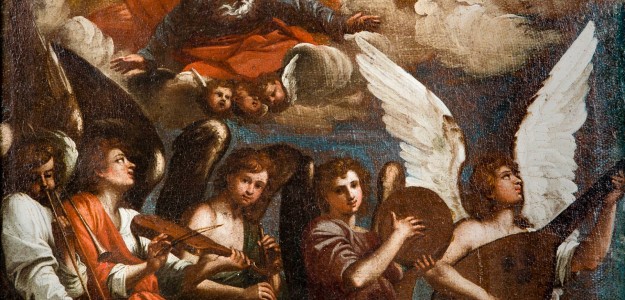
c. 1620—Vicenza, Italy: A painting by Vincenzo Maganza in the church of San Stefano features 4 musical angels, including an angel-trombonist (see below image; public domain) (Die bemalten Orgelflügel 564).

Another Angel-Trombonist in Milan

Notice how the angel-trombonist appears to be swooping down to play for the people below. I recently added this picture and caption to the Trombone History Timeline (17th century—1st half). For another painting in a Milan church by the same artist, see here and 1617 of the Timeline.


1615—Milan, Italy: Bartolomeo Roverio’s painting at Santa Maria church, Chiaravalle Abbey, features an angel-trombonist among a number of other angel-musicians (see below image; public domain) (Die bemalten Orgelflügel 360).

Renaissance Trombone Art: 1 Artist, 3 Names, 3 Images

I recently added the second image below to the Trombone History Timeline (16th Century). It’s by Pieter de Witte (c. 1548-1628), also known as Peitro Candido and Peter Candid. He was probably born in the Low Countries, grew up and trained in Italy, then spent his career in Italy and Germany. He seemed to have an affinity for depicting trombone players in his art work. The other two images shown below are also by the same artist. The dates for the three art works, from top to bottom, are c. 1575, 1593, and 1611.

The Life of an Early Trombone Painting

Throughout art history, you can occasionally find multiple versions of the same image. Sometimes the versions are from the same artist (e.g., preparatory sketches), sometimes they are by other artists in other media (e.g., from a painting to an engraving), and sometimes they are copycat versions by other artists.

There are several historical examples of multiple versions of the same trombone image. I’ve already mentioned some of these in earlier blog posts. See, for example, The Evolution of a Trombone Painting, about a painting by Baldassare Franceschini, or Canvas, Paper, Silver, and Glass: St. Cecilia Trombone Image in Many Forms, about an image originally by Pieter de Witte. Also, along similar lines, Young Trombonists in Four Montserrat Paintings looks at two different pairs of similar trombone paintings.

My latest find begins with a fresco painted by Guido Reni in 1609 in San Gregorio Magno, Rome. Below is a color detail of the left side of the painting, as well as a black and white of the full painting (notice that there is another angel-trombonist on the far right) (see below 2 images; public domain).

Another 17th-century image, supposedly by an anonymous artist from Southern Netherlands, is almost certainly either a preparatory sketch for or a copy of Guido Reni’s fresco (see below image; public domain) (Paris, Louvre; Wangermée vol. 1 287).


Finally, in the early 18th century, French artist Etienne Parrocel made a chalk drawing of three of the angel-musicians (see below image; public domain; Avignon Musée Calvet Inv. 996.7.31). The angel-musicians are obviously taken from Reni’s fresco; however, going from left to right in the original full image, only the first, sixth, and eighth instrumentalists are included by Parrocel. The trombonist’s left-hand grip may have been modified from the original underhand position.

For many more drawings and paintings of trombone-playing angels, see Angel Trombonists Throughout History: 50 Images.