The Life of an Early Trombone Painting

Throughout art history, you can occasionally find multiple versions of the same image. Sometimes the versions are from the same artist (e.g., preparatory sketches), sometimes they are by other artists in other media (e.g., from a painting to an engraving), and sometimes they are copycat versions by other artists.

There are several historical examples of multiple versions of the same trombone image. I’ve already mentioned some of these in earlier blog posts. See, for example, The Evolution of a Trombone Painting, about a painting by Baldassare Franceschini, or Canvas, Paper, Silver, and Glass: St. Cecilia Trombone Image in Many Forms, about an image originally by Pieter de Witte. Also, along similar lines, Young Trombonists in Four Montserrat Paintings looks at two different pairs of similar trombone paintings.

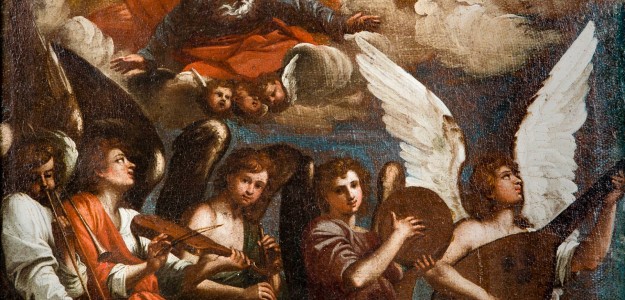
My latest find begins with a fresco painted by Guido Reni in 1609 in San Gregorio Magno, Rome. Below is a color detail of the left side of the painting, as well as a black and white of the full painting (notice that there is another angel-trombonist on the far right) (see below 2 images; public domain).

Another 17th-century image, supposedly by an anonymous artist from Southern Netherlands, is almost certainly either a preparatory sketch for or a copy of Guido Reni’s fresco (see below image; public domain) (Paris, Louvre; Wangermée vol. 1 287).


Finally, in the early 18th century, French artist Etienne Parrocel made a chalk drawing of three of the angel-musicians (see below image; public domain; Avignon Musée Calvet Inv. 996.7.31). The angel-musicians are obviously taken from Reni’s fresco; however, going from left to right in the original full image, only the first, sixth, and eighth instrumentalists are included by Parrocel. The trombonist’s left-hand grip may have been modified from the original underhand position.

For many more drawings and paintings of trombone-playing angels, see Angel Trombonists Throughout History: 50 Images.

Trombone History: Another Angel-Trombonist

Added the below entry and image to the 16th Century Timeline. It hardly needs mentioning if you’ve looked at the overall Trombone History Timeline or the HubPages article on Angel-Trombonists, but the number of trombonists depicted as angels in artwork throughout history is really remarkable.

c. 1590—Ravenna, Italy: Giovanni Laurenti’s painting in the Basilica of Santa Maria in Porto includes an angel-trombonist performing with harp, lute, flute, and recorder (see below image; public domain) (source: recorder home page).

Angel Musicians of Florence’s Santissima Annunziata

Two weeks ago I added the below trombone history image & caption to the 17th century timeline (1st half), as well as posting The Evolution of a Trombone Painting, a blog post that included not only the painting, but several sketches that preceded it.

1644—Florence, Italy: Il Volterrano (also known variously as Baldassare Franceschini and Franceschini Baldassare detto Volterrano) is commissioned to paint a lunette fresco in Florence’s Santissima Annunziata. The image features angels playing violin, trombone, and lute (see above image; public domain) (Strozzi 332; Falletti 76).

Since then, I tracked down a color image and changed out the black & white one in both the post and the timeline page. I also found two other images depicting angel-musicians from the same artist and same area of the church (the Grazzi Chapel of Santissima Annunziata). It’s interesting to see which other instruments (and combinations of instruments) were depicted by the artist in his work in the Florentine church, and it provides at least some idea of what was being played at the time and how instruments were perceived by people. I would also point out, once again, what a prolific half-century 1601-1650 was for trombone iconography! The source for the images is Falletti, 55-78 (see Trombone History Bibliography for full citation). Here they are, below–click on image to enlarge:

Missing Something? Bell-less Trombones in Art

The slide is one of the most identifiable visual characteristics of the trombone in artwork. However, when a slide turns up without a bell, it can be problematic. Could it still be a trombone? Are we trying too hard to make it a trombone? Was it just artist error? Artistic license? A mistake in a restoration process? A literal representation of some unusual permutation of the trombone? An obscured area of the painting? Some other instrument? They’re all possibilities, of course.

I am not going to try to come to any real conclusions with this post, but I would suggest the early rear-facing trombone as one possibility. There are at least two iconographical examples of rear-facing trombones from the 17th century or earlier (see here), as well as many others from the 19th century (see here). In the case of the first three examples below with no apparent bells, the bell on a rear-facing instrument could easily be obscured by the player’s head and/or other parts of the image, such as cap, halo, and wings. In the final example, from the 19th century, the bell is very likely obscured by the player’s helmet; there are multiple other examples of rear-facing trombones in iconography of this precise period and region.

c. 1474—Asciano, Italy: Matteo di Giovanni’s The Assumption of the Virgin, the center panel of an altarpiece in S. Agostino, includes what may be an angel-trombonist along with several other angel-musicians. The instrument has what appears to be a slide but no visible bell (see below detail and full image; public domain) (Belán 111).

1503-1529—Spain: Joan Gascó’s painting, God the Father and the nine angelic choirs, includes what appears to be a trombone-playing angel, grouped with 2 other wind-playing angels, although no bell is apparent on the trombone (see below detail and full image below that; public domain) (Ballester).

1598-1606—Valencia, Spain: Bartolomé Matarana paints a fresco of angel musicians in the the church of Real Colegio–Seminario de Corpus Christi that includes what are probably 2 trombones. Only the slide portions are obvious, although possible bell flares can be seen upon close inspection (see details and full image below) (Olson, Angel Musicians).

c. 1850—Brussels, Belgium: Musicien et trompette de cuirassiers, a lithograph by Henri Hendrickx, portrays a Belgian infantry musician playing on what may be a rear-facing trombone, the bell obscured by the player’s helmet (see below image; public domain) (Bibliotheque royale Albert I; Wangermée vol. 2, 263). See other Belgian rear-facing trombones from the same time period at this post: Belgian Military Trombonists.

Trombone and the Art of Illusion

Quadratura is a type of illusionistic painting that interacts with a building’s architecture, often extending or altering the actual appearance of the architecture. Popular with Baroque artists, it is similar to other illusionistic techniques such as trompe-l’œil, although it tends to refer more to the “opening up” of architectural space and to a more thorough integration with surrounding sculptural and architectural elements (Feinblatt 1-3; for all sources, see Trombone History Bibliography.)

A few of the most intriguing pictures in the Trombone Timeline are from artists known as quadratura painters, and their trombone images do appear to demonstrate elements of that technique. It is noteworthy that the paintings originate from the first half of the 17th century, a period of time particularly replete with trombone images.

Colonna and Mitelli, Four Balcony Musicians

The first is the set of Colonna and Mitelli paintings on the walls and ceiling of the salone of the Palazzo Ducale in Sassuolo, Italy, dating from 1646-47. One of the images depicts a group of four musicians playing from a “fake” balcony (see above), while another shows a group of three musicians performing from a separate false balcony (see below) (Southorn, front jacket; Sala della Guardia, Palazzo Ducale, Sassuolo). Note some of the nice details of the illusion, such as the trombone slide and sheet music extending into the space beyond the balcony, as well as the lute player hanging his leg over the railing.

Colonna and Mitelli, Three Balcony Musicians

A ceiling fresco from the same room of the palace is meant to provide the illusion of a cluster of angels (including, of course, an angel-trombonist) as viewed through an opening in the ceiling (see below) (Pirondini 251).


The other prominent quadratura painter represented in the Trombone Timeline is Lionello Spada (Feinblatt 42). His ceiling fresco, dating from 1615, is located in the cupola of Reggio Emilia’s Chiesa della Ghiara, only a few miles from the ducal palace of Sassuolo discussed above. It depicts numerous angel-musicians, including angels playing trombone, harp, recorder, triangle, tambourine, cornetto, lute, and violin (see below) (Artioli, plate 8). Like the ducal palace ceiling, Spada’s fresco is meant to provide the illusion of architecture opening to a view of angels in the sky above. The cupola also shows false architectural elements, such as ribs of the dome and the decorative bronze cartouches around each angel-musician, interacting with real architectural elements and false sculptural elements (Feinblatt 42).

Finally, closer views of the trombone player (below) and recorder (bottom image, below) reveal some of the fresco’s beautiful artistic details (Artioli, plates 11 and 12).

Lionello Spada, Angel with Trombone, Chiese della Ghiara

Lionello Spada, Angel with Recorder, Chiesa della Ghiara


Trombone History Image Update

Updated the entry below from the 17th century timeline (first half) with a color image and exact date. Also of interest is the fact that the painting is an altarpiece, one of many featuring trombone images.

1616—Bologna, Italy: Ludovico Carracci’s Paradise, an altarpiece painting located in the Church of San Paolo Maggiore, features an angel-trombonist situated prominently among a group of angel-musicians (see below detail and full image; public domain) (Komma 109; Emiliana 167).

Trombone History: From the Balcony

Added the following 3 images and entry to the 17th century timeline (1st half). The fourth image, a drawing, is clearly related, although it comes from a separate source; I expanded its entry to include a reference to the painting. As I have mentioned before, the concentration of trombone images from this half of the 17th century is remarkable.

Reni Gloria leftReni Gloria rightReni Gloria1609—Rome, Italy: Guido Reni’s Gloria d’angeli, a fresco located in S. Gregorio Magno, Cappella di S. Silvia, includes 2 trombones (see above details and full image) (Cavalli, pl. 28 and 32; Pepper, pl. 30). A drawing pictured elsewhere (see 1600s—Southern Netherlands) is almost certainly either a preparatory sketch for or a copy of Reni’s painting.

La Musique 2871600s—Southern Netherlands: An anonymous 17th century drawing portrays five angel-musicians, including a trombonist, performing from a balcony or platform. Separate leaves of music for four of the five players are pictured draped over the edge (see facing image; public domain) (Paris, Louvre; Wangermée vol. 1 287). The drawing is clearly either a preparatory sketch for or a copy of Guido Reni’s fresco, Gloria d’angeli (see 1609).

Trombone Underfoot: A Possible 17th-Century Alto Trombone Image

Added the below images and caption to the Alto Trombone Timeline. It’s quite a beautiful painting. The other instruments “underfoot” are a shawm and a recorder. The trombone appears to be an alto, given its size relative to the things around it (the instruments, most importantly, but also the music and the man’s leg), although how literal the visual depiction was intended to be is always the question.

Mola detailMola

c. 1650—Italy: Swiss-born artist Pier Francesco Mola includes a trombone in his painting, Young Musician Playing a Viola da Gamba. Although it is impossible determine with certainty, the instrument may be an alto trombone, given its size relative to the surrounding instruments and music pages (see facing detail and full image, below; public domain) (Mola 161).

Trombone History: More Trombone Iconography

Added the below image and info to the 16th Century Trombone History Timeline. The artist, Cornelis Court, was well known for making engravings that were copies of pre-existing artworks. In this case, the engraving is after a work by Flemish Renaissance artist Frans Floris. The image, which is obviously symbolic, features a relatively small-looking trombone hanging on the upper right area of the wall. It is nearly impossible to tell, and artists are often less than literal, but the instrument could be an alto trombone. (Compare it proportionally, for example, with the other instruments nearby.)

Cort1565—Musica, an engraving by Dutch artist Cornelis Cort from a series called the Seven Liberal Arts (after works by Frans Floris) includes a small trombone hanging on a wall in the background (see facing image; public domain) (Burgers 99).