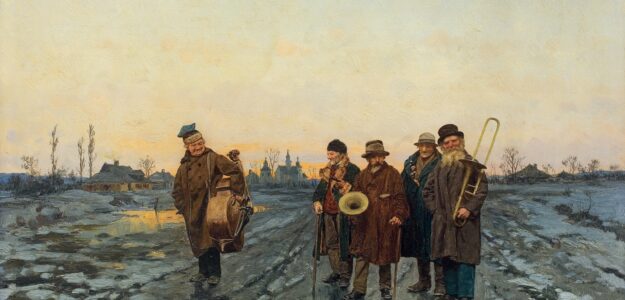
Religious Plus Military: Serpent in Trio

I just added another image, shown below, to the blog post Serpent & Ophicleide: History and Images. There are now 126 pictures in that post! As in this image, the mixture of religious and military clothing is interesting, highlighting traditional habitats of the serpent.

1789—Paris, France: An image labeled Le Concert features a serpent performing with trio (see below image; public domain) (French National Library).le concert 1789

Trombone Bell Found: An Early Rear-Facing Trombone

A few years ago a made a blog post on “Bell-less Trombones.” As you can see if you read the comments to that post, some of the bells were actually found by an alert reader. However, one image that continued to be a mystery to me until recently was Joan Gascó’s painting, God the Father and the nine angelic choirs. Although the trombone slide was pretty clear, I just could not see anything that looked like a bell from the image I had. As it turns out I was probably looking in the wrong place. Last week I found a source that enabled me to view the trombonist in much closer detail, showing what I think is actually a rear-facing trombone. (For an extensive listing of rear-facing trombones throughout history, including some early examples, see Backward Advances: Rear-Facing Trombones Throughout History.) A color reproduction of the painting would obviously be very helpful, but no luck with that yet. So first, here’s the full image; the angel-trombonist is on the bottom-right (click to expand; public domain image):

gasco big cropped

Now here is a very close detail of the angel-trombonist. What I think is the bell, partially obscured by the halo, is circled in red:gasco dtl marked

Finally, here is a close view of several of the halos and the material above the halos, so you can see that the bell is not just part of a halo or something above or in back of the player:Gasco dtl halos

Also, it is worth noting that the source that enabled me to zoom in so closely, the French National Library, lists the artist as Gabriel Guardia (instead of Joan Gascó); see here. Regardless of which is the true artist, it would appear that the painting originates from Spain in the late 1400s/early 1500s.

Answer to Blog Comment on Alto Trombone

Yesterday I received a lengthy comment on one of my blog entries about the alto trombone. You can see the original post and comment here. Because of the length of my reply and the number of links I wanted to incorporate, it was easier to post my reply here. I’ve had similar questions/comments from a few other people, so the reply may be of interest to a broader set of readers anyway.

__________

Yes, I have in fact read Howard Weiner’s 2005 article, and I agree with you that his is a minority opinion.

I will give you the short answer. Having read the article thoroughly, I find at least 10 reasons Weiner’s argument for an “alto trombone in B-flat” is unconvincing:

1) It is based on only one solid source (Nemetz). The others that he uses are contradictory or unclear at best (e.g., Frölich); see here.

2) Many, many other sources contradict the alto=tenor idea, clearly placing the alto trombone in a different, higher key. For every source that clearly indicates an alto in B-flat, a careful researcher can point to 5 that clearly indicate an instrument pitched in a higher key (see here).

3) At one point in the article, Weiner argues from his own personal aesthetic opinion as a premise, representing neither sound reasoning nor good history (see here).

4) Weiner misses entirely the Brahms letter in which the highly influential and respected composer notes his preference for the alto trombone and indicates what a “genuine” alto trombone was considered to be at the time (see here).

5) Weiner misconstrues the comments in Albrechtsberger’s treatise. Whereas Weiner is happy to allow for false or “falset” tones in his discussion of bass trombone, the possibility apparently never enters his mind when it comes to alto trombone. Anyone with any kind of playing experience on alto trombone knows that false tones are particularly easy in the low register, the register where the one note in question falls.

6) If alto=tenor had been true in the widespread way (both chronologically and geographically) that Weiner suggests, there should be widespread evidence in contemporary and later treatises, dictionaries, methods, trade catalogs, etc. It is simply not there to the extent that it should be. In fact, the reverse is true: the bulk of the evidence points to a widespread view of the alto trombone as a smaller instrument pitched in a higher key (see here for treatises, dictionaries, and methods; see here for 19th century trade catalogs).

7) Weiner ignores the evidence of existing instruments from the period. A full 25 percent of all existing trombones from before the year 1800 are alto trombones (see here for dates, locations, amounts, and  percentages). The idea that these were amateur instruments lacks documentation. There is no evidence that amateurs used the alto trombone to any greater extent than they used tenor (that is to say, take away the tenor trombones also used by amateurs and you very likely end up with the same overall percentage).

8) Weiner oversimplifies and thus misrepresents Praetorius (see here).

9) Weiner makes a faulty generalization from the opinion of one (Praetorius) to many (any “self-respecting virtuoso”). Again, this is neither sound reasoning nor good history (see here).

10) With all due respect, Howard Weiner is not an active trombone performer. I would question whether he has publicly performed any solo work on the alto trombone in the last 20 years, let alone whether he has played it on both alto and tenor, and whether he has sufficient playing experience on both to determine which is easier (or more “idiomatic”). Partials being closer together can be helpful, sure, but so can partials being farther apart, not to mention slide positions being closer together. I was amused to read recently a passage in a trombone history book where another supposed “expert” explained to readers that certain works were more “idiomatic” on tenor trombone than alto trombone; this from a person who had earlier admitted in an online forum that he never actually learned the alto trombone!

Trombone-Playing Monk

Just added this one to the 19th century timeline (2nd half):


1900—An image by Cederström (probably Ture Nikolaus Cederström, 1843-1924) entitled Concert in the Monastery is reproduced in Elson’s 2nd volume of Famous Composers and their Works. Among the octet of monk-musicians is a trombonist (see below image; click to expand; public domain) (Elson, Famous Composers vol. 2, 15).cederstrom new

Another Italian Angel-Trombonist

A few days ago I mentioned in this blog an angel-trombone painting by Procaccini. Well, that one led to another image by the same artist (as these things often do). Here it is, along with its caption, below. You can also see it in context in the 17th century timeline and in the HubPages article on angel-trombonists.


1624-25—Milan, Italy: A red-chalk study by Camillo Procaccini for one of the ceiling compartments in the church of SS Paolo e Barnaba includes an angel-trombonist (see below image; public domain) (British Museum; see also Neilson, Camillo Procaccini, Paintings and Drawings, pl. 289).Procaccini cropped

Front and Center: Another Trombone-Playing Angel

Today I added the below caption and image to the Trombone History Timeline (16th century). I will also be adding it to Angel Trombonists Throughout History: 56 Images. I think it’s a striking painting that really features the trombone. I wish I could find an image with a little higher resolution and a little better angle. The book I mention in the caption has a photo with a more direct angle, but the picture is black and white and smaller than this one.


c. 1600—Milan, Italy: Camillo Procaccini’s fresco in Milan’s church, Sant’Angelo (officially Santa Maria degli Angeli) features an angel playing trombone (see below image; public domain) (source: wikimedia commons). For additional documentation, see Neilson, Camillo Procaccini: Paintings and Drawings, pl. 77.angelo recropped

Traditional Homes of the Serpent

I just added the below entry and picture to the Serpent & Ophicleide History blog post. There are now 125 images in that post! If you scroll through the images, you can see the trend of military and church settings for the serpent.


1862-71—Paris, France: A caricature by Draner (Jules Renard) from his collection, Types Militaires, reflects the two traditional homes of the serpent: church and military (see below image; public domain).draner

More Rear-Facing Trombones, and a Generalization

Today I added the below caption and image to the Trombone History Timeline (19th century, first half). The images expands quite a bit if you click on it. The slide grip of both trombonists, you will notice, is awkward (to put it mildly).

I also added the picture to the article, Backward Advances: Rear-Facing Trombones Throughout History, which now has more than 50 visual examples, and decided to append this generalization:  ”I would probably characterize it [the over-the-shoulder trombone] something like this: Iconography suggests that the over-the-shoulder trombone, which can occasionally be seen in images before the 19th century, became widespread in the 19th century. Use of the instrument appears to taper off by the end of the century. Although there is significant variety in iconography, many of the images originate from France, and a large number of them are military.” If you’re like me, you see a generalization and you immediately want to look for exceptions. Well, have at it, itchy fingers (comment box below)!

1820—A hand-colored engraving, entitled Banda Militare, includes depictions of 2 rear-facing trombones (see below image; click on image to expand; public domain) (Oberlin Conservatory Special Collections).banda militare

Alto Trombone Timeline: 100-Plus Primary Sources

Mola detail light

Over the weekend I went through the Alto Trombone History Timeline and double-checked sources. I ended up adding several sources to the Alto Bibliography that had inadvertently been omitted (primarily 19th-century trade catalogs). With these additions, the Alto Timeline now features more than 100 primary sources, not to mention the numerous secondary sources. With the possible exception of Ken Shifrin’s excellent dissertation on the use of alto trombone in the orchestra, I don’t believe there is any other single document on alto trombone that utilizes as many primary sources.

Alto Trombone in 19th Century Spanish Dictionary

I recently added this caption (below) to the Alto Trombone Timeline, bringing the total number of primary sources in that timeline to 93. The location is noteworthy; there are not many sources from Spain on the alto trombone.


1899—Madrid, Spain: Luisa Lacál, discussing the trombone family in her lexicon, Diccionario de la música, téchico, histórico, bio-bibliográfico, states that the alto trombone (trombone contralto or alt-posaune) is pitched in E-flat (Lacál 549).