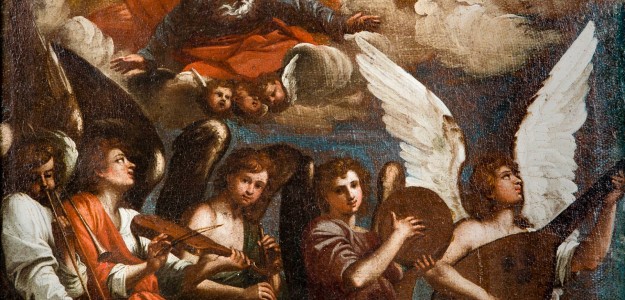
Front and Center: Another Trombone-Playing Angel

Today I added the below caption and image to the Trombone History Timeline (16th century). I will also be adding it to Angel Trombonists Throughout History: 56 Images. I think it’s a striking painting that really features the trombone. I wish I could find an image with a little higher resolution and a little better angle. The book I mention in the caption has a photo with a more direct angle, but the picture is black and white and smaller than this one.


c. 1600—Milan, Italy: Camillo Procaccini’s fresco in Milan’s church, Sant’Angelo (officially Santa Maria degli Angeli) features an angel playing trombone (see below image; public domain) (source: wikimedia commons). For additional documentation, see Neilson, Camillo Procaccini: Paintings and Drawings, pl. 77.angelo recropped

St. Cecilia, Two Heads on a Platter, and Cherub with Trombone

St. Cecilia is the patron saint of music, so the organ and cherub (putto) with trombone reflect that symbolism. Why Cecilia has the heads of Valeriano and Tiburtio on a platter is beyond me, but it’s too bad they didn’t get to hear the trombone and organ music.

I just added this painting and caption to the Trombone History Timeline (17th century—first half). Below the color image is the black and white reproduction that can be found at the The Digital Library of the National Library of France website. You will notice that the images are reversed.

For more images of cherubs (putti) playing trombone, see Trombone History: Cherubs Playing the Trombone.

__________________________________

c. 1620—Italy: Italian Baroque painter Bernardo Strozzi includes a putto holding a trombone in the painting, Santa Cecilia con le teste di Valeriano e Tiburtio (see below image; public domain) (source: The Digital Library of the National Library of France).strozzi color sharpstrozzi bw

Details from Denmark: 3 Trombones on the Ceiling

Yesterday I added a pair of details to the caption below from the Trombone History Timeline (17th century, 1st half). I will also soon be adding them to the HubPages article, How to Hold a Sackbut: The Grip of the Early Trombone in Pictures. Here are the details, along with the full image and caption originally included.


c. 1635—Copenhagen, Denmark: A ceiling painting in the Rosenborg Castle depicts musicians of the court of Christian IV of Denmark (1577-1648), including 3 trombonsits (see 2 details and full image below; public domain) (Hindley plate 17).

Color Version of Woman Trombonist

I recently updated the below entry from the Trombone History Timeline (16th century). There are a few other places that have a small black & white detail of this trombone player, but this website is currently the only place I know of that you can find the color detail, full color engraving, and original tablecloth together.

For more historical images of woman trombone players, see Females in Trombone History, 1500-1900.


c. 1562-68—Germany: An embroidered tablecloth depicts an aristocratic woman playing trombone. The people in the middle of the tablecloth are Count Poppo of Henneberg and wife Sophie of Brunswick (see detail and full images below; click image to expand; public domain) (Herbert, Trombone 79). The top detail, below, is from a 19th-century color engraving that is a copy of the original tablecloth (Hefner-Alteneck, vol. 9, pl. 594). The second image is a photo of the original tablecloth, now lost (Newe deudsche gesitliche Gesenge, unpaginated front matter). The third is the full 19th-century copy that the top detail is drawn from.

Another Angel Trombonist in the Clouds

I just added the below entry and pictures to the Trombone History Timeline (17th century—first half). It is an engraving after an image by Peter Candid (also known as Peter de Witte and Pietro Candido). For more trombone images by Candid, see here. As you can see, it features yet another angel trombonist; for many more pictures of angels playing trombone, see Angel Trombonists Throughout History.


1615—Munich, Germany (?): Allegory of the Immaculate Conception, an engraving by Raphael Sadeler (1584-1632) after Peter Candid (also known as Peter de Witte and Pietro Candido), includes an angel trombonist among a group of musical angels (see detail and full image below image;  public domain). Click on detail to expand.

Pair of Early Baroque Trombone Prints

I recently added these two new images to the Trombone History Timeline (17th Century—1st half). Both are from the early part of the Baroque period. They illustrate two important activities of trombonists of the time (playing for a royal funeral and performing for a royal procession). The second picture was in the timeline already, but this version is a clearer, higher-resolution detail that I recently found. Be sure to click on the first picture for a larger version; it expands quite a bit. Enjoy!


1608—Nancy, France: An engraving by Friedrich Brentel depicting the funeral of Charles III, Duke of Lorraine, includes 2 trombonists performing with other musicians in a loft of St. François Church (see detail and full image below; public domain) (“Obsequies of Charles III, Duke of Lorraine,” Bibliotheque Nationale, Paris; see also Lesure 60 and Whitwell, Baroque 25). Click to expand detail. You can also find the image online at the Metropolitan Museum of Art.

 1613—Heidelberg, Germany: The welcoming festivities for Elector Friedrich V of the Rhine Palatinate and his Bride, Princess Elizabeth of England, include a series of triumphal arches constructed along the streets by the faculties of the University of Heidelberg. At the first arch, staged by the Faculty of Philosophy, “pleasing music was [performed] by trombones and cornetts.” The festival record continues, “His Highness the Elector, as well as his spouse, were received with a cordial and very lovely musical [performance with] all kinds of string-playing and [other] instruments. Up high [on the stage] stood an angel who blew on two [sic] sackbuts….When His Highness the Elector, as well as the princes, were escorted in the procession by the four faculties of the world-famous University of Heidelberg, [they] passed through four triumphal arches [surrounded by] many well-wishers. Upon the first archway, which was hung with tapestries, sweet music by sackbuts and cornetts was presented” (Bowles, Musical Ensembles 188). A graphic representation of the welcoming ceremonies depicts a group of musicians, including 3 trombones, performing on a triumphal arch (see below detail; public domain) (Bowles, Musical Ensembles 190; Guion, A History 103).

Angels at San Stefano, Vicenza

I recently added this painting and caption to the Trombone History Timeline (17th century—1st half). The painting is quite striking, consisting of only four musicians and featuring a beautiful contrast in colors. The trombone in the picture has an extra loop of tubing on the rear bow, making it look remarkably similar to a modern f-attachment instrument.

c. 1620—Vicenza, Italy: A painting by Vincenzo Maganza in the church of San Stefano features 4 musical angels, including an angel-trombonist (see below image; public domain) (Die bemalten Orgelflügel 564).

Renaissance Trombone Art: 1 Artist, 3 Names, 3 Images

I recently added the second image below to the Trombone History Timeline (16th Century). It’s by Pieter de Witte (c. 1548-1628), also known as Peitro Candido and Peter Candid. He was probably born in the Low Countries, grew up and trained in Italy, then spent his career in Italy and Germany. He seemed to have an affinity for depicting trombone players in his art work. The other two images shown below are also by the same artist. The dates for the three art works, from top to bottom, are c. 1575, 1593, and 1611.

Two New Baroque Trombone Paintings

I just added two new paintings to the Trombone History Timeline. They are shown below, along with their captions. I have also added them to the post, Pick That Thing Up and Play! 11 Trombone Paintings from 17th-Century Flanders (which was formerly titled 9 Paintings from 17th-Century Flanders). It’s interesting how similar several of the 11 paintings in that post are.


c. 1610—The Judgment of Midas, a painting by Flemish artist Adriaen van Stalbemt, includes a trombone. The trombone rests on the ground among several other instruments (see below image; public domain).

1639—Adriaen van Stalbemt, a Flemish Baroque artist from Antwerpt, paints Midas Listening to Apollo, which includes a trombone among several other instruments resting on the ground (see below image; public domain).

Better Cherub Image, Plus 2 Additional Views

I recently found a clear color image of the trombone-playing cherub in Milan’s San Simpliciano. I have replaced the old, blurry, black and white image in the Trombone History Timeline (16th century) and in the HubPages article, Trombone History: Cherubs Playing the Trombone (where you can view 10 additional depictions of cherub-trombonists). An interesting side note: the cherub to the right of the trombonist may actually be playing a serpent; if so, it would be a very early visual depiction of the instrument.

You can see the new image, along with its caption, immediately below. Beneath that are two additional views of the painting. Enjoy!


c. 1590—Milan, Italy: Aurelio Luini depicts a cherub playing trombone in his fresco in Milan’s San Simpliciano (see below image; public domain) (Kendrick, Sounds of Milan 77 [black & white version]).

Here is a view of the full cherub painting (click image for larger version):

And finally, here is a wide view of the painting and the organ it is connected with: