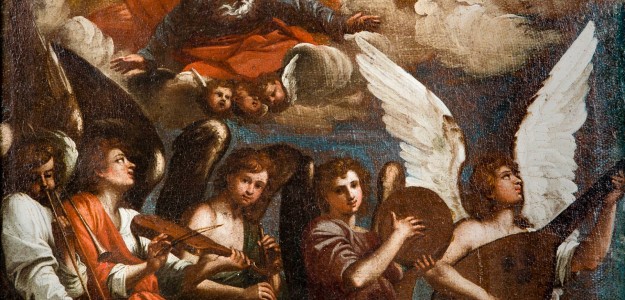
Angel Trombonist in Italian Switzerland

I just added the below image and caption to the Trombone History Timeline (17th century, first half). I also added it to the HubPages articles Angel Trombonist Throughout History and How to Hold a Sackbut: The Grip of the Early Trombone in Pictures. It’s nice to see the trombone front and center. Click on the image for a larger version.

1600s—Malvaglia, Switzerland: A fresco in the parish church of San Martino features a concert of angel musicians with a trombonist (see below detail; public domain).

Better Cherub Image, Plus 2 Additional Views

I recently found a clear color image of the trombone-playing cherub in Milan’s San Simpliciano. I have replaced the old, blurry, black and white image in the Trombone History Timeline (16th century) and in the HubPages article, Trombone History: Cherubs Playing the Trombone (where you can view 10 additional depictions of cherub-trombonists). An interesting side note: the cherub to the right of the trombonist may actually be playing a serpent; if so, it would be a very early visual depiction of the instrument.

You can see the new image, along with its caption, immediately below. Beneath that are two additional views of the painting. Enjoy!


c. 1590—Milan, Italy: Aurelio Luini depicts a cherub playing trombone in his fresco in Milan’s San Simpliciano (see below image; public domain) (Kendrick, Sounds of Milan 77 [black & white version]).

Here is a view of the full cherub painting (click image for larger version):

And finally, here is a wide view of the painting and the organ it is connected with:

Angel Trombonist from Malta

I recently added another angel trombonist to the 17th Century of the Trombone History Timeline and to the HubPages article, Angel Trombonists throughout History. This image is from Malta, an island off Italy. Here it is, along with its caption:

1661-66—Valletta, Malta: Artist Mattia Preti includes an angel-trombonist in his fresco on the apse of San Giovanni (see below image; public domain) (photo by Alfred Gouder).

The same artist, Mattia Preti, included trombone in another painting. Here it is, along with its caption, below. You can see that the paintings are similar. Notice that the unusual grip of the trombone is similar in the two paintings.

1651—Modena, Italy: Mattia Preti’s fresco,Gloria di Angeli Musicanti, located in the apse of San Biagio, includes a depiction of an angel playing trombone among many other angel musicians (see facing detail; public domain) (Adani; Quintavalle plate 95).

The Life of an Early Trombone Painting

Throughout art history, you can occasionally find multiple versions of the same image. Sometimes the versions are from the same artist (e.g., preparatory sketches), sometimes they are by other artists in other media (e.g., from a painting to an engraving), and sometimes they are copycat versions by other artists.

There are several historical examples of multiple versions of the same trombone image. I’ve already mentioned some of these in earlier blog posts. See, for example, The Evolution of a Trombone Painting, about a painting by Baldassare Franceschini, or Canvas, Paper, Silver, and Glass: St. Cecilia Trombone Image in Many Forms, about an image originally by Pieter de Witte. Also, along similar lines, Young Trombonists in Four Montserrat Paintings looks at two different pairs of similar trombone paintings.

My latest find begins with a fresco painted by Guido Reni in 1609 in San Gregorio Magno, Rome. Below is a color detail of the left side of the painting, as well as a black and white of the full painting (notice that there is another angel-trombonist on the far right) (see below 2 images; public domain).

Another 17th-century image, supposedly by an anonymous artist from Southern Netherlands, is almost certainly either a preparatory sketch for or a copy of Guido Reni’s fresco (see below image; public domain) (Paris, Louvre; Wangermée vol. 1 287).


Finally, in the early 18th century, French artist Etienne Parrocel made a chalk drawing of three of the angel-musicians (see below image; public domain; Avignon Musée Calvet Inv. 996.7.31). The angel-musicians are obviously taken from Reni’s fresco; however, going from left to right in the original full image, only the first, sixth, and eighth instrumentalists are included by Parrocel. The trombonist’s left-hand grip may have been modified from the original underhand position.

For many more drawings and paintings of trombone-playing angels, see Angel Trombonists Throughout History: 50 Images.

Viennese Angel-Trombonist

I just added the following image to the 18th century Trombone History Timeline. I also added it to the HubPages articles Angel Trombonists Throughout History and How to Hold a Sackbut: The Grip of the Early Trombone in Pictures.

1725-30—Vienna, Austria: A fresco by Johann Michael Rottmayr in the Karlskirche (St. Charles’s Church) includes a trombone-playing angel (see below image; public domain).

Trombone on Baroque Organ Shutters

I just added the below image and caption to the Trombone History Timeline (17th century, first half). Another angel-trombone.


1638—Schleiz, Germany: A painting on the left organ shutter in the Bergkirche includes an angel trombonist among several angel musicians (see below image; public domain).

Trombone in Bavarian Abbey

Just added the below image and entry to the Trombone History Timeline (18th century). Interesting visual perspective—and definitely an unorthodox grip if it’s a trombone.


c. 1705—Irsee, Germany (near Kaufbeuren): A fresco by Magnus Remy (1674-1734) decorating the ceiling of Irsee Abbey features angels playing various brass instruments, including what appears to be a trombone (see below image; public domain).

Angel Playing Trombone in Renaissance Painting

Just added this painting to the Trombone History Timeline (16th century). Trastevere is a neighborhood in Rome, and this church is said to be one of the primary landmarks of the area. The artist collaborated on paintings in several other churches in Rome, but this painting was the first major project that he carried out on his own. Notice the pairing of instruments.

For 45 more historical pictures of angels playing trombone, see Angel Trombonists Throughout History.


1591—Rome, Italy: Artist Ferrau Fenzoni includes an angel playing trombone in a ceiling painting in the chapel of St. Francis in the church of Santa Maria in Trastevere (see lower-middle of below image; public domain) (Schwed, New Drawings by Ferrau Fenzoni).

More Angel-Trombones on Pipe Organs

Added the below entry and picture to the Trombone History Timeline (18th century) and to an old blog post titled Perching on the Pipes: Trombone & Organ Images. What a beautiful instrument—and two trombones to top it off!

1740—Coburg, Germany: A Schuke organ is installed in St. Moriz Church. Atop the pipes are two angel-trombonists (see below image; public domain).

Bone in the Clouds: Another Baroque Angel-Trombonist

Today I added another image to the Trombone History Timeline (17th century, first half)—yet another angel-trombonist. I’ll also be adding it to the HubPages article, Angel-Trombonists Throughout History. Below is the drawing, along with the timeline caption. The artist is actually known primarily for his work as an early art historian. The image looks like it could be a preparatory drawing for a fresco, although I haven’t had any luck tracking down a related painting.


c. 1650—German artist Joachim von Sandrart draws a red chalk “angel concert” that includes a trombone (see below image; public domain) (source: Deutsche Fotothek).